


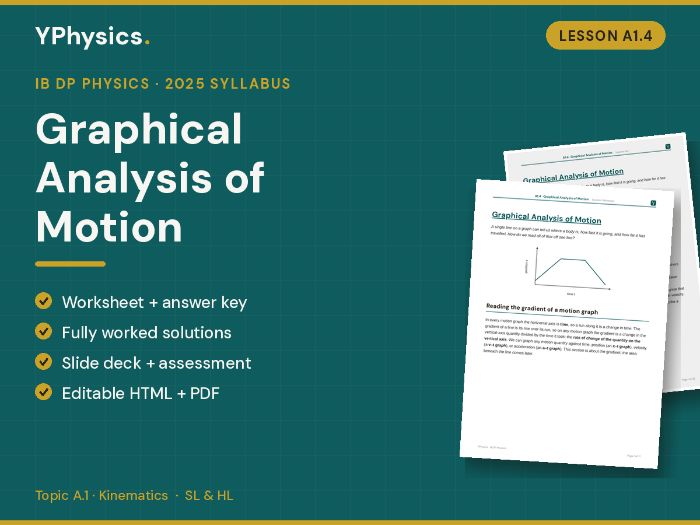
IB DP Physics lesson pack on graphical analysis of motion for Topic A.1 Kinematics, SL and HL, first assessment 2025: gradients, areas, tangents and chords on position-time, velocity-time and acceleration-time graphs. Editable worksheet, 43-slide lesson deck, teacher key, worked solutions and a questions-only assessment, supplied as self-contained HTML plus colour and black-and-white PDF.
What students learn
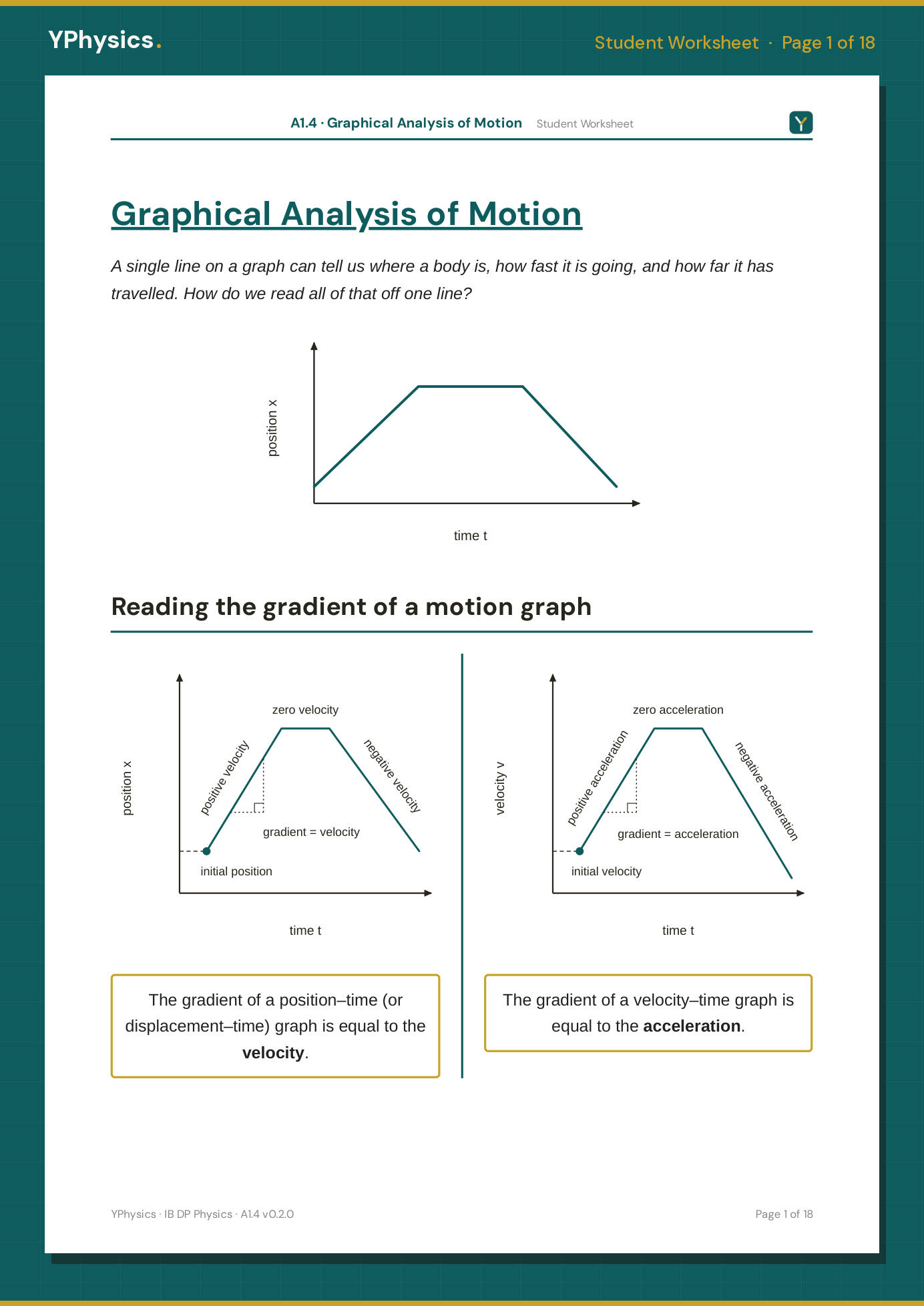
- The gradient of a position-time graph is the velocity, and the gradient of a velocity-time graph is the acceleration.
- Where a graph curves, the average velocity is the gradient of a chord and the instantaneous velocity is the gradient of a tangent.
- Displacement is the area under a velocity-time graph, with area below the axis negative, so displacement and distance come apart. The area under an acceleration-time graph is the change in velocity.
- Five explained multiple-choice questions, and a ten-mark data question in the Paper 1B pattern: a trolley timed at a light gate, a supplied graph with error bars and one reading to add, the acceleration from the gradient, the distance from the area, and a systematic error read from where the line meets the time axis.
IB skills (Tool 3: Mathematics, with Inquiry 3: Concluding and evaluating):
- Interpret the features of a graph: gradient, changes in gradient, intercepts, maxima and minima, and area (taught).
- Sketch velocity-time and acceleration-time graphs with labelled but unscaled axes (practised).
- Draw and interpret uncertainty bars (practised).
- Identify and discuss random and systematic errors (practised).
What’s included:
- Student Worksheet - 18 pages
- Teacher Key - 24 pages
- Worked Solutions - 17 pages
- Assessment - 15 pages
- Lesson deck - 43 slides
It builds on the speed, velocity and acceleration packs, and leaves the suvat equations to the follow-on packs. Worksheet and deck open in any modern browser with nothing to install, and the worksheet is fully editable. SI units, IB notation and IB command terms throughout. Suitable for grades 11-12 (ages 16-19) as a lesson, cover lesson, homework or revision.
Related resources:
- Acceleration and Non-Uniform Motion, the pack before this one
- SUVAT Equations I: The Fundamentals, where these graphs become equations
- Uncertainties on a Graph, the skill pack behind the data question
- Measuring the Acceleration of Free Fall, the topic practical (free)
Updated 15 Oct 2026: please reprint.
A rating helps other teachers find this.
Something went wrong, please try again later.
This resource hasn't been reviewed yet
To ensure quality for our reviews, only customers who have purchased this resource can review it
Report this resourceto let us know if it violates our terms and conditions.
Our customer service team will review your report and will be in touch.
£9.00