


Help students evaluate how international organisations influence global trade.
The WTO, UNCTAD and Aid for Trade provide the core examples. Evidence from developed, emerging and lower-income economies helps students distinguish the promotion of freer trade from the achievement of fairer outcomes.
Designed for students aged 16 to 18 studying Cambridge International A Level Geography (9696), 2027 to 2029 syllabus, topic 13, statement 13.2.1. This is an independently produced Geography Oasis resource. It is not endorsed by Cambridge International.
Learning Focus
- Explain the aims and roles of the WTO and UNCTAD.
- Distinguish dispute settlement from advice and development support.
- Explain Aid for Trade and the barriers it addresses.
- Assess tensions between different countries’ interests.
- Evaluate influence, limitations and possible reforms.
Teaching and Student Materials
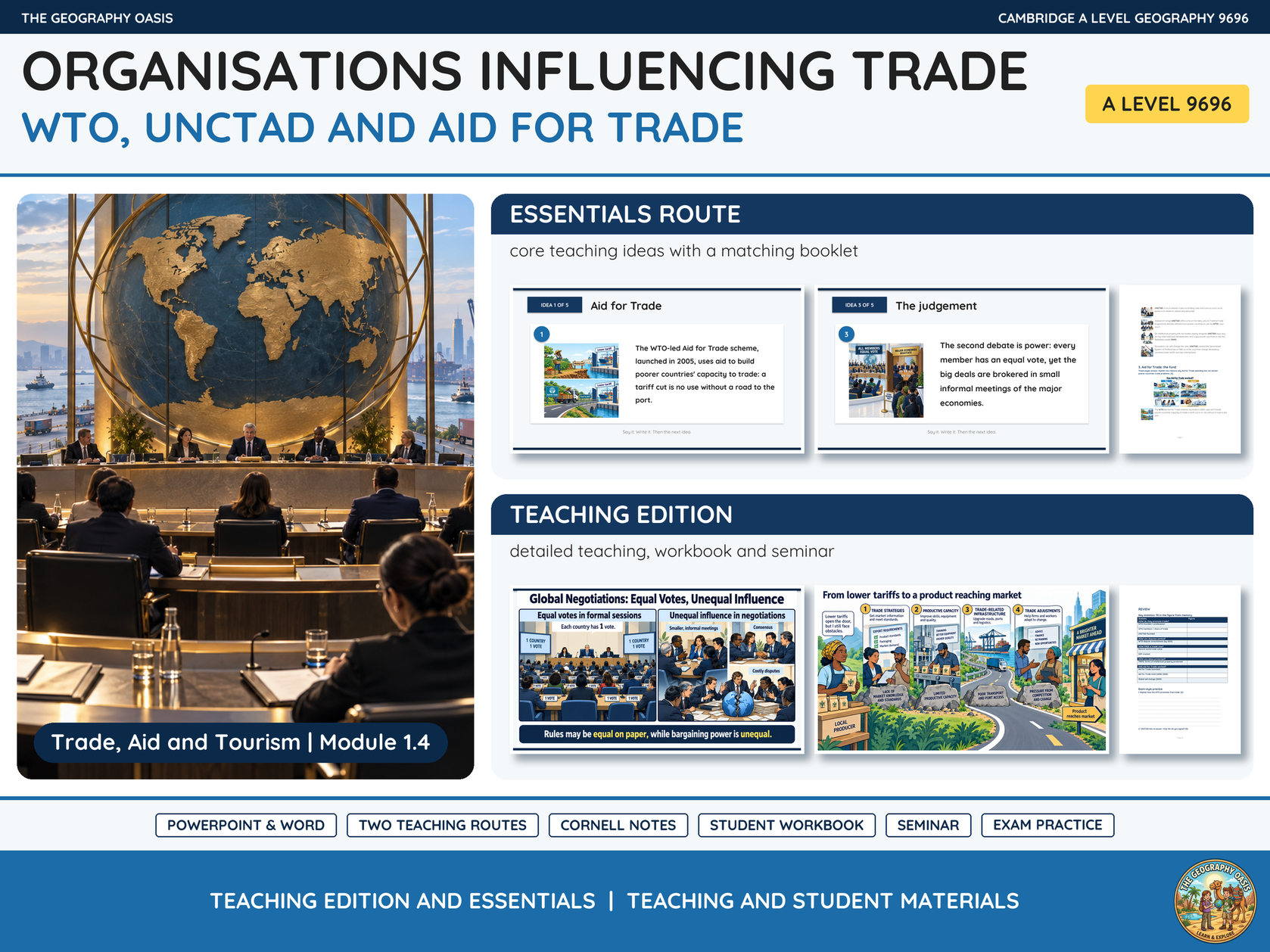
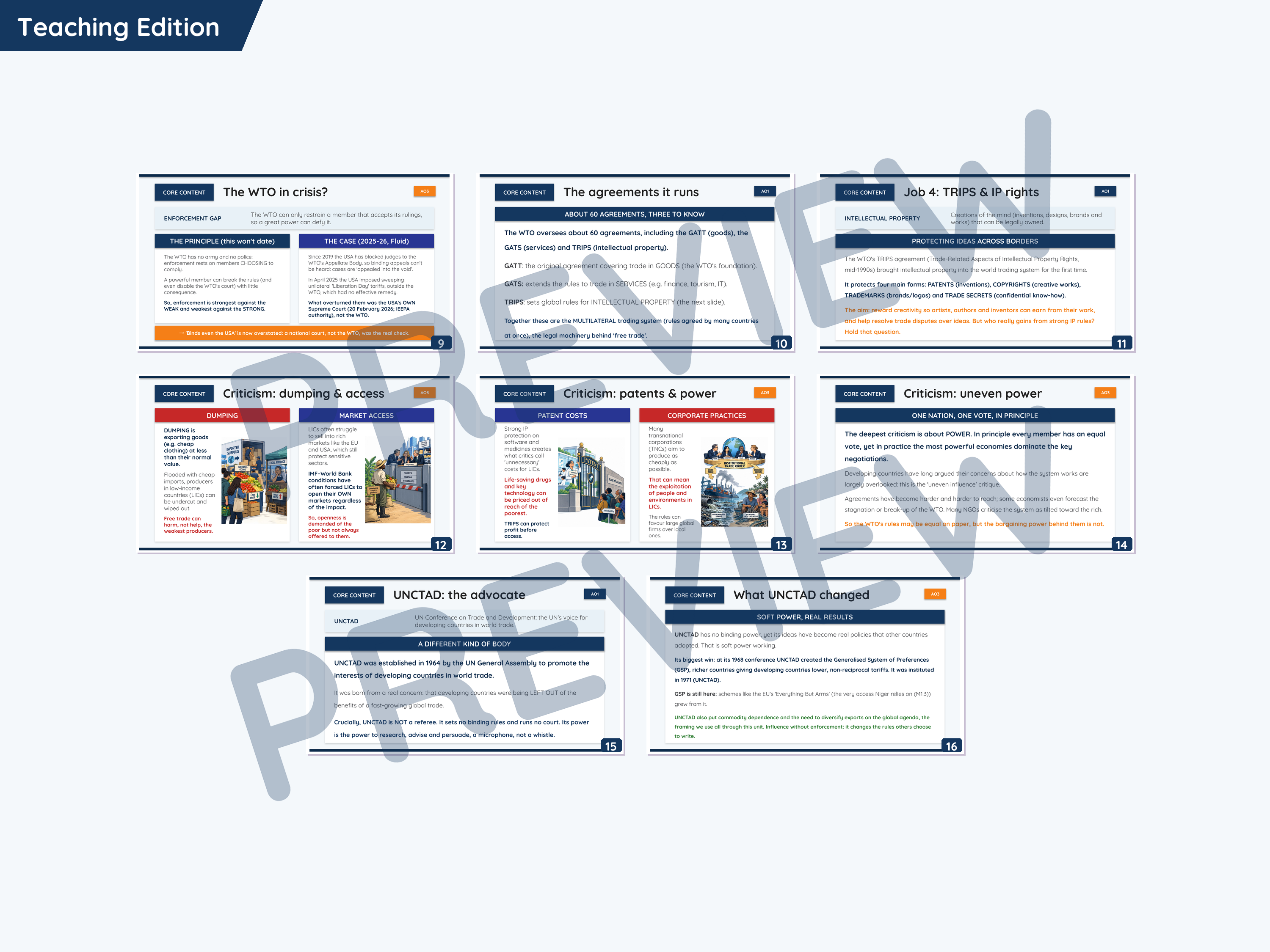
- Detailed Teaching Edition and shorter Essentials PowerPoint presentations.
- Student workbook, detailed Cornell notes and Evaluative Arguments booklet.
- Essentials booklet in completed and notes versions.
- Trade System Report Card, with its presentation and printable materials.
- Serves the Many or the Few?, a separate seminar with slides and printable materials.
- Original essay practice in print and digital versions, with content sheet and teacher guide.
- Six original data-response questions, each combining interpretation and explanation, with Student, Guided Practice and Answers booklets and slides.
- Module overview video and START HERE guide.
Groups assess four parts of the trade system against their stated aims, share their evidence and allocate a reform budget. Grades must be justified against a specific purpose. A Model WTO discussion assigns different interests and negotiates special and differential treatment. Students then form their own judgement on fairness and reform.
Printable student materials use A4 pages. Supplied as editable PowerPoint (.pptx) and Word (.docx), with accompanying teaching PDFs where present and an MP4 overview film. Written content is editable; diagrams and illustrations may be supplied as images. The workbook has a black and white alternative and a version for typed answers.
Ongoing access to the module’s interactive Geography Oasis activities is included as a bonus, using the access code supplied in the pack.
This is module M1.4 of the Trade, Aid and Tourism unit and can be taught separately or alongside the complete nine-module bundle.
Download both ZIP parts and extract them into the same folder to access the complete resource.
If you find it useful, a review helps other teachers discover the resource.
Something went wrong, please try again later.
This resource hasn't been reviewed yet
To ensure quality for our reviews, only customers who have purchased this resource can review it
Report this resourceto let us know if it violates our terms and conditions.
Our customer service team will review your report and will be in touch.
£10.49