zip, 168.94 MB
zip, 168.94 MB

Help students compare tourism development and evaluate management in two contrasting areas.

Langkawi and the Lower Kinabatangan in Malaysia provide the required contrasting tourist-area comparison. Students examine how tourism grew, who gains, which pressures matter and how success should be measured.

Designed for students aged 16 to 18 studying Cambridge International A Level Geography (9696), 2027 to 2029 syllabus, topic 13, statement 13.3.3. This is an independently produced Geography Oasis resource. It is not endorsed by Cambridge International.

Learning Focus

  • Explain the attractions and contrasting tourism characteristics of both areas.

  • Describe development over time.

  • Compare economic, social and environmental effects.

  • Evaluate management for different stakeholders.

  • Propose a justified improvement and evidence for assessing it.

Teaching and Student Materials

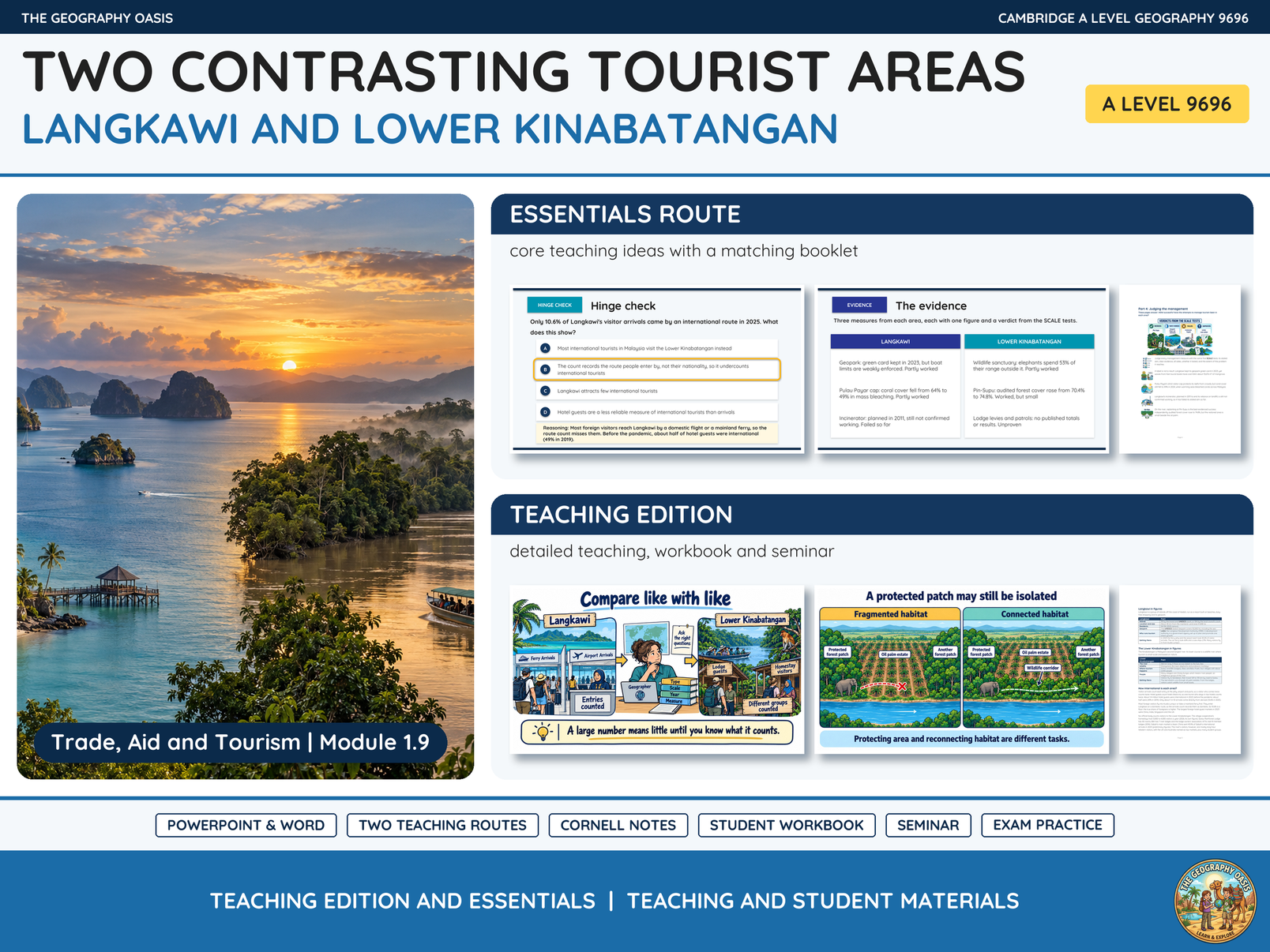
  • Detailed Teaching Edition and shorter Essentials PowerPoint presentations.

  • Student workbook, detailed Cornell notes and Evaluative Arguments booklet.

  • Essentials booklet in completed and notes versions.

  • Fix One Measure, with its presentation and printable materials.

  • Success for Whom?, a separate seminar with slides and printable materials.

  • Original essay practice in print and digital versions, with content sheet and teacher guide.

  • Six original data-response questions, each combining interpretation and explanation, with Student, Guided Practice and Answers booklets and slides.

  • Module overview video and START HERE guide.

Pairs improve one weak management measure for a supplied client. They specify the change, consider who pays and define measurable evidence of success before presenting their proposal. Two stakeholder hearings test tourism management in Langkawi and the Lower Kinabatangan. Students speak in one hearing, listen in the other and reach a qualified judgement.

Printable student materials use A4 pages. Supplied as editable PowerPoint (.pptx) and Word (.docx), with accompanying teaching PDFs where present and an MP4 overview film. Written content is editable; diagrams and illustrations may be supplied as images. The workbook has a black and white alternative and a version for typed answers.

This is module M1.9 of the Trade, Aid and Tourism unit and can be taught separately or alongside the complete nine-module bundle.

If you find it useful, a review helps other teachers discover the resource.

Syllabus fit

Cambridge International A Level Geography 9696, 2027–2029, Paper 4, section 13.3.3. The custom preview shows a teaching slide, workbook excerpt and matched assessment materials.

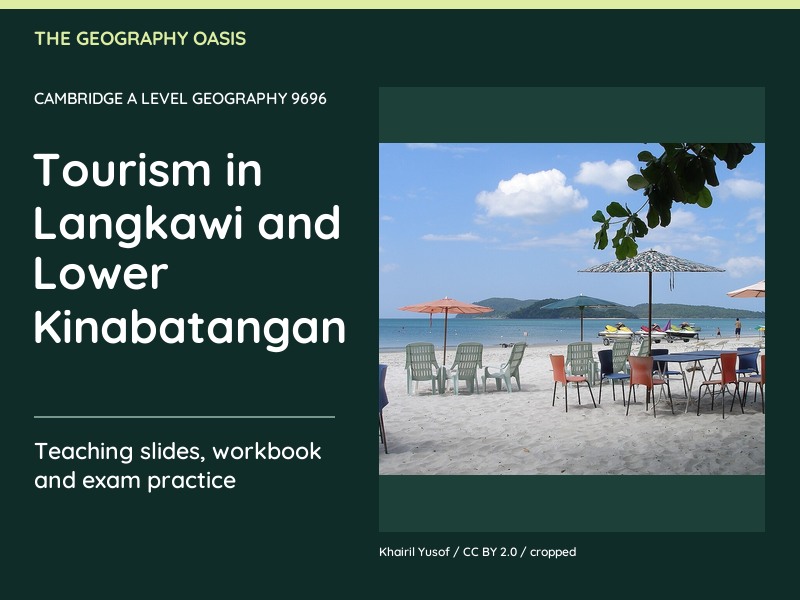
Cover credit: Pantai Cenang, Langkawi by Khairil Yusof (cropped), CC BY 2.0.

Get this resource as part of a bundle and save up to 29%

A bundle is a package of resources grouped together to teach a particular topic, or a series of lessons, in one place.

Bundle

Trade, Aid and Tourism Bundle | Cambridge A Level Geography 9696

T**each global trade, international aid and tourism with nine connected modules and original exam practice.** Malaysia and Niger provide the contrasting trade comparison. Langkawi and the Lower Kinabatangan provide the contrasting tourist-area comparison. Students interpret evidence, explain causes and make supported judgements. For students aged 16 to 18 studying Cambridge International A Level Geography (9696), 2027 to 2029 syllabus, topic 13: Global interdependence. Independently produced by Geography Oasis and not endorsed by Cambridge International. **Modules Included** **- M1.1 Global Trade Patterns:** changing trade flows and unequal gains. **- M1.2 Factors Affecting Trade:** physical, historical, economic and political influences. **- M1.3 Two Contrasting Countries: **Malaysia and Niger trade comparison. **- M1.4 Organisations Influencing Trade: **WTO, UNCTAD and Aid for Trade. **- M1.5 International Aid: **aid types, motives and effectiveness. **- M1.6 International Tourism Patterns: **arrivals, receipts, flows and seasonality. **- M1.7 Why Tourism Grows and Changes: **growth factors and changing tourism types. **- M1.8 Impacts and Sustainability of Tourism:** tourism effects and sustainable management. **- M1.9 Two Contrasting Tourist Areas:** Langkawi and Lower Kinabatangan comparison. Teaching and Student Materials **Every module includes:** - Detailed Teaching Edition and shorter Essentials presentations. - Student workbook, Cornell notes and Evaluative Arguments. - Completed and notes versions of the Essentials booklet. - Separate seminar and signature activity with printable materials. - Original essay practice, content sheet and teacher guide. - Six original data-response questions, with independent, guided and answer booklets. - Module overview MP4 and START HERE guide. Activities include trade dossiers, a Model WTO negotiation, aid-case diagnosis and tourism stakeholder hearings. Students must justify and reconsider their conclusions. **Each module includes its own access code for ongoing access to the interactive website activities.** Printable student materials use A4 pages. Supplied as editable PowerPoint (.pptx) and Word (.docx), with teaching PDFs where present. Diagrams and illustrations may be images. Workbook alternatives include black and white, with versions for typed answers where supplied. **Teach in sequence or select the modules your class needs. A review helps other teachers discover the unit.** **Syllabus fit** Cambridge International A Level Geography 9696, 2027–2029, Paper 4, sections 13.1–13.3. See the individual resources for samples of the teaching slides, workbook activities and assessment materials. Cover credit: Keppel Terminal by Calvin Teo (cropped), CC BY-SA 2.5.

£67.49

Reviews

Something went wrong, please try again later.

This resource hasn't been reviewed yet

To ensure quality for our reviews, only customers who have purchased this resource can review it

Report this resourceto let us know if it violates our terms and conditions.
Our customer service team will review your report and will be in touch.