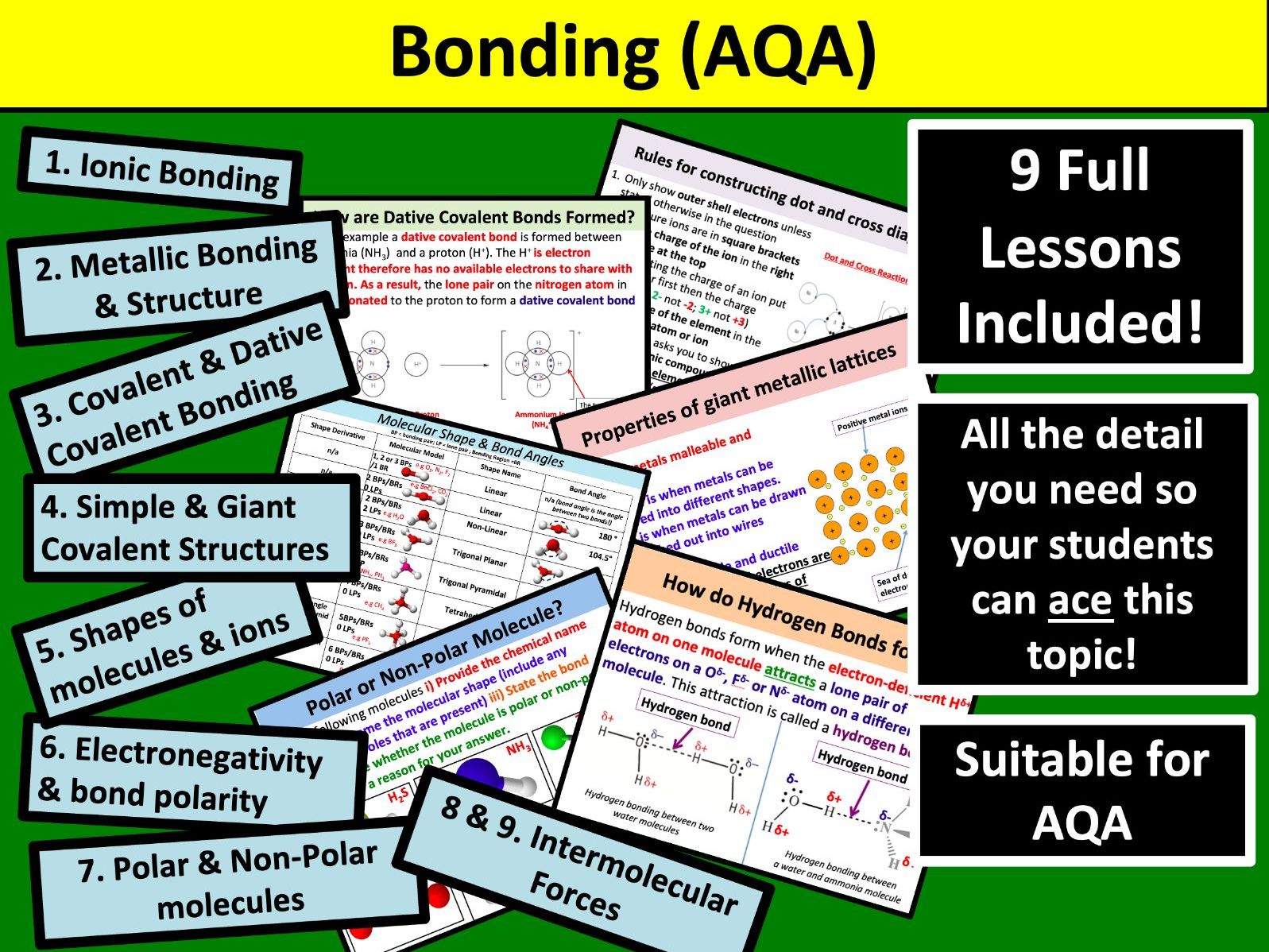
To know ionic bonding as electrostatic attraction between positive and negative ions, and the construction of ‘dot-and-cross’ diagrams
To explain solid structures of giant ionic lattices are a result of oppositely charged ions strongly attracted to each other in all directions
To link the structure and bonding of ionic compounds on their physical properties including melting and boiling points, solubility and electrical conductivity in solid, liquid and aqueous states
Lesson 2: Metallic Bonding and Structure
To describe the structure of metals
To explain metallic bonding as strong electrostatic attraction between cations and delocalised electrons
To explain the physical properties of giant metallic structures
Lesson 3: Covalent and Dative Covalent Bonding
To know covalent bonding as electrostatic attraction between a shared pair of electrons and the nucleus
To construct dot and cross diagrams of molecules and ions to describe single and multiple covalent bonding
To apply the term average bond enthalpy as a measurement of covalent bond strength
To know what a dative covalent bond is
To construct dot and cross diagrams of molecules and ions to describe dative covalent bonding
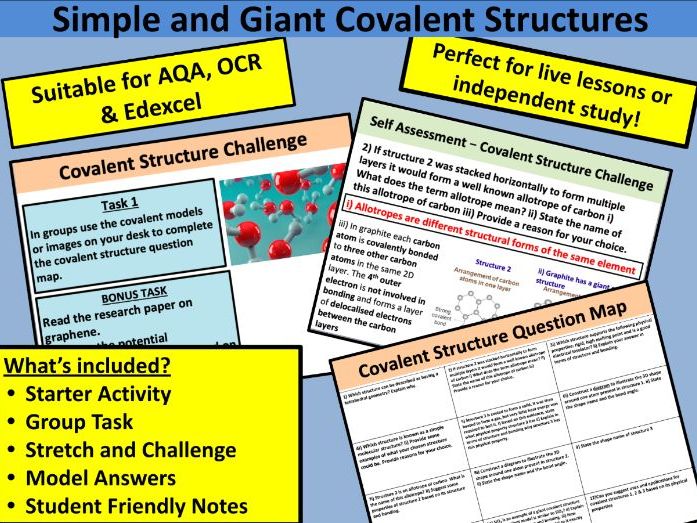
Lesson 4: Simple and Giant Covalent Structures
To describe the structure of simple and giant covalent compounds
To explain how the structure and bonding of simple and giant covalent compounds link to their different physical properties
To evaluate the potential applications of covalent structures based on their physical properties (stretch & challenge)
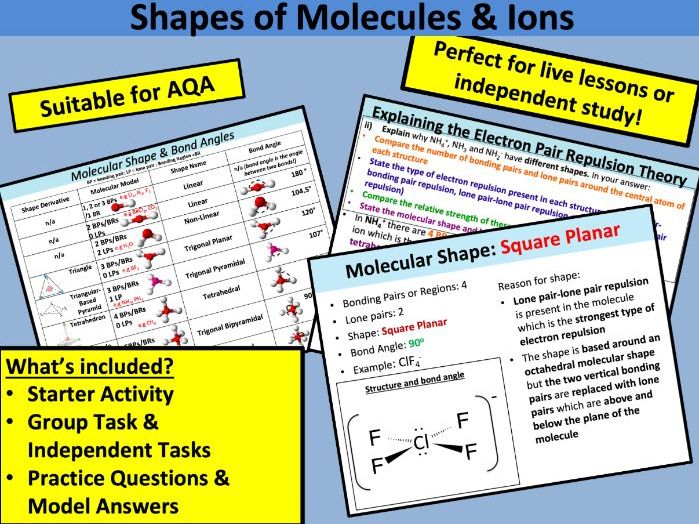
Lesson 5: Shapes of Molecules and Ions
To determine the number of bonding pairs & lone pairs in a molecule or ion
To recall the shapes and bond angles of molecules and ions with up to six electron pairs surrounding the central atom
To explain the shapes of molecules and ions using the electron pair repulsion theory
To construct diagrams to illustrate the 3D shapes of molecules and ions
Lesson 6: Electronegativity and Bond Polarity
To define the term electronegativity
To explain the trend in electronegativity down a group and across a period
To explain what a polar covalent bond is bond and to illustrate this type of bond in a molecule
Lesson 7: Polar and Non-Polar Molecules
To describe the difference between polar and non-polar molecules
To explain why non-polar molecules can contain polar bonds
To predict whether molecules are polar or non-polar
Lesson 8 : Intermolecular Forces (Part 1)
To understand intermolecular forces based on induced-dipole interactions and permanent dipole-dipole interactions
To explain how intermolecular forces are linked to physical properties such as boiling and melting points
To compare the solubility of polar and non-polar molecules in polar and non-polar solvents
Lesson 9 : Intermolecular Forces (Part 2)
To understand hydrogen bonding as intermolecular forces between molecules containing N, O or F and the H atom of –NH, -OH or HF
To construct diagrams which illustrate hydrogen bonding
To explain the anomalous properties of H2O resulting from hydrogen bonding
Declaimer: Please refrain from purchasing this popular resource for an interview lesson or a formal observation. This is because planning your own lessons including using your own lesson PowerPoints is a fundamental skill of a qualified/unqualified teacher that will be reviewed during these scenarios outlined above