Complete Year 7 to 9 Linear Equations Bundle
Resource Bundle



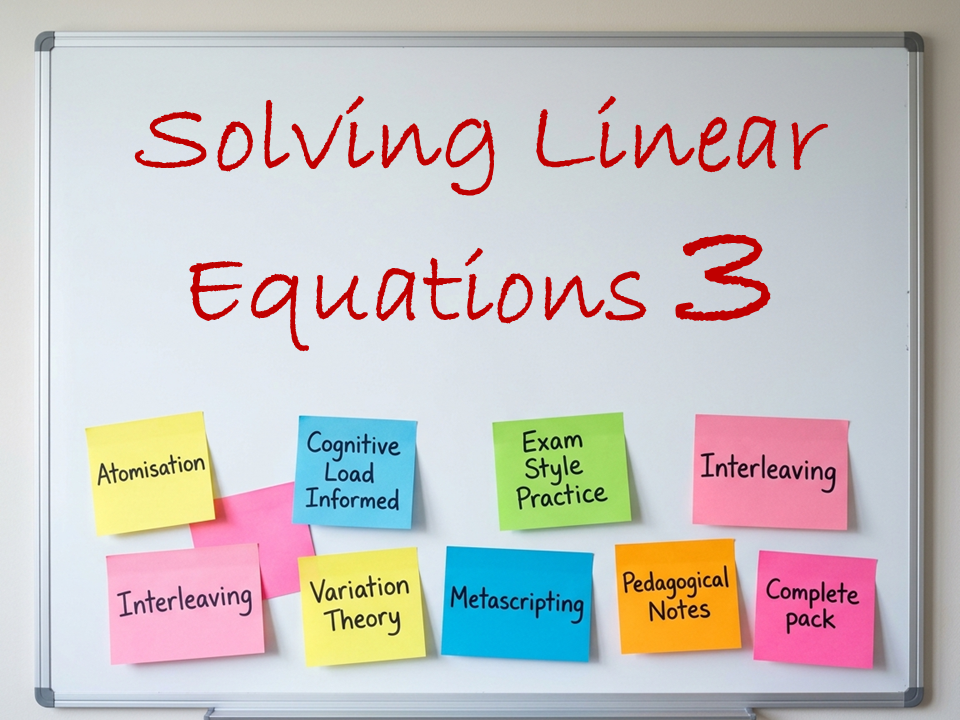
The Linear Equations Master Trilogy (Units 1, 2 & 3): Complete Solution
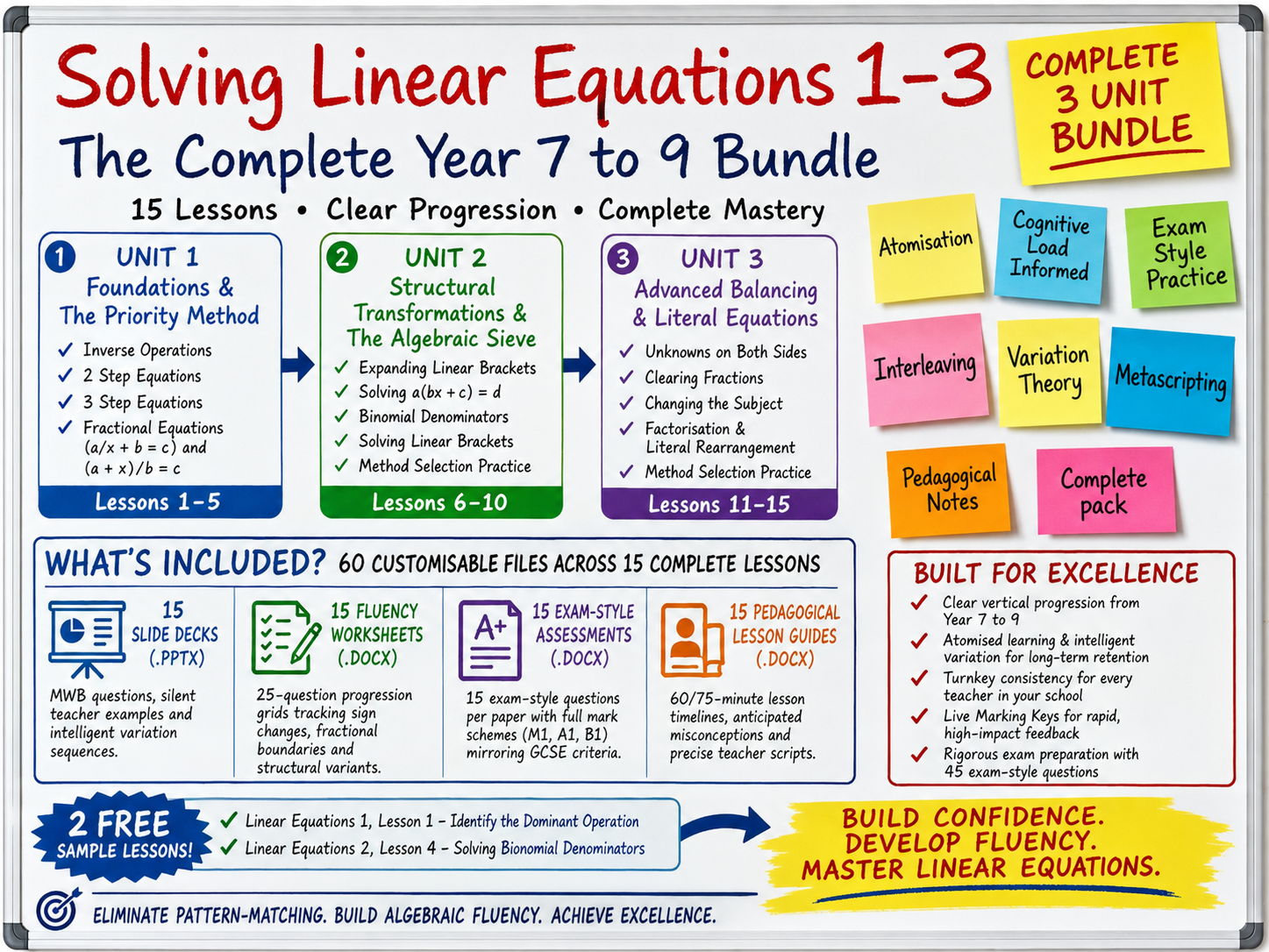
Eliminate fragile mechanics, eradicate superficial pattern-matching, and establish absolute algebraic fluency across your entire cohort. The Linear Equations Master Trilogy is a comprehensive, 15-lesson secondary maths curriculum solution designed specifically for schools which demand pedagogical rigour, flawless vertical progression, and teaching consistency. Crucially, it employs the robust (Google it) dominant operation method throughout.
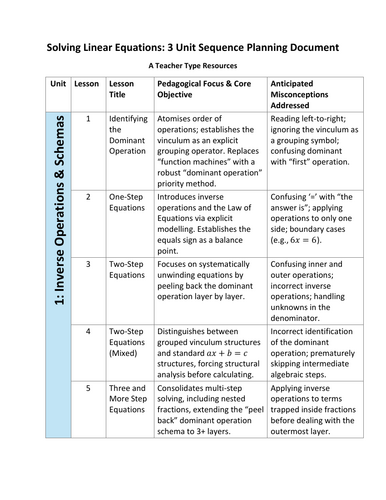
Also includes the Planning Document with per unit and per lesson breakdown, ready for your MTP
Divided neatly into three units, this can start in year 7 (after order of operations and collecting like terms), and then be spaced up until year 9. For lower prior attaining groups, they will work well up to KS4.
Built on the principles of cognitive load theory, atomisation, and intelligent variation, this trilogy provides a seamless architectural trajectory. It completely transforms how students process algebraic structures—moving them systematically from basic operational inversion to advanced literal formula manipulation.
Try before you buy - two free sample lesson packs:
Linear Equations 1, Lesson 1 - Identify the Dominant Operation
Linear Equations 2, Lesson 4 - Solving Bionomial Denominators
The Curriculum Trajectory: 15 Atomised Lessons
Unit 1: Foundations & The Priority Method
Establishes the foundational mechanics of linear equations. Students master the priority method for inverse operations and learn to navigate the structural boundaries of the vinculum. Includes deep-dives into 2-step, 3-step, and fractional equations (a/x+b=c and (a+x)/b=c).
Unit 2: Structural Transformations & The Algebraic Sieve
Shifts students from direct manipulation to structural rewriting. Introduces the “algebraic sieve,” training students to identify when an equation is locked by grouping barriers. Covers fluent single-bracket expansion, solving a(bx+c)=d, and managing complex binomial denominators by treating them as implicit bracketed groups.
Unit 3: Advanced Balancing & Literal Equations
The higher-tier capstone. Students progress to balancing unknowns on both sides (ax+b=cx+d), clearing scattered terms within fractions, and shifting completely from numeric solving to literal rearrangement. By anchoring changing the subject directly to the balancing schemas established earlier in the unit, factorisation is introduced as a logical necessity rather than an isolated trick.
Why Schools Need To Use This Trilogy
What Is Included in the Master Bundle?
This complete asset library contains 60 fully customizable files across 15 complete lessons:
Something went wrong, please try again later.
This resource hasn't been reviewed yet
To ensure quality for our reviews, only customers who have purchased this resource can review it
Report this resourceto let us know if it violates our terms and conditions.
Our customer service team will review your report and will be in touch.