


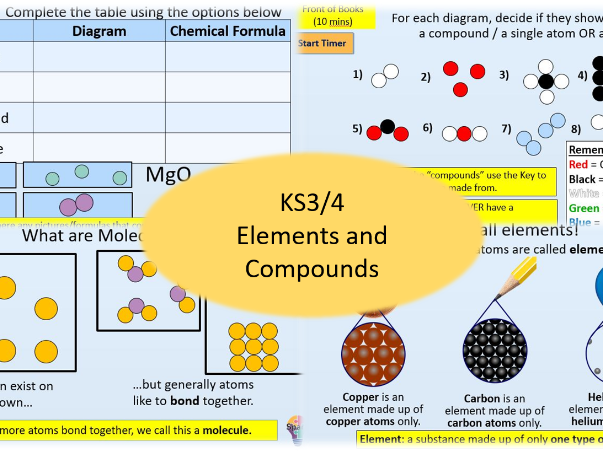
This lesson is the first lesson in the “Atomic Structure” topic. This topic is designed to act as a “bridging topic” between KS3 and KS4 chemistry.
In this lesson students will learn what elements, compounds, atoms and molecules are, and how to identify them from particle diagrams and chemical formulas. This lesson creates a strong basis of chemical literacy that is vital for success at GCSE chemistry and beyond.
This lesson contains:
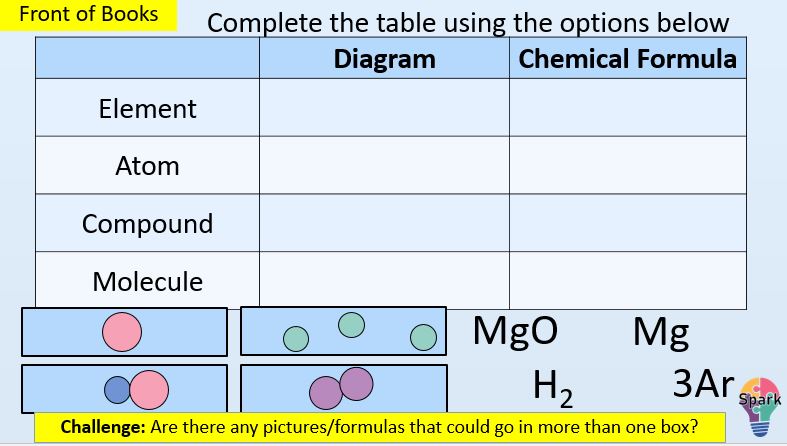
- Lesson powerpoint - including teacher notes and answers in “notes” section
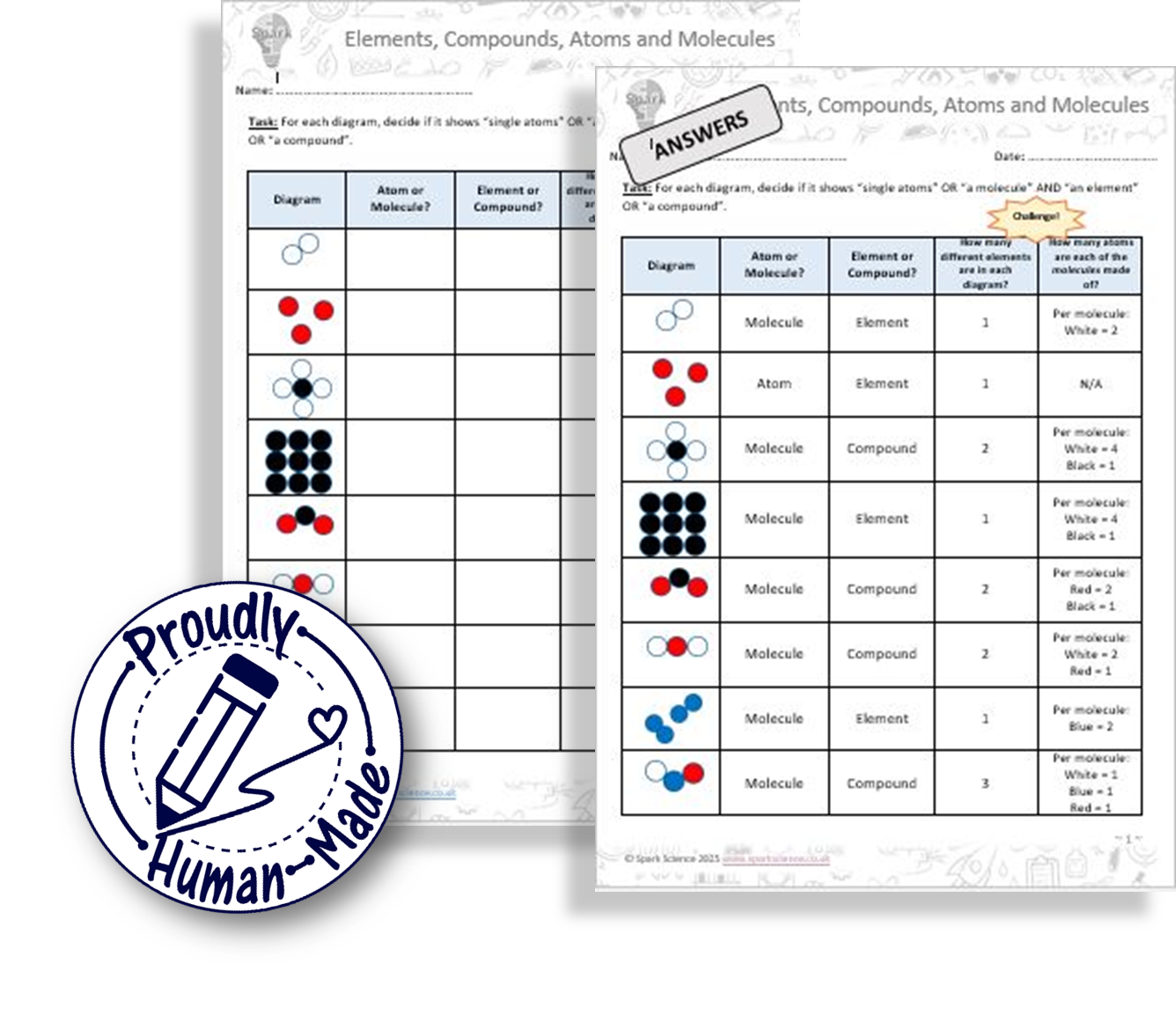
- Student led lesson worksheet
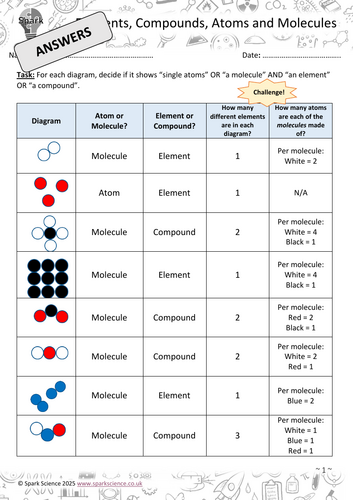
- Teacher answer sheet
Lesson resources contain:
- Interactive powerpoint including teacher delivery notes and answers throughout
- AFL activities and student quizzes
- 2 plenary task options
- Explicit teaching and practice of scientific vocabulary
Objectives:
Students will be able to…
- Know what an “element” and a “compound” is
- Describe the difference between an element and a compound
- Know what an “atom” and a “molecule”
- Describe the difference between an atom and a molecule
This lesson contains a student led lesson sheet, with the focus being on students learning through doing and practicing skills and identifying patterns and reasons themselves. Resources and slides ask students the key questions and develops ideas and concepts from the ground up and address common issues, mistakes and misconceptions.
This lesson contains AFL tasks which require mini-whiteboards and molymods, but can be adapted if these are not available.
Get this resource as part of a bundle and save up to 22%
A bundle is a package of resources grouped together to teach a particular topic, or a series of lessons, in one place.
Bundle
AQA Chemistry: Atomic Structure Whole Topic
This topic bundle is designed as part of a bridging Year 9, covering content from AQA GCSE Chemistry Topic 1 "Atomic Structure and the Periodic Table". which help students build strong foundations of knowledge they will need to succeed in GCSE science. **This bundle contains the following lessons:** 1. Elements and Compounds 2. Mixtures 3. Filtration and Crystallisation 4. Distillation 5. Chromatography Practical 6. Analysing Chromatograms 7. Structure of the Atom 8. Counting Subatomic Particles 9. Electron Configurations 10. History of the Atomic Model 11. The Alpha Particle Scattering Experiment This bundle is a complete topic pack containing all powerpoints, student worksheets, stretch and challenge tasks, and answer sheets for the Chemistry topic “Atomic Structure”. It also contains many student-led activities on the powerpoints, plenary activities, a variety of AfL activities, and reading and literacy tasks. **Lesson objectives:** * Know what "element", "compound", "molecule" and "atom" mean * Identify elements, compounds, molecules and atoms in particle diagrams and chemical formulae * State what a mixture is * Describe particle diagrams of mixtures in terms of elements and compounds * Give limitations of using different models to represent mixtures * Know what “soluble” and “insoluble” mean * Identify mixtures that can be separated using filtration and crystallisation * Describe and explain the process of filtration and crystallisation to separate a mixture * State what evaporate and condense mean * Identify mixtures that can be separated using distillation * Describe and explain the process of distillation to separate a mixture * Identify the mobile and stationary phase in paper chromatography * Describe how to use chromatography to separate the substances in a mixture * Explain why different substances travel different distances in chromatography * Carry out a chromatography practical to investigate the composition of inks * Analyse the composition of a mixture using a chromatogram * Calculate the Rf value for a chromatogram spot * Identify unknown chemicals using Rf values * Describe what a subatomic particle is * Describe the structure of an atom in terms of subatomic particles * Give the positions, relative mass and charge of the three subatomic particles * Know what the mass number and proton/atomic number tell us about an element * Count the number of protons, neutrons and electrons found in elements * Explain why the number of protons and electrons are always the same in atoms * State how many electrons sit in each shell of an atom * Draw and write the electron configuration for the first 20 elements of the periodic table * Identify elements from their electron configurations * Identify and name the different historical models of the atom * State the major discoveries about the structure of the atom and the scientists associated with them * Compare and contrast features of different models of the atom * Describe the alpha particle scattering experiment and its results * Explain the results of the alpha particle scattering experiment and what it proved about the structure of the atom **Resource contains:** * Lesson powerpoints for each lesson (.pptx) * Student worksheets (PDF) * Student worksheet answers (PDF) **Lessons contain:** * Interactive lesson powerpoints for all lessons with full answers * Teacher delivery instructions and tips in Powerpoint notes sections * Stretch and challenge tasks throughout * Independent student-led activities including reading comprehension * Explicitly taught scientific literacy * A variety of AfL tasks throughout * Plenary tasks and quizzes for each lesson
£22.99
Bundle
KS3 - Elements, Compounds and Mixtures Bundle
A comprehensive, complete, engaging and challenging set of lessons and activities to teach students the basics of elements, compounds, mixtures and chemical formulas. This scheme/package is designed with non-science/non-chemistry specialist teachers in mind! **Lessons included in this bundle:** 1. Elements and Compounds 2. Chemical Formulas 3. Counting atoms in a Formula 4. Pure Substances 5. Mixtures **Included in each lesson:** 1. Lesson powerpoint - including teacher notes and answers in "notes" section 2. Student-led lesson worksheet 3. Teacher answer sheet **Lesson resources contain:** 1. In-built stretch and challenge tasks throughout 2. In-built scaffolded learning for lower abilities 3. Various AFL activities to assess progress and understanding that you can tailor to fit any class or available resources (these include “think, pair, share”, molymod activities, mini-whiteboard quizzes) 4. Relevant risk assessments for any practical work (updated as of March 2023) **By the end of the topic, students will:** * Know what an “element” and a “compound” is * Describe the difference between an element and a compound * Know what an “atom” and a “molecule” are * Describe the difference between an atom and a molecule * Draw/make particle diagrams and models to represent elements, compounds, single atoms and molecules * Understand why scientists use chemical symbols to represent elements * Identify simple elements from their chemical symbols * Identify elements in a chemical formula * Classify chemical formulas as elements or compounds * Count the number of atoms in a basic formula * Identify elements in a chemical formula * Count the number of atoms in formulas containing subscripts * Count the number of atoms in formulas containing multipliers * Describe what a pure substance is * Identify examples of pure substances in everyday life * Identify pure substances from particle diagrams and examples * Carry out a practical investigation to identify pure substances * Describe what a mixture is * Give examples of mixtures in everyday life * Identify mixtures from particle diagrams and examples * Draw/make models representing mixtures
£7.00
Something went wrong, please try again later.
This resource hasn't been reviewed yet
To ensure quality for our reviews, only customers who have purchased this resource can review it
Report this resourceto let us know if it violates our terms and conditions.
Our customer service team will review your report and will be in touch.
£2.00