pptx, 839.08 KB
pptx, 839.08 KB
docx, 90.24 KB
docx, 90.24 KB

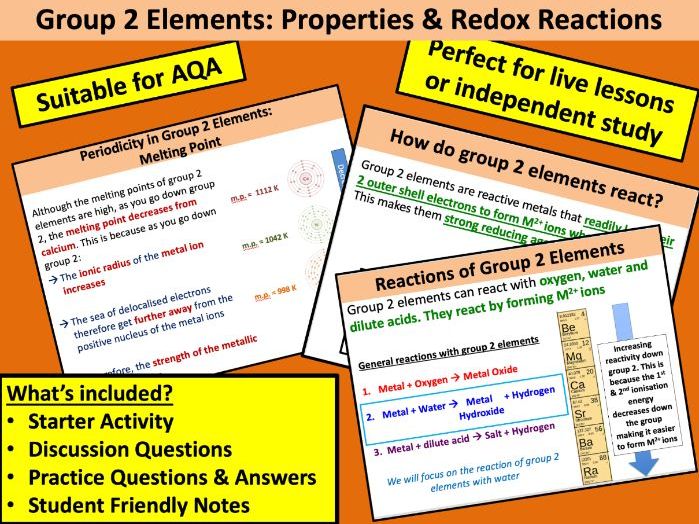
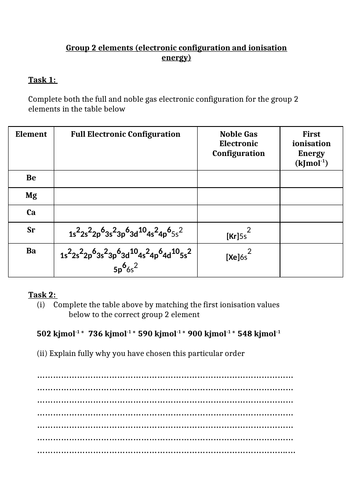
A structured KS5 lesson including starter activity, AfL work tasks and practice questions with answers on Group 2 Elements: Properties and Redox Reactions. Suitable for the AQA Specification.

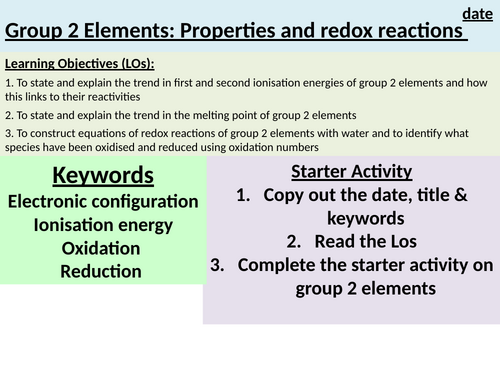
By the end of this lesson KS5 students should be able to:

  1. To state and explain the trend in first and second ionisation energies of group 2 elements and how this links to their reactivities
  2. To state and explain the trend in the melting point of group 2 elements
  3. To construct equations of redox reactions of group 2 elements with water and to identify what species have been oxidised and reduced using oxidation numbers

Declaimer: Please refrain from purchasing this popular resource for an interview lesson or a formal observation. This is because planning your own lessons, including using your own lesson PowerPoints, is a fundamental skill of a qualified/unqualified teacher that will be assessed during the scenarios outlined above

Get this resource as part of a bundle and save up to 10%

A bundle is a package of resources grouped together to teach a particular topic, or a series of lessons, in one place.

Bundle

Group 2 and 7 (AQA)

6 full lesson bundle on the topic of **Group 2 and 7** from the **AQA AS Level Chemistry specification.** See below for the lessons and learning objectives. **Lesson 1: Group 2 Elements: Properties and Reactions** 1. To state and explain the trend in first and second ionisation energies of group 2 elements and how this links to their reactivities 2. To state and explain the trend in the melting point of group 2 elements 3. To construct equations of redox reactions of group 2 elements with water and to identify what species have been oxidised and reduced using oxidation numbers **Lesson 2: Uses of Group 2 Elements and Compounds** 1. To state the trend in solubility and alkalinity of group 2 metal hydroxides and sulfates 2. To describe the use of magnesium in the extraction of titanium from its ore 3. To describe the uses of Mg (OH)2, Ca(OH)2 and CaO/CaCO3 **Lesson 3: The Halogens: Trends in Physical & Chemical Properties** 1. To describe and explain the trend in electronegativity, boiling and melting points of the halogens 2. To describe and explain the trend in oxidising ability of halogens and reducing ability of the halide ions 3. To outline experiments to support the trend in oxidising ability of halogens **Lesson 4: Uses of Chlorine** 1. To explain the term disproportionation 2. To explain how the reaction of chlorine with water or cold dilute sodium hydroxide are examples of disproportionation reactions 3. To evaluate the uses of chlorine **Lesson 5: Reactions of Halides** 1. Describe an experiment to identify sodium halides with sulfuric acid (evidence of trend in reducing power) 2. Describe an experiment to identify metal halides with silver ions 3. Analyse various experiments (in questions) based on identifying halide ions **Lesson 6: Required Practical 4: Testing for Cations & Anions** 1. Researching the risks associated with the experiment and creating appropriate risk assessment based on your findings 2. Researching appropriate experimental methods for testing for group 2 cations, NH4+ ions, CO32- ions, SO42- ions and halide ions 3. Constructing appropriate results tables to record your observations during the experiment

£40.07

Reviews

Something went wrong, please try again later.

This resource hasn't been reviewed yet

To ensure quality for our reviews, only customers who have purchased this resource can review it

Report this resourceto let us know if it violates our terms and conditions.
Our customer service team will review your report and will be in touch.