zip, 7.82 MB
zip, 7.82 MB
png, 94.79 KB
png, 94.79 KB

Lesson: How do Humanists make moral decisions?

This lesson is Lesson 2 in the new ‘Making Moral Decisions’, ethics-based unit, devised as part of a brand new, relevant and engaging scheme of work for KS3 students. For my own setting, this unit is taught in Year 7, as a way of engaging students into moral debate through the use of powerful stories.

This lesson explores how Humanists make moral decisions, exploring their values and influences. This lesson includes a dramatic re-telling of the famous Lifeboat thought experiment, culminating in the judgement of whether Humanism is helpful when making moral decisions.

Although part of a unit, this lesson can also be taught as a stand-alone lesson. The PPT is editable so that the starter questions can be changed to suit your students. The corresponding lesson sheets would also support a home-learned curriculum as the PowerPoints and Packs themselves include scaffolding, where required, and opportunities for the teacher to apply adaptive teaching techniques.

The interleaved schemed of work are specifically designed to promote the two skills desired for success in RE/Ethics and at GCSE:

  • AO1 (Knowledge and Understanding)
  • AO2 (Analysis and Evaluation)
    The resources are specifically created to ensure students are aware of the skill they are demonstrating and how to improve further through modelling.

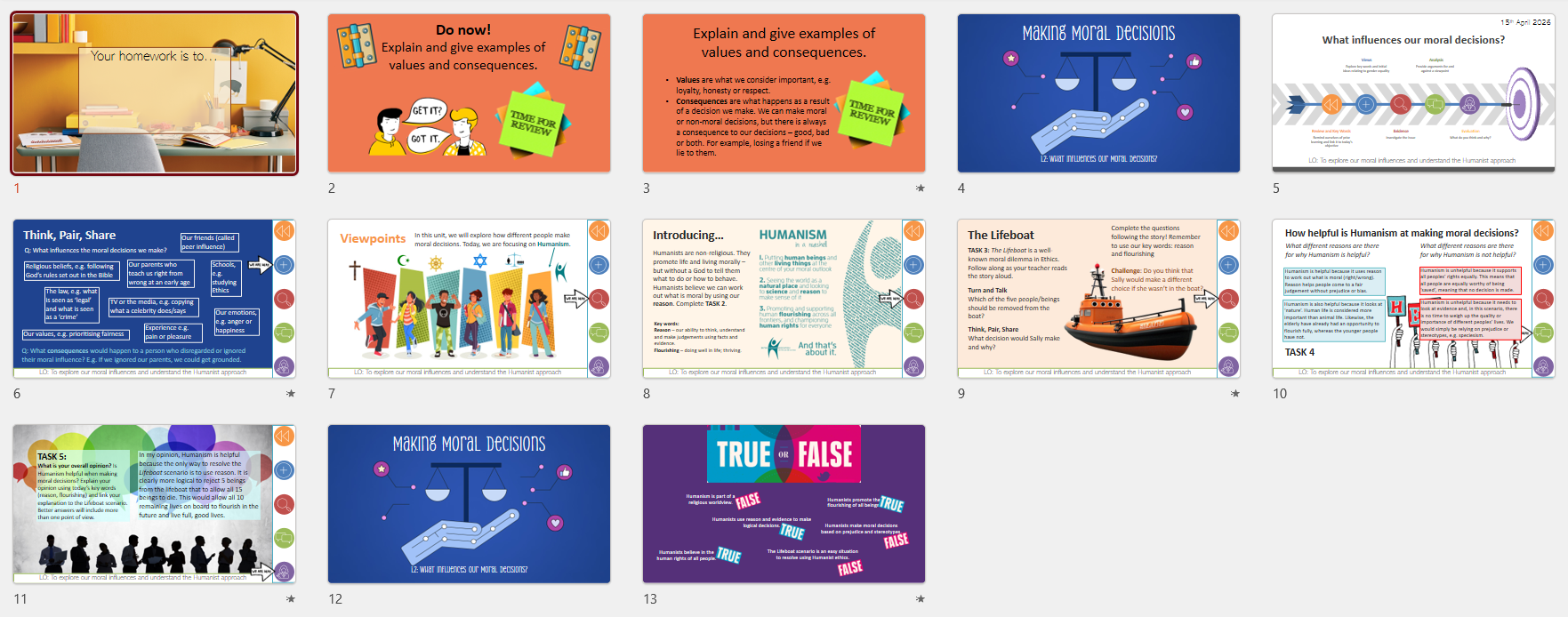
Lesson includes:

  • Homework Slide
  • Starter activity/‘Do now’ activity
  • Lesson overview (lesson objective and the lesson journey)
  • Key words (literacy focus)
  • Cloze activity
  • The Lifeboat - learning through stories
  • Analysis / debate task (AO2 - analysis) and finalised judgement (AO2 - evaluation)
  • Plenary

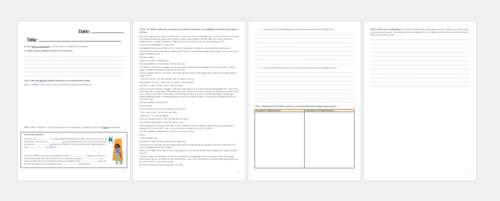
Lesson Sheets:
If you would rather work in exercise books, the lesson sheets are designed so that you can print off relevant pages - it is a resource pack. This would be useful if you have appropriate curriculum time to cover the content of the course. Unfortunately, this is not the case across all schools, and therefore the lesson sheets help by providing time-saving activities, whilst still being able to cover the breadth and depth of the course.
In addition, students who may be limited by literacy issues, e.g. slower writing paces, are not disadvantaged or capped in their progress. Therefore, some classes could use a mixed approach - part lesson sheets, part exercise book - and all students will be able to progress through the same volume of content.

Get this resource as part of a bundle and save up to 33%

A bundle is a package of resources grouped together to teach a particular topic, or a series of lessons, in one place.

Bundle

KS3 Ethics: Making Moral Decisions - Unit of 6 Lessons

Unit: Making Moral Decisions This is a new 6 lesson unit called ‘Making Moral Decisions’. It is an ethics-based unit, devised as part of a brand new, relevant and engaging scheme of work for KS3 students. For my own setting, this unit is taught in Year 7, as a way of engaging students into moral debate through the use of powerful stories. Lessons: 1. What are moral decisions? 2. How do humanists make moral decisions? 3. How do utilitarians make moral decisions 4. How do members of the Abrahamic faiths make moral decisions? 5. How do members of the Eastern religions make moral decisions? 6. Respecting others' values Lessons 2-6 include the exploration of morality through powerful, dramatic narratives in which a moral decision must be made. For example, the Trolley Problem in Utilitarianism, or the problem of speciesism in Eastern Religion. The corresponding lesson sheets would also support a home-learned curriculum as the PowerPoints and Packs themselves include scaffolding, where required, and opportunities for the teacher to apply adaptive teaching techniques. The interleaved schemed of work are specifically designed to promote the two skills desired for success in RE/Ethics and at GCSE: AO1 (Knowledge and Understanding) AO2 (Analysis and Evaluation) The resources are specifically created to ensure students are aware of the skill they are demonstrating and how to improve further through modelling. Lessons include: * Homework Slide * Starter activity/‘Do now’ activity * Lesson overview (lesson objective and the lesson journey) * Key words (literacy focus) * Case studies card sort * Analysis / debate task (AO2 - analysis) and finalised judgement (AO2 - evaluation) * Plenary Lesson Sheets: If you would rather work in exercise books, the lesson sheets are designed so that you can print off relevant pages - it is a resource pack. This would be useful if you have appropriate curriculum time to cover the content of the course. Unfortunately, this is not the case across all schools, and therefore the lesson sheets help by providing time-saving activities, whilst still being able to cover the breadth and depth of the course. In addition, students who may be limited by literacy issues, e.g. slower writing paces, are not disadvantaged or capped in their progress. Therefore, some classes could use a mixed approach - part lesson sheets, part exercise book - and all students will be able to progress through the same volume of content.

£19.99

Reviews

Something went wrong, please try again later.

This resource hasn't been reviewed yet

To ensure quality for our reviews, only customers who have purchased this resource can review it

Report this resourceto let us know if it violates our terms and conditions.
Our customer service team will review your report and will be in touch.