

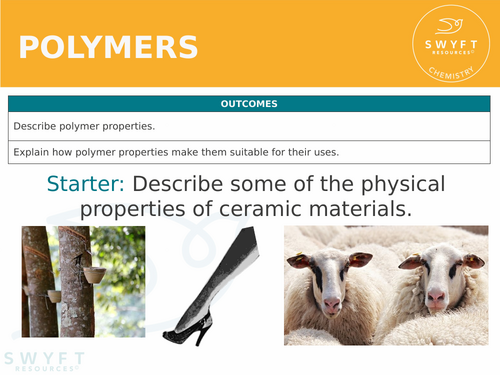

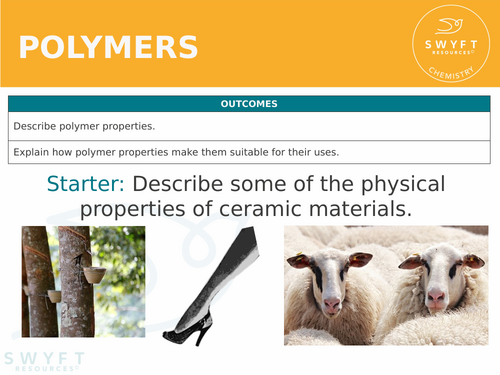
This lesson is designed for the KS3 Year 8 Science course, specifically the C2 1.2 unit on ‘Metals & Other Materials’.
For more lessons designed for KS3 and KS4 please visit my shop at: https://www.tes.com/teaching-resources/shop/SWiftScience.
The lesson begins with a video which introduces what a polymer is, how polymers can be made stronger or more flexible. Whilst students are watching the video, they will need to answer a set of questions. This can be self-assessed using the mark scheme provided.
The next slides show an image of the differences between monomers and polymers, and then a description of the difference between natural and synthetic polymers. Students will then watch a video where they need to listen out for the names of synthetic polymers and natural polymers.
For the next activity, each student will be given specific information about one of the following polymers - cotton, PVC, wool, high-density polyethene, low-density polyethene and rubber. They will need to walk around the room and share information with each other, to complete a table on the properties and uses of these polymers. Students will also need to identify whether the material was natural or synthetic. The answers to this task are provided within the PowerPoint, so children can either self-assess or peer-assess their work once complete.
The final task of the lesson requires students to plot the density date onto a bar chart, to compare the densities of different polymers.
The plenary task requires students to write a message to summarise what they have learned in the lesson today.
Get this resource as part of a bundle and save up to 40%
A bundle is a package of resources grouped together to teach a particular topic, or a series of lessons, in one place.
Something went wrong, please try again later.
This resource hasn't been reviewed yet
To ensure quality for our reviews, only customers who have purchased this resource can review it
Report this resourceto let us know if it violates our terms and conditions.
Our customer service team will review your report and will be in touch.
£2.50