


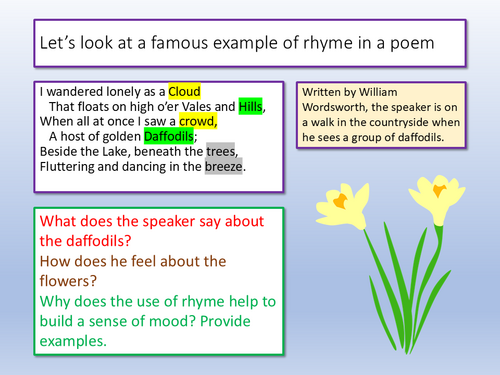
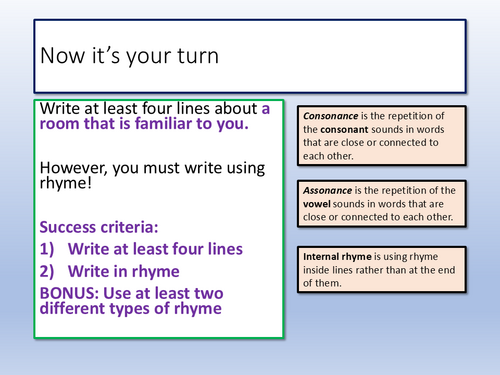

Poetry writing lesson for KS3 students that focuses on rhyme and types of rhyme (half-rhyme, full rhyme, end rhyme, internal rhyme, assonance, consonance). Students explore different examples of poems that employ rhyme for effects and how rhyme can be powerful, before creating their own short poems on a room that is familiar to them, using the multiple model examples provided in the lesson to help them use rhyme effectively.
Together we explore the use of language devices and how they convey the writer’s thoughts and feelings to the reader, including the effects they can have on a reader.
Students use these examples, as well as success criteria, to create their own quatrains. Students then peer assess their poems based on the success criteria.
Poetry writing is a creative and engaging way to help students understand and analyse poetry, which is so essential for GCSE English Literature study and exams.
This lesson will be part of a full unit on writing poetry that will explore language, structure, form, effects, imagery, messages and more.
**All reviews help us to keep making teaching resources for the English classroom. Have a query or question? Get in touch at info@englishgcse.co.uk **
Get this resource as part of a bundle and save up to 69%
A bundle is a package of resources grouped together to teach a particular topic, or a series of lessons, in one place.
Something went wrong, please try again later.
This resource hasn't been reviewed yet
To ensure quality for our reviews, only customers who have purchased this resource can review it
Report this resourceto let us know if it violates our terms and conditions.
Our customer service team will review your report and will be in touch.
£3.30