


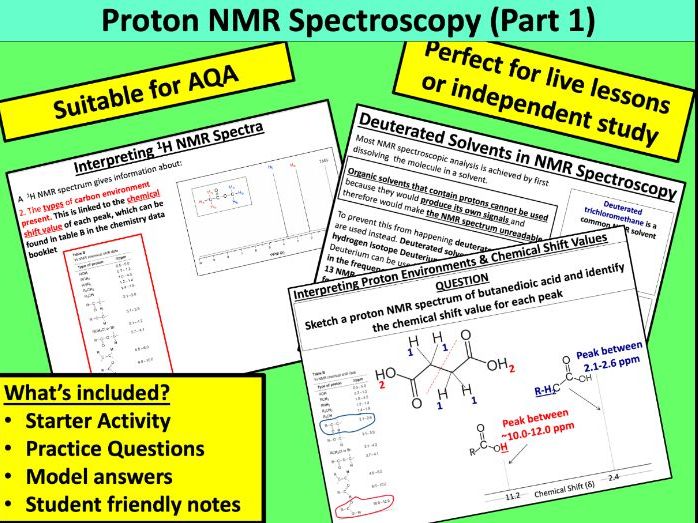
A complete lesson including starter activity, AfL work tasks and main work tasks (all with answers included) on proton NMR Spectroscopy- Part 1. Suitable for the AQA Specification.
By the end of this lesson KS5 students should be able to:
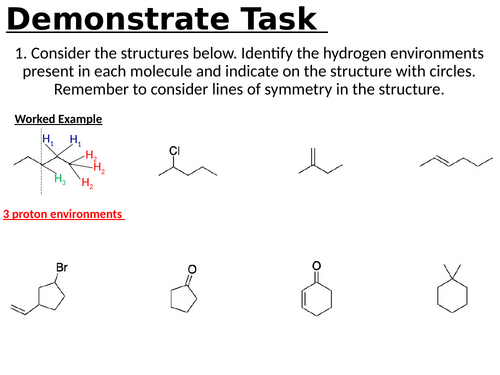
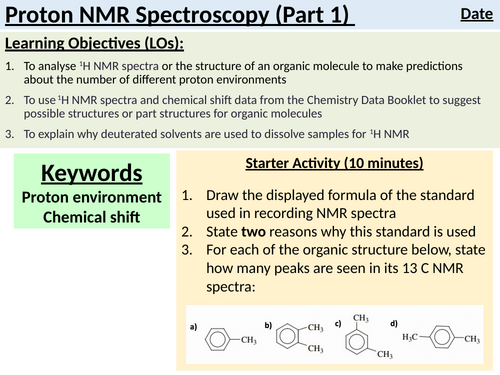
- To analyse 1H NMR spectra or the structure of an organic molecule to make predictions about the number of different proton environments
- To use 1H NMR spectra and chemical shift data from the Chemistry Data Booklet to suggest possible structures or part structures for organic molecules
- To explain why deuterated solvents are used to dissolve samples for 1H NMR
Declaimer: Please refrain from purchasing this popular resource for an interview lesson or a formal observation. This is because planning your own lessons including using your own lesson PowerPoints is a fundamental skill of a qualified/unqualified teacher that will be reviewed during these scenarios outlined above
Get this resource as part of a bundle and save up to 10%
A bundle is a package of resources grouped together to teach a particular topic, or a series of lessons, in one place.
Bundle
NMR Spectroscopy and Chromatography
4 Full Lesson Bundle on Carbon-13 and Proton NMR Spectroscopy and Chromatography. Suitable for the AQA A Level Chemistry specification. Please review the learning objectives below. **Lesson 1: Carbon-13 NMR Spectroscopy** 1. To explain why TMS is a suitable substance to use as a standard 2. To analyse 13 C NMR spectra or the structure of an organic molecule to make predictions about the number of different carbon environments 3. To use 13 C NMR spectra and chemical shift data from the Chemistry Data Booklet to suggest possible structures or part structures for organic molecules **Lesson 2: Proton NMR Spectroscopy (Part 1)** 1. To analyse 1H NMR spectra or the structure of an organic molecule to make predictions about the number of different proton environments 2. To use 1H NMR spectra and chemical shift data from the Chemistry Data Booklet to suggest possible structures or part structures for organic molecules 3. To explain why deuterated solvents are used to dissolve samples for 1H NMR **Lesson 3: Proton NMR Spectroscopy (Part 2)** To analyse proton NMR spectra of an organic molecule to make predictions about: i) The different types of proton environment present from chemical shift values ii) The relative numbers of each type of proton present from the relative peak areas using integration traces or ratio numbers when required iii) The number of non-equivalent protons adjacent to a given proton from the spin-spin splitting pattern, using the n+1 rule iv) Possible structures for the molecule **A bonus question on combined techniques are also included in lesson 3!** **Lesson 4: Chromatography** 1. To explain how thin layer chromatography (TLC) can be used to separate and identify the components in a mixture 2. To explain how column chromatography (CC) can be used to to separate and identify the components in a mixture 3. To explain how gas chromatography (GC) and gas chromatography –mass spectrometry (GC-MS) can be used to separate and identify the components in a mixture **Declaimer: Please refrain from purchasing this popular resource for an interview lesson or a formal observation. This is because planning your own lessons including using your own lesson PowerPoints is a fundamental skill of a qualified/unqualified teacher that will be reviewed during these scenarios outlined above**
£29.97
Bundle
NMR Spectroscopy (AQA)
3 Full Lesson Bundle on Carbon-13 and Proton NMR Spectroscopy. Suitable for the AQA A Level Chemistry specification. Please review the learning objectives below. **Lesson 1: Carbon-13 NMR Spectroscopy** 1. To explain why TMS is a suitable substance to use as a standard 2. To analyse 13 C NMR spectra or the structure of an organic molecule to make predictions about the number of different carbon environments 3. To use 13 C NMR spectra and chemical shift data from the Chemistry Data Booklet to suggest possible structures or part structures for organic molecules **Lesson 2: Proton NMR Spectroscopy (Part 1)** 1. To analyse 1H NMR spectra or the structure of an organic molecule to make predictions about the number of different proton environments 2. To use 1H NMR spectra and chemical shift data from the Chemistry Data Booklet to suggest possible structures or part structures for organic molecules 3. To explain why deuterated solvents are used to dissolve samples for 1H NMR **Lesson 3: Proton NMR Spectroscopy (Part 2)** To analyse proton NMR spectra of an organic molecule to make predictions about: i) The different types of proton environment present from chemical shift values ii) The relative numbers of each type of proton present from the relative peak areas using integration traces or ratio numbers when required iii) The number of non-equivalent protons adjacent to a given proton from the spin-spin splitting pattern, using the n+1 rule iv) Possible structures for the molecule **A bonus question on combined techniques are also included in lesson 3!** Declaimer: Please refrain from purchasing this popular resource for an interview lesson or a formal observation. This is because planning your own lessons including using your own lesson PowerPoints is a fundamental skill of a qualified/unqualified teacher that will be reviewed during these scenarios outlined above
£21.97
Something went wrong, please try again later.
This resource hasn't been reviewed yet
To ensure quality for our reviews, only customers who have purchased this resource can review it
Report this resourceto let us know if it violates our terms and conditions.
Our customer service team will review your report and will be in touch.
£7.97