


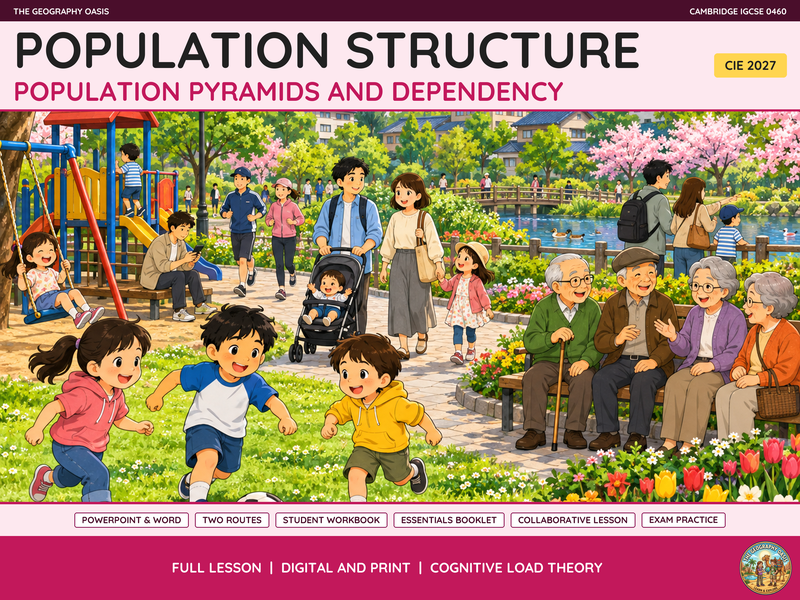
Help students read population pyramids and explain what age and sex structure reveals about a country.
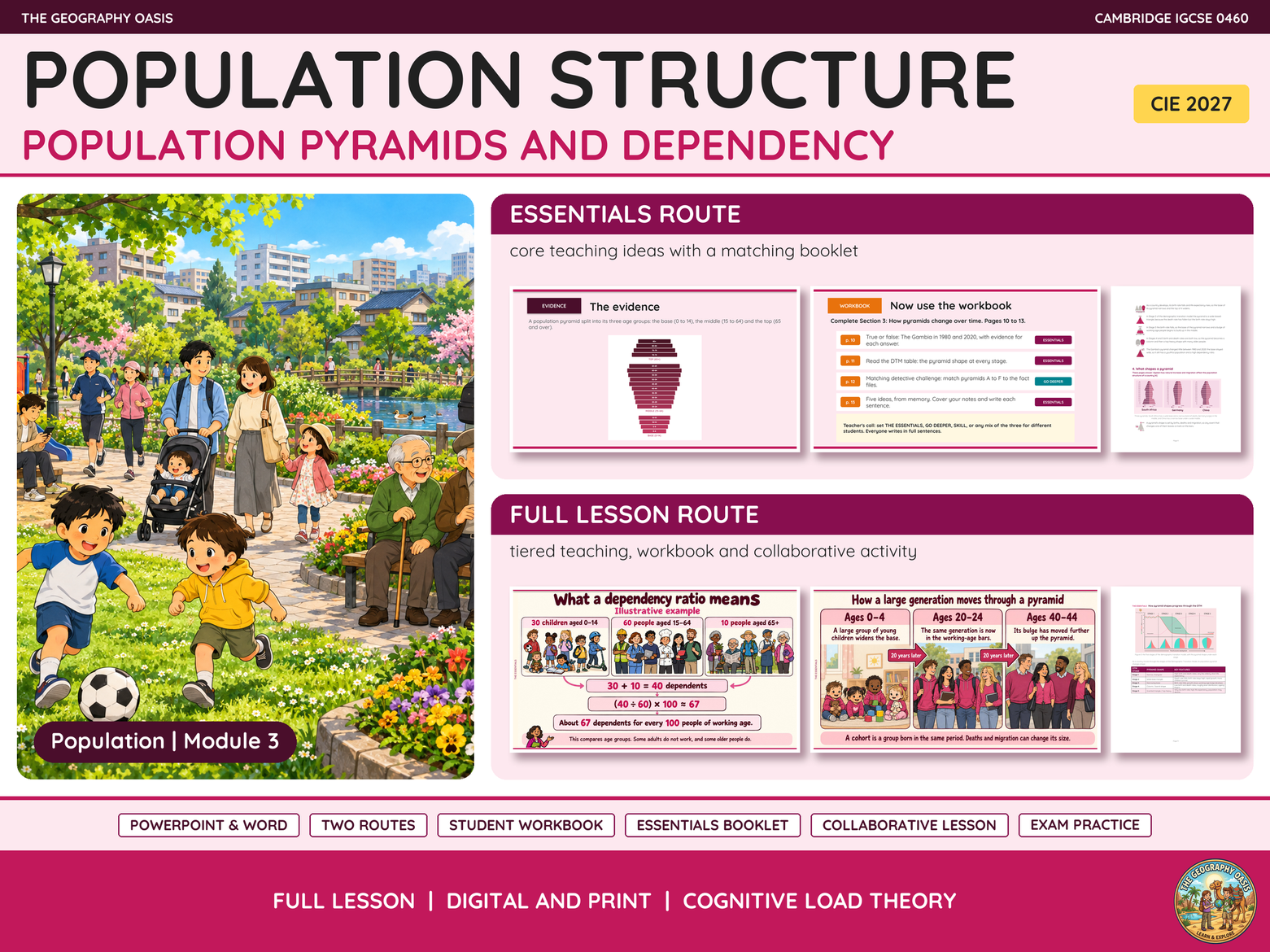
Population Structure combines pyramid interpretation with dependency-ratio calculations and explanations of demographic change. Examples including South Africa, Germany, China and The Gambia help students connect distinctive pyramid shapes to geographical processes.
Learning covered
- Read the age and sex structure shown by a population pyramid.
- Describe and compare pyramid shapes using evidence.
- Calculate and interpret dependency ratios.
- Explain how natural increase and migration change population structure.
- Link unusual features in a pyramid to possible demographic causes.
Teaching options and materials
Choose between the tiered Full Lesson presentation and the focused Essentials presentation, which includes detailed teacher notes. The Full Lesson workbook is supplied in colour, black and white and an online-labelled Word version. The Essentials Booklet includes completed and student-notes versions, with black-and-white alternatives.
Also included are a separate exam practice pack, mark scheme, short assessment and START HERE guide.
Read My Pyramid
Teams become experts on one country’s pyramid and prepare a short teaching explanation. While they teach, other students annotate a blank pyramid outline. The class then checks the annotations, so the success of the explanation is judged by what others understood. A follow-up challenge asks students to apply their interpretation.
The collaborative activity includes its own presentation and printable pack.
Designed for ages 14–16 and Cambridge IGCSE Geography 0460 population topics for the 2027 course. Supplied as editable PowerPoint and Word files, plus a PDF guide. Illustrations are embedded images. Online-labelled versions are documents rather than hosted activities.
Module 3 of the Geography Oasis Population unit; available to teach separately or as part of the seven-module unit.
If you find this resource useful, a review helps other teachers discover it and supports the creation of future resources.
Get this resource as part of a bundle and save up to 27%
A bundle is a package of resources grouped together to teach a particular topic, or a series of lessons, in one place.
Something went wrong, please try again later.
This resource hasn't been reviewed yet
To ensure quality for our reviews, only customers who have purchased this resource can review it
Report this resourceto let us know if it violates our terms and conditions.
Our customer service team will review your report and will be in touch.
£6.99