


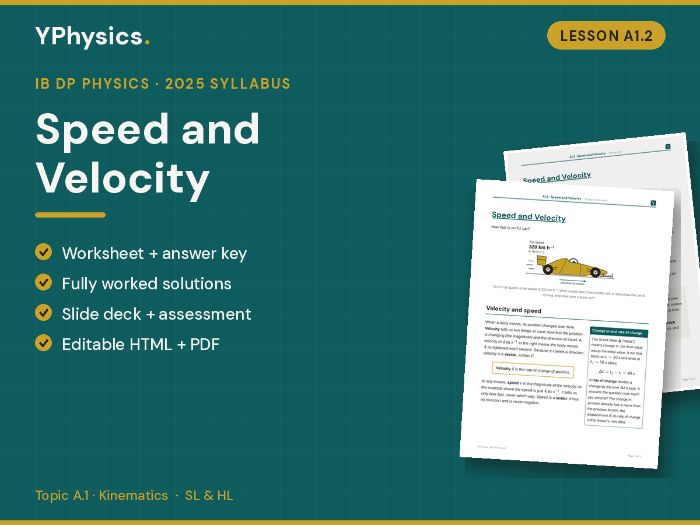
IB DP Physics lesson pack on speed and velocity for Topic A.1 Kinematics, SL and HL, first assessment 2025: velocity as the rate of change of position, and average against instantaneous values. Editable worksheet, 28-slide lesson deck, teacher key, worked solutions and a questions-only assessment, supplied as self-contained HTML plus colour and black-and-white PDF.
What students learn
- Velocity is the rate of change of position. The one-dimensional sign convention separates velocity, a vector, from speed, a scalar that is never negative.
- Average speed is total distance over time taken; average velocity is displacement over time taken. An instantaneous value emerges as the averaging interval shrinks.
- Worked examples: a there-and-back car journey, and a circular running track where the average velocity for a full lap is zero while the average speed is not.
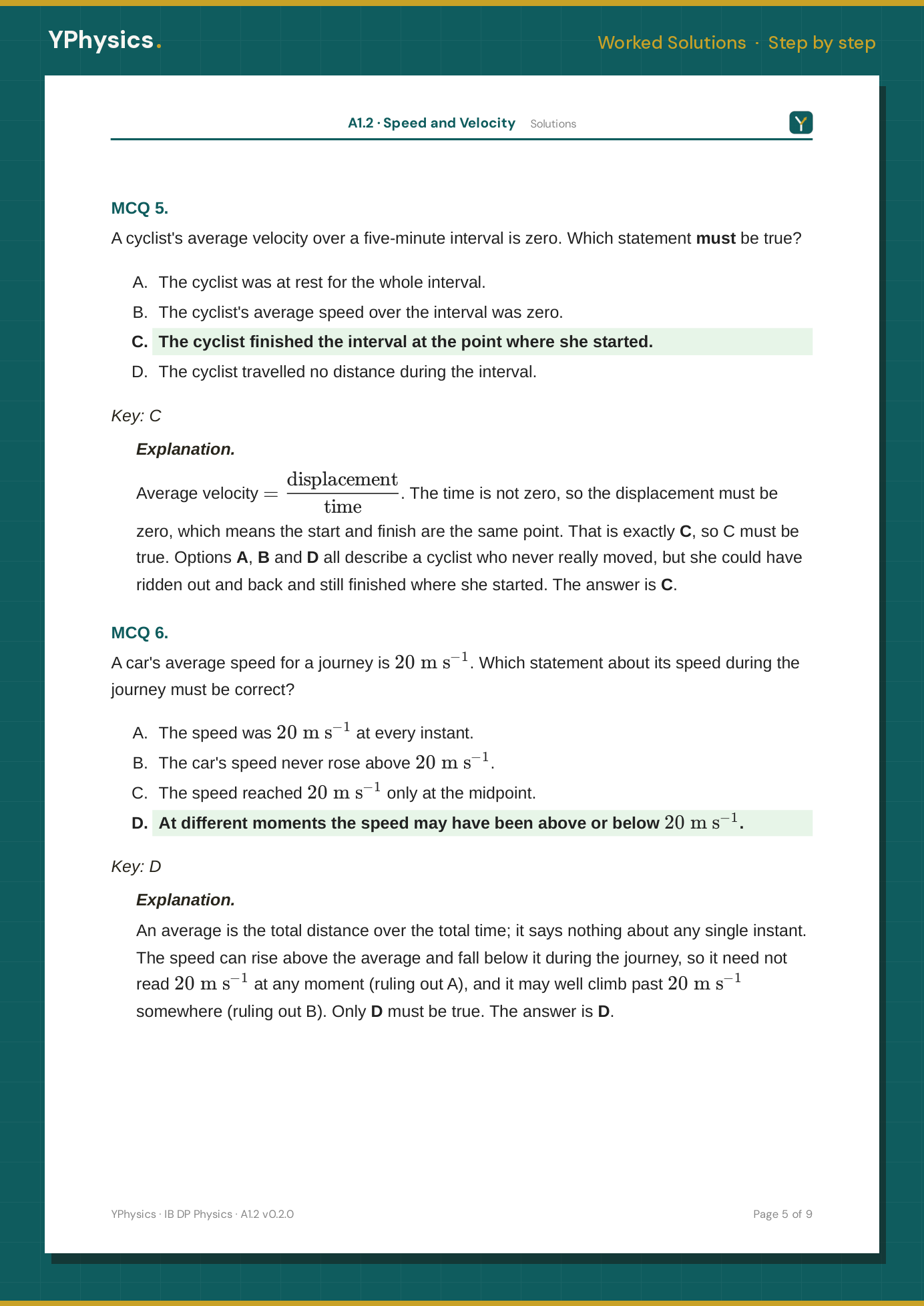
- Five explained multiple-choice questions, and exam practice with a straight-track rover run that punishes the average-of-the-leg-speeds shortcut, and a two-leg drone flight.
IB skills (Tool 3: Mathematics):
- Determine rates of change, the “how much per second?” idea (taught).
- Identify quantities as scalars or vectors (practised).
- Convert km h⁻¹ to m s⁻¹ in a “show that” step (practised).
- Add two perpendicular displacement vectors by Pythagoras (practised).
What’s included:
- Student Worksheet - 10 pages
- Teacher Key - 13 pages
- Worked Solutions - 9 pages
- Assessment - 8 pages
- Lesson deck - 28 slides
Acceleration and motion graphs are left to the follow-on packs. Worksheet and deck open in any modern browser with nothing to install, and the worksheet is fully editable. SI units, IB notation and IB command terms throughout. Suitable for grades 11-12 (ages 16-19) as a lesson, cover lesson, homework or revision.
Related resources:
- Foundations of Motion: Distance and Displacement, the pack before this one (free)
- Acceleration and Non-Uniform Motion, the pack that follows
- Graphical Analysis of Motion, where these quantities become gradients
Updated 14 Oct 2026: reprint unless yours is v0.1.3+, 24 Aug 2026.
A rating helps other teachers find this.
Something went wrong, please try again later.
This resource hasn't been reviewed yet
To ensure quality for our reviews, only customers who have purchased this resource can review it
Report this resourceto let us know if it violates our terms and conditions.
Our customer service team will review your report and will be in touch.
£9.00