pptx, 783.48 KB
pptx, 783.48 KB

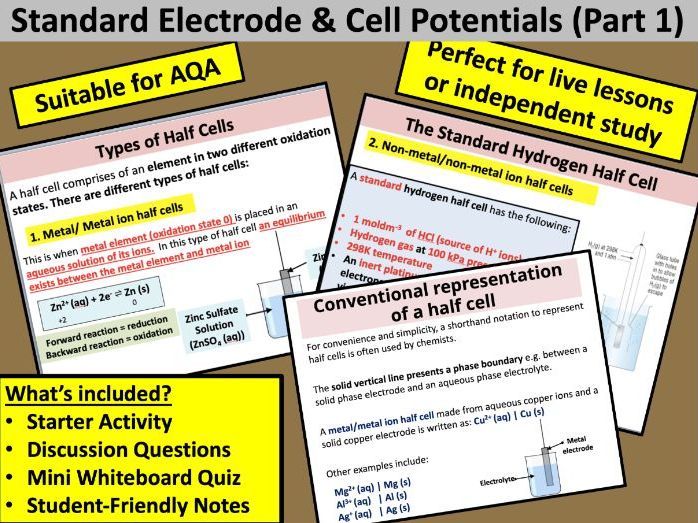
A structured KS5 lesson including starter activity and AfL work tasks with answers included on Standard Electrode & Cell Potentials (Part 1 of 2). Suitable for the AQA Specification.

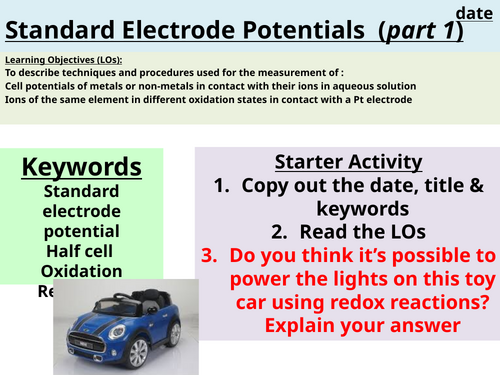
By the end of this lesson KS5 students should be able:

**To describe techniques and procedures used for the measurement of :

**i) Cell potentials of metals or non-metals in contact with their ions in aqueous solution
**ii) Ions of the same element in different oxidation states in contact with a Pt electrode

The teacher will be able to check students have met these learning objectives through mini AfL tasks for students to complete

If you are teaching the OCR Specification, please purchase this lesson instead:

https://www.tes.com/teaching-resource/resource-12244684

Declaimer: Please refrain from purchasing this popular resource for an interview lesson or a formal observation. This is because planning your own lessons, including using your own lesson PowerPoints, is a fundamental skill of a qualified/unqualified teacher that will be assessed during the scenarios outlined above

Get this resource as part of a bundle and save up to 10%

A bundle is a package of resources grouped together to teach a particular topic, or a series of lessons, in one place.

Bundle

Electrode Potentials and Electrochemical Cells (AQA)

4 Full Lesson Bundle which covers the AQA A Level Chapter on Electrode Potentials and Electrochemical Cells **Learning Objectives:** **Lesson 1: Standard Electrode & Cell Potentials (Part 1)** LO1: To describe techniques and procedures used for the measurement of : i) Cell potentials of metals or non-metals in contact with their ions in aqueous solution ii) Ions of the same element in different oxidation states in contact with a Pt electrode **Lesson 2: Standard Electrode & Cell Potentials (Part 2)** LO1: To use the term standard electrode potential E⦵ including its measurement using a hydrogen electrode LO2: To construct conventional representations of electrochemical cells LO3: To calculate a standard cell potential (EMF) by combining two standard electrode potentials LO4: To predict the feasibility of electrode potentials to modern storage cells **Lesson 3: Limitations of Cell Potentials** LO1. To understand the limitations of predicting the feasibility of a reaction using cell potentials due to kinetics and non-standard conditions LO2. To explain why electrochemical cells may not work based on the limitations of using cell potentials **Lesson 4: Storage & Fuel Cells** LO1: To understand the application of the principles of electrode potentials to modern storage cells LO2: To explain that a fuel cell uses the energy from a reaction of a fuel with oxygen to produce a voltage LO3: To derive the reactions that take place at each electrode in a hydrogen fuel cell The teacher will be able to check students have met these learning objectives through starter activities, discussion questions, mini AfL tasks and practice questions for students to complete **Declaimer: Please refrain from purchasing this popular resource for an interview lesson or a formal observation. This is because planning your own lessons, including using your own lesson PowerPoints, is a fundamental skill of a qualified/unqualified teacher that will be assessed during the scenarios outlined above**

£24.64

Reviews

Something went wrong, please try again later.

This resource hasn't been reviewed yet

To ensure quality for our reviews, only customers who have purchased this resource can review it

Report this resourceto let us know if it violates our terms and conditions.
Our customer service team will review your report and will be in touch.