


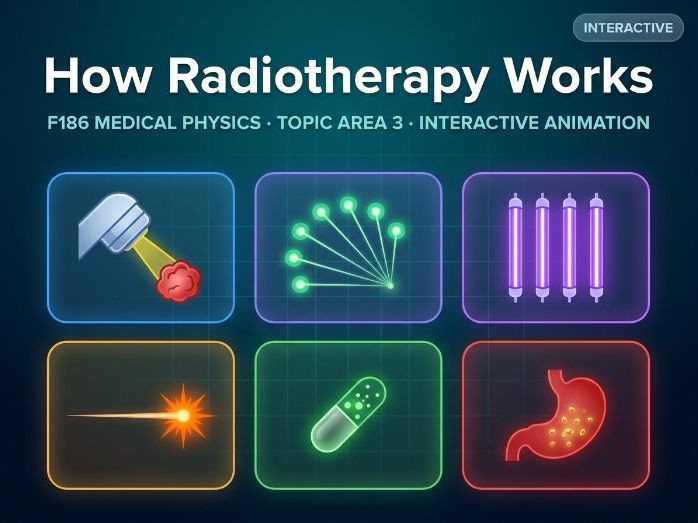

A complete, interactive animation covering OCR Cambridge Advanced National in Applied Science (H151) Unit F186 Medical Physics – Topic Area 3: Application of ionising therapy techniques (spec 3.1–3.2).
Designed for Level 3 learners who benefit from clear visuals and scaffolding. Teach straight from the board, or set it for independent revision.
▶ Watch the 2-minute preview above.
WHAT’S COVERED (34 step-through scenes)
3.1 External source –
• X-ray radiotherapy: how radiation kills cancer cells; the linac and multileaf collimator; crossfire beams; fractionation; safety and professionals
• Gamma Knife: cobalt-60 beams meeting at one target; uses, contraindications and latency
• UV skin treatment: where UV sits on the ionising boundary; penetration; psoriasis, eczema and vitiligo; safety
• Proton beam therapy: the cyclotron and the Bragg peak; penetration and energy compared with X-rays and gamma; who it suits
3.2 Internal source –
• Radionuclide therapy: iodine-131 and the thyroid; SIRT with yttrium-90; contact restrictions and safety
• Brachytherapy: LDR seeds and HDR afterloading; the inverse square law; choosing internal vs external therapy; safety and professionals
INTERACTIVE FEATURES
• Crossfire – add beams and watch the tumour dose build while sparing the spinal cord
• Fractionation – healthy cells repair between doses, cancer cells don’t
• Depth–dose graph – drag the tumour depth and compare X-ray, gamma and proton curves
• Inverse square law slider
• Choose-the-therapy patient activity (seven patients)
• Quick-check quiz for every technique (click to answer, instant feedback)
• Pop-up glossary – click any key word
• Advantages and disadvantages for every technique
• End-of-topic comparison table and recap with further-reading links
HOW TO USE
One HTML file – double-click to open in any modern browser (Chrome, Edge, Firefox, Safari). Works fully offline: no installs, no logins, no internet needed. Full-screen button, keyboard and presenter-clicker control (→ / ← / space), replay and pause on every animation, and a menu to jump to any scene.
Spec-mapped to help learners gather the knowledge they need for NEA Task 2 (therapy).
Independent resource – not endorsed by OCR.
All F186 animations:
F186 Topic Area 1: https://www.tes.com/teaching-resource/resource-13653316
F186 Topic Area 2 (FREE): https://www.tes.com/teaching-resource/resource-13653334
F186 Topic Area 3: https://www.tes.com/teaching-resource/resource-13653339
F186 Topic Area 4: https://www.tes.com/teaching-resource/resource-13653344
BUNDLE: https://www.tes.com/teaching-resource/resource-13653376
Get this resource as part of a bundle and save up to 35%
A bundle is a package of resources grouped together to teach a particular topic, or a series of lessons, in one place.
Bundle
OCR AAQ Applied Science F186 Medical Physics: Complete Lesson Bundle
Everything you need to teach Unit F186 Medical Physics for the OCR Level 3 Cambridge Advanced National in Applied Science (H151). This bundle contains five PowerPoints, one for each topic area in the specification. They were written by a Head of Science who teaches this unit, for classes that benefit from scaffolding, real-world context and clear step-by-step explanations. . **What’s included** * Topic 1: Application of NON-IONISING DIAGNOSIS techniques * Topic 2: Application of IONISING DIAGNOSIS techniques * Topic 3: Application of IONISING THERAPY techniques * Topic 4: Application of NON-IONISING THERAPY techniques * Topic 5: PLANNING for diagnosis and therapy . Each PowerPoint includes . Learning objectives and the matching specification points A starter activity Clear, animated explanations of the content Advantages and disadvantages tables Sample patient case studies Summary and recall questions Homework tasks and further resources, with clickable links Teacher notes on the activity slides . Why buy the bundle? . It covers all five topic areas, so you can plan the whole unit around it. Every topic uses the same layout, which makes lessons easy to follow for students and easy to deliver for you. It is 16:9 PowerPoint, so you can adapt it for your own class. . **Also included: interactive animations** Teach the key ideas visually with my F186 Medical Physics interactive animations. Each one is a standalone file that runs in your browser. It needs no installation or internet connection, and it works on any classroom laptop/computer (not iPad). . * F186 Medical Physics Topic Area 1 Interactive Animation * F186 Medical Physics Topic Area 2 Interactive Animation * F186 Medical Physics Topic Area 3 Interactive Animation * F186 Medical Physics Topic Area 4 Interactive Animation . FREE tasters: https://www.tes.com/teaching-resource/resource-13478585 https://www.tes.com/teaching-resource/resource-13653334 Please note that this resource is not affiliated with or endorsed by OCR. It was written for the Level 3 AAQ Applied Science specification. More Applied Science and GCSE Science resources are available in Dr Dan’s TES shop. . Tags: OCR AAQ, Applied Science, F186, Medical Physics, H151, Cambridge Advanced Nationals, Level 3, Radiotherapy, Diagnostic Imaging, Ultrasound
£24.99
Bundle
F186 Medical Physics Interactive Animations Topic Areas 1–4
Teach the whole of OCR Cambridge Advanced National in Applied Science (H151) Unit F186 Medical Physics, Topic Areas 1–4, with four interactive animations – 128 step-through scenes covering every diagnosis and therapy technique in the specification. Designed for Level 3 learners who benefit from clear visuals and scaffolding. Teach straight from the board, or set them for independent revision and NEA preparation. WHAT'S IN THE BUNDLE 1. Topic Area 1 – Non-ionising diagnosis (35 scenes) MRI · Ultrasound · Endoscopy · ECG Interactives: ultrasound frequency and gain sliders, echo-timing calculator, choose-the-endoscopy patient activity, ECG heart-rate calculator, ECG rhythm switcher (AF, heart block, VT, VF, heart attack) 2. Topic Area 2 – Ionising diagnosis (32 scenes) Plain X-ray · CT and contrast media · Radiopharmaceuticals and the gamma camera · PET Interactives: X-ray kVp/mA/exposure-time simulator, gamma camera building an image, PET annihilation locating a tumour, choose-a-tracer patient activity 3. Topic Area 3 – Ionising therapy (34 scenes) X-ray radiotherapy · Gamma Knife · UV skin treatment · Proton beam · Radionuclide therapy · Brachytherapy Interactives: crossfire beams, fractionation, depth–dose graph (X-ray vs gamma vs proton), inverse square law slider, choose-the-therapy patient activity 4. Topic Area 4 – Non-ionising therapy (27 scenes) Lasers · Photodynamic therapy · Pacemakers and ICDs · Ultrasound therapies Interactives: laser wavelength chooser, photon energy simulator, demand pacing on a live ECG monitor, ICD shock simulation, ultrasound therapy dial (HIFU, LIPUS, lithotripsy, hyperthermia) IN EVERY FILE • How each technique works – animated step by step • Uses, safety, professionals involved, advantages and disadvantages for every technique • Quick-check quiz for every technique (click to answer, instant feedback) • Pop-up glossary – click any key word • End-of-topic comparison table and recap with further-reading links • Full-screen mode, presenter-clicker and keyboard control, replay and pause, jump-to-scene menu HOW TO USE Four single HTML files – double-click to open in any modern browser (Chrome, Edge, Firefox, Safari). Works fully offline: no installs, no logins, no internet needed. Best on laptops, desktops and classroom boards. Topic Areas 1–2 support NEA Task 1 (diagnosis); Topic Areas 3–4 support NEA Task 2 (therapy). Want to try before you buy? Topic Area 2 is available FREE in my shop. Independent resource – not endorsed by OCR.
£18.00
Something went wrong, please try again later.
This resource hasn't been reviewed yet
To ensure quality for our reviews, only customers who have purchased this resource can review it
Report this resourceto let us know if it violates our terms and conditions.
Our customer service team will review your report and will be in touch.
£7.50