Sequences Bundle | I Do, We Do, You Do | Year 8 Maths | Print Free
Resource Bundle



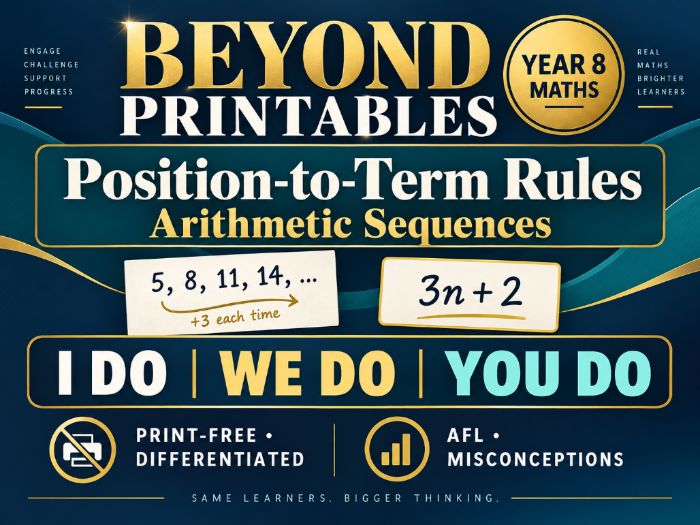
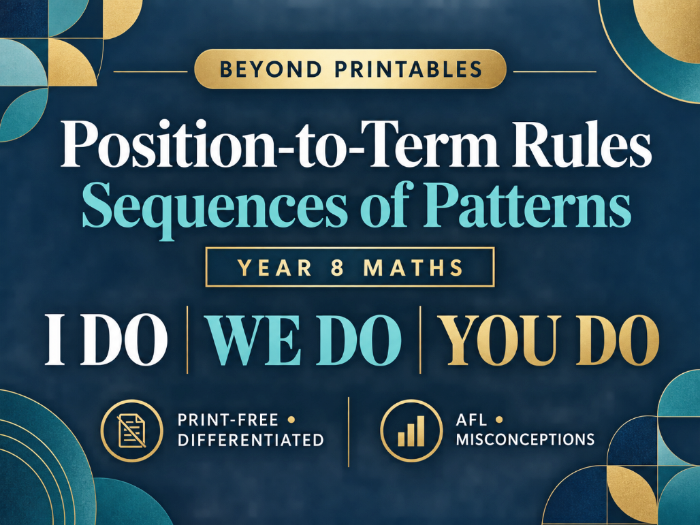
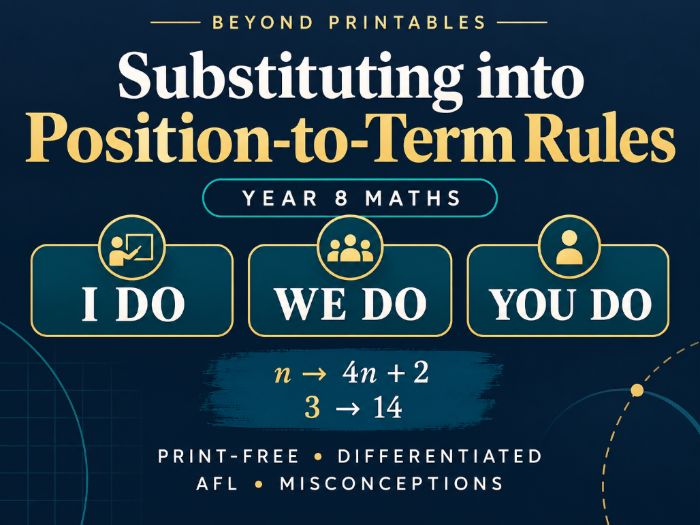
Editable Beyond Printables Year 8 maths PowerPoints. Project modelling, practice and answers; pupils can work in exercise books. The exact TES titles and resource numbers identify every included lesson.
EXACT LESSONS INCLUDED
(1) M381 — Term-to-term Rules for Numerical Sequences | I Do, We Do, You Do | Year 8 Maths print-free LESSON [TES 13574676]
(2) M241 — Term-to-term Rules for Pattern Sequences | I Do, We Do, You Do | Year 8 Maths print-free LESSON [TES 13574637]
(3) M166 — Substituting into Position-to-Term Rules | I Do, We Do, You Do | Year 8 Maths print-free LESSON [TES 13574678]
(4) M991 — Position-to-Term Rules for Arithmetic Sequences | I Do, We Do, You Do | Year 8 Maths print-free LESS [TES 13575085]
(5) M866 — Position-to-Term Rules for Sequences of Patterns | I Do, We Do, You Do | Year 8 Maths print-free LES [TES 13575081]
Each lesson includes retrieval or prerequisite work, modelling, assessment checks, practice and differentiated questions with answers.
Choose Developing, Secure or Greater Depth tasks for the class. Super Challenge questions extend reasoning within the topic.
The presentations are editable. Keep questions with their matching answers when adapting the lesson for a particular class.
The bundles overlap: lessons also occur in the relevant subject collection and complete Year 8 collection. Check the list before buying twice.
Use the presentations in sequence or select a lesson for targeted KS3 revision. Allow pupils time to explain their methods and check their answers.
Print free means worksheets are not required; pupils may need exercise books, squared paper or geometry equipment for particular tasks.
These are original Beyond Printables teaching resources; they are not official Sparx products or access to the Sparx platform.
The lesson files are separate PowerPoints, so a teacher can locate and reopen a single topic without working through the whole bundle.
Teachers can pause on a modelled example, invite a pupil explanation, then reveal and discuss the worked answer before continuing. The guided examples support this classroom routine.
The independent questions are intended for written working, not just a final answer. Pupils can compare a calculation, diagram or explanation with the displayed answer and correct it.
A teacher can start a lesson with retrieval, use the checks on mini-whiteboards and direct pupils to practice suited to their current understanding. The presentation can be revisited later.
For a revision lesson, select a short run of examples and practice rather than presenting every slide. For first teaching, allow more time for discussion and checking misconceptions.
Where a question asks for reasoning, encourage pupils to state why the method applies. Comparing two plausible approaches can expose an error before pupils move to a new example.
The sequence can be taught over several lessons or used as a topic bank. Select the next presentation after checking what pupils already know.
Something went wrong, please try again later.
This resource hasn't been reviewed yet
To ensure quality for our reviews, only customers who have purchased this resource can review it
Report this resourceto let us know if it violates our terms and conditions.
Our customer service team will review your report and will be in touch.