


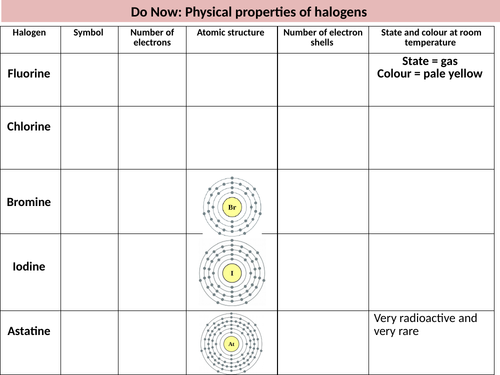
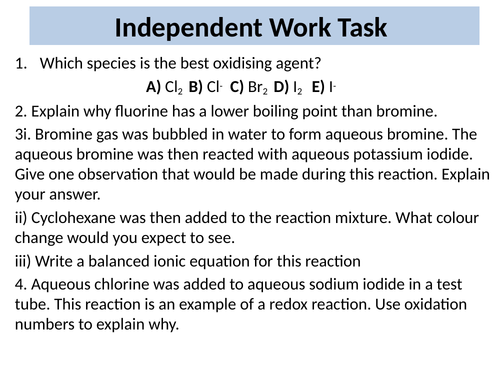
A structured theory lesson including starter activity, AfL work tasks and main work tasks all with answers on The Halogens: Physical Properties and Trends in Reactivity
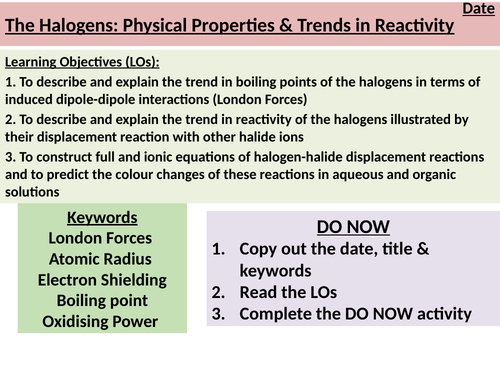
By the end of this lesson KS5 students should be able to:
- To describe and explain the trend in boiling points of the halogens in terms of induced dipole-dipole interactions (London Forces)
- To describe and explain the trend in reactivity of the halogens illustrated by their displacement reaction with other halide ions
- To construct full and ionic equations of halogen-halide displacement reactions and to predict the colour changes of these reactions in aqueous and organic solutions
All tasks have worked out answers, which will allow students to self assess their work during the lesson.
Declaimer: Please refrain from purchasing this popular resource for an interview lesson or a formal observation. This is because planning your own lessons including using your own lesson PowerPoints is a fundamental skill of a qualified/unqualified teacher that will be reviewed during these scenarios outlined above
Get this resource as part of a bundle and save up to 21%
A bundle is a package of resources grouped together to teach a particular topic, or a series of lessons, in one place.
Bundle
Inorganic Chemistry and The Periodic Table
A 7 full lesson bundle covering the Edexcel AS Level Chemistry Chapter: **Inorganic Chemistry and The Periodic Table.** Suitable for the Edexcel Specification. **Lesson 1: Group 2 Elements and Compounds** 1. To state and explain the trend in first and second ionisation energies of group 2 elements and how this links to their reactivities 2. To construct equations for the redox reactions of the elements Mg to Ba in Group 2 with oxygen, chlorine and water 3. To construct equations for the reactions of the oxides of Group 2 elements with water and dilute acid, and their hydroxides with dilute acid 4. To know the trends in solubility of the hydroxides and sulfates of Group 2 elements **Lesson 2: Thermal Stability of Nitrates and Carbonates** 1. To understand the term thermal stability 2. To recall the trend in thermal stability in group 1 and 2 nitrates and carbonates 3. To explain the trend in thermal stability in terms of the size and charge of the cations involved **Lesson 3: Flame Tests of Group 1 and 2 Compounds** 1. To describe how to carry out a flame test 2. To recall the flame colours of group 1 and 2 cations during a flame test 3. To understand the formation of flame colours are due to electron transitions **Lesson 4: The Halogens: Properties and Reactivity** 1. To describe and explain the trend in boiling points of the halogens in terms of induced dipole-dipole interactions (London Forces) 2. To describe and explain the trend in reactivity of the halogens illustrated by their displacement reaction with other halide ions 3. To construct full and ionic equations of halogen-halide displacement reactions and to predict the colour changes of these reactions in aqueous and organic solutions **Lesson 5: Disproportionation Reactions** 1. To explain the term disproportionation 2. To explain how the reaction of chlorine with water, cold dilute sodium hydroxide and hot alkali are examples of disproportionation reactions 3. To review analogous disproportionation reactions **Lesson 6: Reactions of Halide Ions** 1. To state and explain the trend in reducing ability of halides ions 2. To describe experiments that illustrate the evidence of the trend in reducing ability of group 1 halides using concentrated sulfuric acid 3. To describe experiments to identify metal halides using silver ions 4. To describe the reaction of hydrogen halides with water and ammonia **Lesson 7: Testing for Anions and Cations** 1. To recall the reactions, including ionic equations for identifying carbonate ions, CO32-, hydrogencarbonate ions, HCO3– and sulfate ions, SO42- 2. To recall the reactions, including ionic equations for identifying ammonium ions, NH4+ 3. To review the reactions, including ionic equations where applicable, to test for halide ions and for Group 1 and 2 metals
£47.97
Bundle
The Periodic Table (OCR)
9 Full Lesson Bundle covering **Module 3.1 - The Periodic Table** from OCR A Level Chemistry A specification. Please review the learning objectives below Lesson 1: The Structure of The Periodic Table 1. To know how the periodic table is arranged 2. To describe the periodic trend in electron configurations across periods 2 and 3 3. To classify elements into s, p and d blocks Lesson 2: AS Chemistry: Ionisation Energy (Part 1) 1. To define the term ‘first ionisation energy’ and successive ionisation energies 2. To describe the factors affecting ionisation energy 3. To explain the trend in successive ionisation energies of an element Lesson 3: AS Chemistry: Ionisation Energy (Part 2) 1. To explain the trend in first ionisation energies down a group 2. To explain the trend in first ionisation energies across period 2 3. To explain the trend in first ionisation energies across period 3 Lesson 4: Periodicity: Melting Points 1. To describe the trend in structure from giant metallic to giant covalent to simple molecular lattice 2. To explain the variation in melting points across period 2 & 3 in terms of structure and bonding Lesson 5: AS Chemistry: Group 2 Elements 1. To know group 2 elements lose their outer shell s2 electrons to form +2 ions 2. To state and explain the trend in first and second ionisation energies of group 2 elements and how this links to their relative reactivities with oxygen, water and dilute acids 3. To onstruct half equations of redox reactions of group 2 elements with oxygen, water and dilute acids and to identify what species have been oxidised and reduced using oxidation numbers Lesson 6: AS Chemistry: Group 2 Compounds 1. To know the reaction between group 2 metal oxides and water 2. To state the trend in solubility and alkalinity of group 2 metal hydroxides 3. To describe the uses of some group 2 compounds including their equations Lesson 7: The Halogens: Properties & Reactivity 1. To describe and explain the trend in boiling points of the halogens in terms of induced dipole-dipole interactions (London Forces) 2. To describe and explain the trend in reactivity of the halogens illustrated by their displacement reaction with other halide ions 3. To construct full and ionic equations of halogen-halide displacement reactions and to predict the colour changes of these reactions in aqueous and organic solutions Lesson 8: Disproportionation & The Uses of Chlorine 1. To explain the term disproportionation 2. To explain how the reaction of chlorine with water or cold dilute sodium hydroxide are examples of disproportionation reactions 3. To evaluate the uses of chlorine (How Science Works) Lesson 9: Qualitative Analysis 1. To carry out test tube reactions and record observations to determine the presence of the following anions : CO32- SO42- , Cl-, Br-, and I- 2. To carry out test tube reactions and record observations to determine the presence of the following cations: NH4+, Fe2+, Fe3+, Mn2+ and Cu2+ 3. To construct ionic equations to explain the qualitative analysis tests of cations and anions ***Declaimer: Please refrain from purchasing this popular resource for an interview lesson or a formal observation. This is because planning your own lessons including using your own lesson PowerPoints is a fundamental skill of a qualified/unqualified teacher that will be reviewed during these scenarios outlined above***
£54.07
Something went wrong, please try again later.
This resource hasn't been reviewed yet
To ensure quality for our reviews, only customers who have purchased this resource can review it
Report this resourceto let us know if it violates our terms and conditions.
Our customer service team will review your report and will be in touch.
£7.97