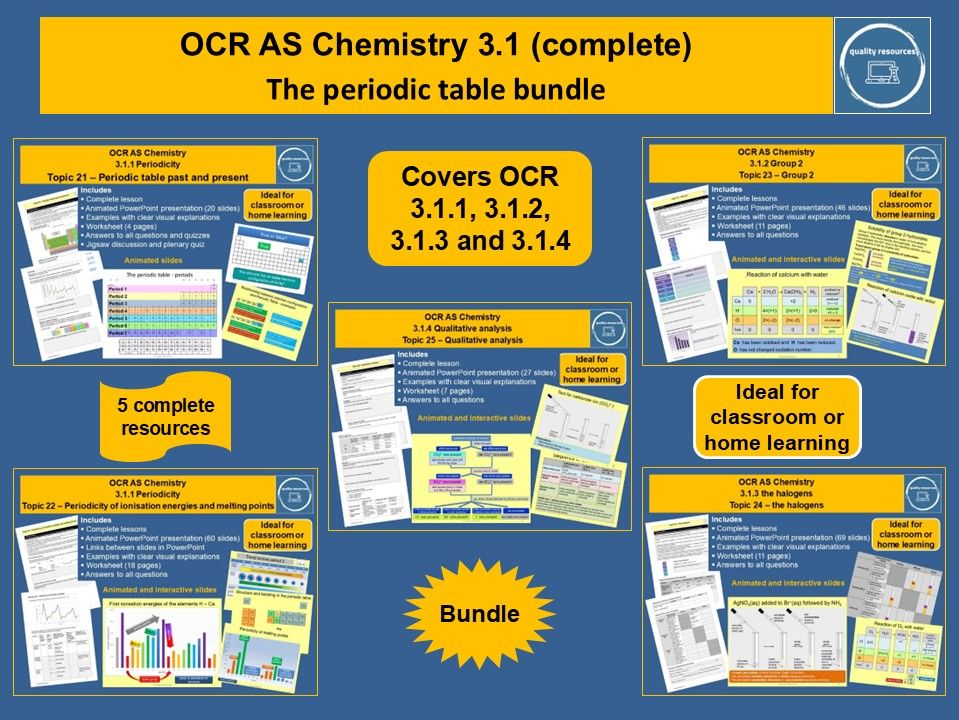
The periodic table bundle OCR AS Chemistry
Resource Bundle



Note re-numbering - if you have already paid for this resource you can download it again to get the updated version without further payment.
My resources now cover the whole of OCR AS Chemistry.
Each download includes a list of all available lessons and bundles.
This bundle covers all of the OCR A level chemistry specification section 3.1 (the periodic table).
The resources included are
• Periodic table past and present
• Periodicity of ionisation energies and melting points
• Group 2
• The halogens
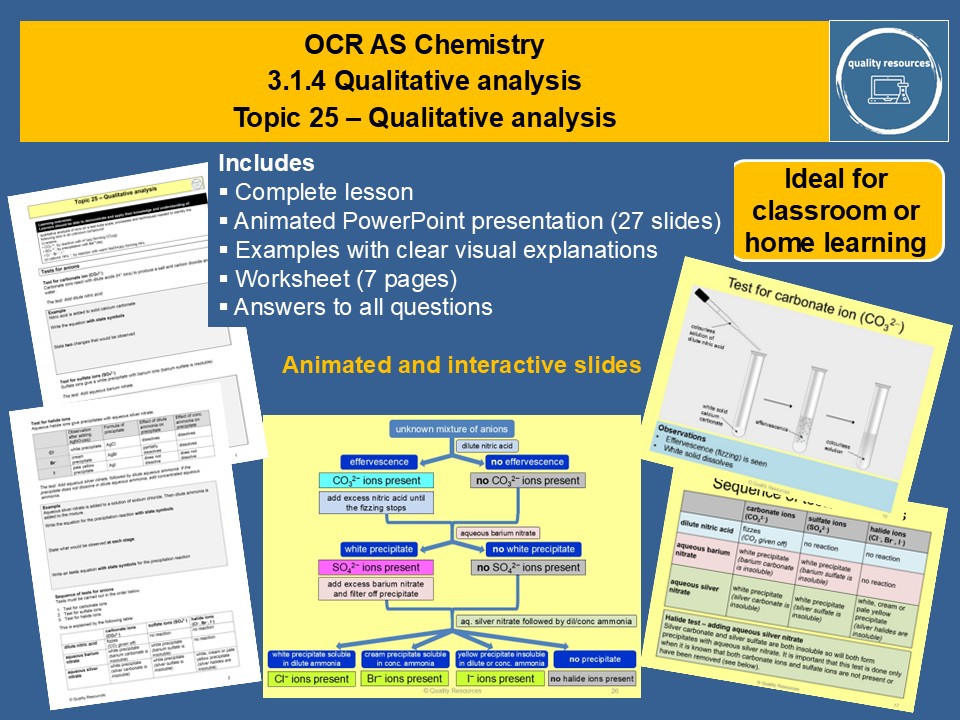
• Qualitative analysis
Each topic includes a fully interactive PowerPoint including starter, group activities, questions and plenary along with a worksheet. Answers to all exercises are provided. Some of the resources include a PowerPoint quiz and all are ideal for classroom or home learning.
This bundle is part of a series covering the OCR AS Chemistry specification and relates to the following sections:
Module 3 – The Periodic table and energy
Part 1 –The Periodic Table
3.1.1 Periodicity
3.1.2 Group 2
3.1.3 The halogens
3.1.4 Qualitative analysis
Please review!
Content covered:
Periodic table past and present
• The history of the periodic table, including Newlands’ and Mendeleev’s contributions
• The structure of the modern periodic table – periods, groups and blocks
• Relationship between electron configuration and the periodic table
• Periodicity – the variation in properties when plotted against atomic number
• Periodicity and metallic character
• Metal and non-metals
Periodicity of ionisation energies and melting points
• First ionisation energy – definition
• Factors affecting ionisation energies: nuclear charge, atomic radius and shielding
• Explanation of shielding
• Successive ionisation energies
• Predicting group from successive ionisation energies
• Periodicity of first ionisation energies
• Trends across a period and down a group
• Explanations of small decreases from group 2 to group 3 and from group 5 to group 6
• Periodicity of structure of elements: giant metallic, giant covalent and simple molecular structures
• Periodicity of melting points and explanation in terms of structure.
Group 2
• Structure and physical properties of group 2 elements
• Electron configuration and formation of ions
• First ionisation enthalpy and reactivity
• Redox reactions of group 2 metals with oxygen, water and acids
• Properties of group 2 compounds
• Group 2 oxides and hydroxides – reactions with acids
• Group 2 oxides – reaction with water
• Solubility and alkalinity of group 2 hydroxides
• Reactions of group 2 carbonates with acid
• Uses of group 2 compounds
The halogens
• Structure and physical properties of group 17 elements
• Electron configuration and formation of ions
• Redox reactions of halogens
• Reactivity of halogens
• Displacement reactions
• Disproportionation reactions of the halogens, including production of bleach
• Benefits and hazards of treating drinking water with chlorine
• Precipitation reactions of aqueous halide ions with aqueous silver nitrate
• Use of silver nitrate as a test for aqueous halide ions
Qualitative analysis
• Precipitation and acid-base reactions
• Tests for carbon dioxide and ammonia
• Tests for anions including carbonate, sulfate, chloride, bromide and iodide ions
• Sequence of tests for anions, with reasons
• Analysing mixtures of anions
• Tests for cations – ammonium ion
Links
Next lesson: Topic 26 – Introduction to enthalpy changes
https://www.tes.com/teaching-resource/enthalpy-changes-ocr-as-chemistry-12509439
Next medium bundle: Physical chemistry - enthalpy, rate and equilibrium bundle
https://www.tes.com/teaching-resource/physical-chemistry-enthalpy-rate-and-equilibrium-13214222
Something went wrong, please try again later.
This resource hasn't been reviewed yet
To ensure quality for our reviews, only customers who have purchased this resource can review it
Report this resourceto let us know if it violates our terms and conditions.
Our customer service team will review your report and will be in touch.