


Changing Materials – Full Unit Summary (Lessons 1–8)
A complete, practical, experiment‑rich science unit for Year 5
This resource provides a fully planned and sequenced 8‑lesson unit on Changing Materials, designed for Year 5 and packed with hands‑on investigations, clear explanations, assessment opportunities, and child‑friendly scientific vocabulary. Every lesson includes practical activities, differentiated tasks, safety guidance, and ready‑to‑use worksheets/slides.
Lesson 1 — Testing Material Properties
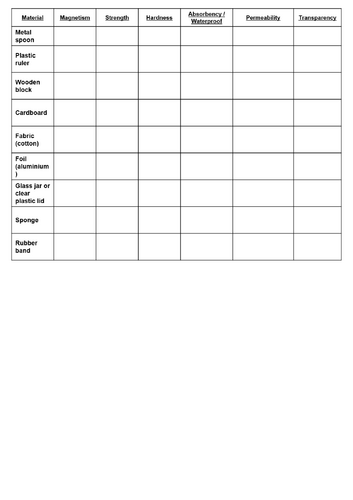
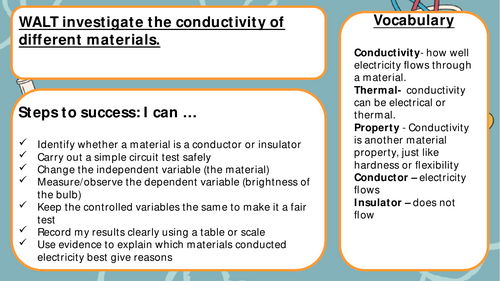
Children explore the physical properties of everyday materials through a carousel of hands‑on stations. They test hardness, strength, flexibility, permeability, transparency, absorbency, and magnetism, using a simple 1–5 ranking system. This lesson builds strong foundational vocabulary and gives pupils real experience handling and comparing materials.
Lesson 2 — Mixing & Separating Materials
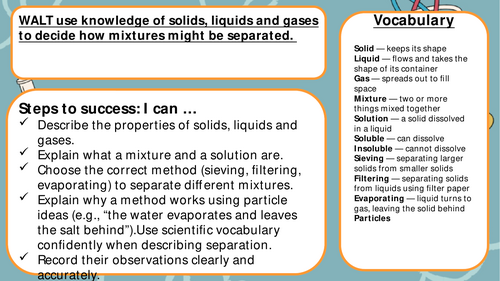
Pupils investigate how materials behave when mixed and learn how mixtures can be separated using filtering, sieving, and magnetism. They compare mixtures vs solutions and begin to understand reversible processes.
Lesson 3 — Dissolving & Solutions
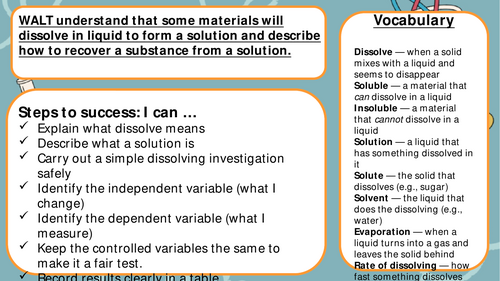
Children explore dissolving using common classroom materials (salt, sugar, sand). They learn the terms solute, solvent, and solution, and test which materials dissolve in water. They also investigate how dissolved materials can be recovered through evaporation, reinforcing reversible change.
Lesson 4 — Reversible Changes
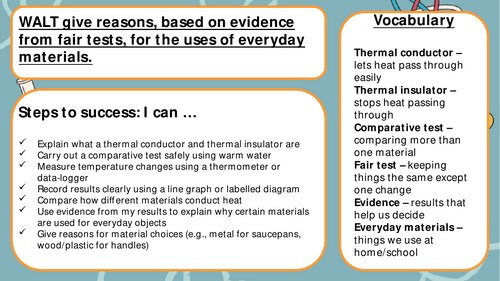
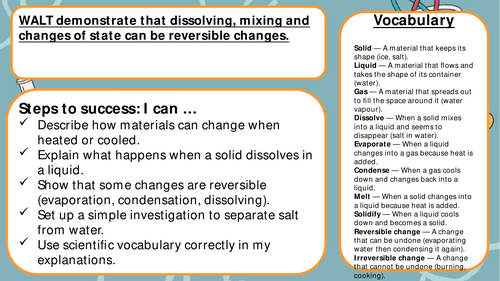
This lesson focuses on changes that do not create new materials. Pupils examine melting, freezing, evaporating, condensing, and dissolving. They apply scientific vocabulary and classify examples using sorting tasks and practical demonstrations.
Lesson 5 — Irreversible Changes
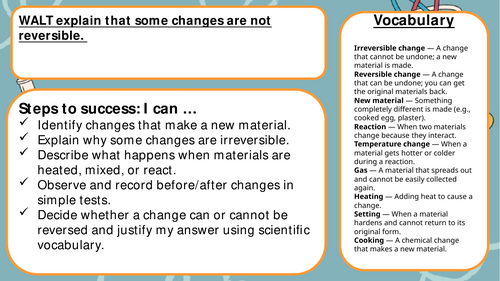
Children learn that some changes create new materials and cannot be undone. Through teacher‑led demonstrations (cooking, rusting, burning small samples), pupils compare reversible vs irreversible changes and deepen their understanding of chemical change.
Lesson 6 — Burning & New Materials
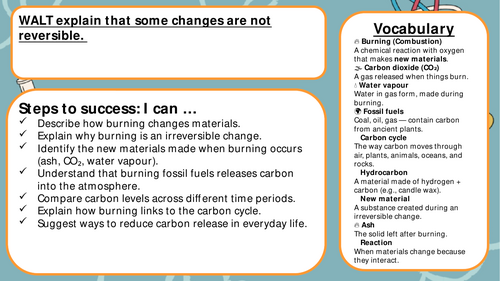
A structured, safe investigation using tea‑lights allows pupils to observe how burning changes materials. They test small samples (paper, pasta, wool, crackers, etc.) and record how each material burns, what new materials form, and why burning is always irreversible.
Lesson 7 — Carbon Cycle & Environmental Impact
Pupils learn how burning releases carbon dioxide and how carbon moves through the carbon cycle. They explore the link between burning materials, fossil fuels, and climate change through diagrams, models, and simple CO₂ demonstrations.
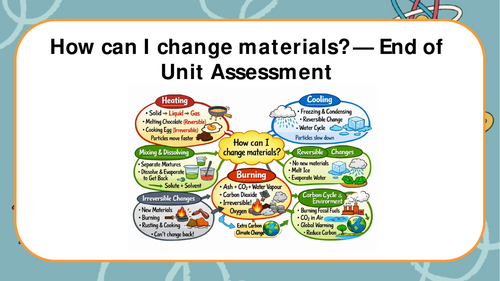
Lesson 8 — End‑of‑Unit Assessment (Mind Map)
Instead of a test, pupils complete an accessible, inclusive mind map answering the Big Question:
“How can I change materials?”
This allows all learners to demonstrate understanding through vocabulary, diagrams, examples, and explanations. Expected and Greater Depth exemplars are included.
Something went wrong, please try again later.
This resource hasn't been reviewed yet
To ensure quality for our reviews, only customers who have purchased this resource can review it
Report this resourceto let us know if it violates our terms and conditions.
Our customer service team will review your report and will be in touch.
£6.00