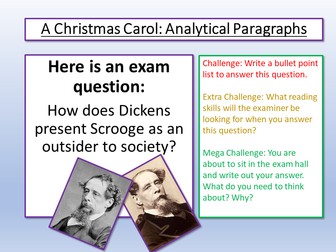
Ideal for both KS3 and KS4 students, this fully resourced and differentiated lessons looks at the way Dickens presents Scrooge as an outsider and supports students in writing notes on the whole novella around a central theme. A great lesson for Y7 right the way through to Y11 and easily adaptable. Recently revamped and includes both models and scaffolds for writing analytical paragraphs around A Christmas Carol.
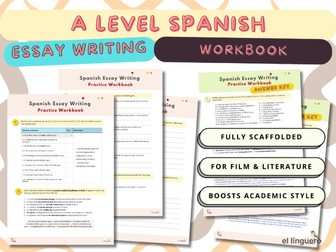
This A Level Spanish Essay Writing Workbook provides structured practice to help students develop the academic written style required for A Level Spanish essays (film and literature).
This resource is intended to be used alongside A Level Spanish Essay Writing Sentence Builders (https://www.tes.com/teaching-resource/resource-13355734), which provides the sentence starters and analytical structures needed to complete the tasks confidently.
Students often learn sophisticated vocabulary and sentence starters but struggle to apply them accurately and consistently in their own writing.
This workbook offers graduated tasks that take students from recognition to confident production.
What’s included (exercise by exercise):
Match the function - Students match analytical sentence starters to their purpose (e.g. introducing an idea, contrasting, concluding, supporting with evidence).
Replace the weak analysis - Students are given basic analytical sentences where a weak phrase is highlighted. They replace it using a stronger academic structure from the list provided. (Examples from Volver and La Casa de Bernarda Alba).
Translation practice (Spanish to English) - Students translate essay-style sentences into English, ensuring they fully understand how high-level structures work before using them independently. (Examples from Volver, La Casa de Bernarda Alba and Bodas de Sangre).
Upgrade the sentence - Students rewrite simple sentences using stronger academic frames from the sentence builders, improving clarity, precision and sophistication. (Examples from Volver and La Casa de Bernarda Alba).
Transform the paragraph - A short, basic paragraph is rewritten using at least three advanced structures (e.g. connectors, subjunctive, inversion, analytical phrasing). (Volver)
Justify with evidence - Students are given thematic statements and must support them using sentence starters for introducing evidence and analytical interpretation. (Volver)
FULL answer key included.
If you enjoy this resource, you’ll love the ideas I share on Instagram. Come say hi: https://www.instagram.com/ellinguero/
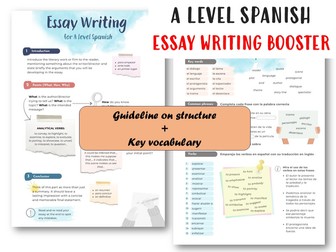
A great learning mat with a step by step guide for writing an effective paragraph that can apply to most Language style questions and Literature exam questions.
This learning mat breaks down each component of the paragraph and offers a variety of sentence openers and academic language that students can use.
A brilliant resource for differentiation of to give to students as a self-help sheet. I have these out on the tables almost every lesson!
Review and follow :-)
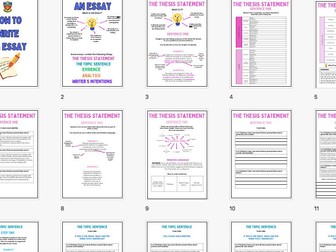
Document to help students with the structure and the language.
First page focuses on what needs to be there (in terms of the structure), and the second one focuses on the language with very simple questions (match up and fill in the gaps).
12 SAMPLE ESSAY QUESTIONS FOR GCSE MUSIC
To support students with their long answer questions in the GCSE Music exam, here are 12 Practice Questions.
The PPT is self-contained, and can be sent to students who are revising, or working remotely.
All four Areas of Study from the Eduqas specification are covered, three times - 12 Questions in total - with a wide variety of music, and mood/emotions for students to link them to.
Q1–4: four 4-mark essays, to be used to get students’ brains warmed up!
Q5–8: four 8-mark essays, to be used when they’re nearly ready for the full answer.
Q9–12: four 10-mark essays, to be used to practise for the real exam.
The questions include music from the likes of Michael Giacchino, Led Zeppelin, Dusty Springfield, Britten and Sondheim.
The bundle includes:
22-slide PowerPoint, with all 12 questions written out, plus reflections on all previous exam essay questions from 2018–2023.
PDF of Questions and Mark Scheme together
PDF of the Questions (each one being two sheets of A4, perfect for printing on double-sided A3 sheets)
PDF of the full and detailed Mark Scheme
Access to free audio
Please have a look at my other GCSE Music resources.
Thank you!
**How to Write a Poetry Essay – Leaving Certificate Higher Level
**
This student-friendly guide walks learners step by step through the process of writing a successful Higher Level poetry essay for the Leaving Certificate. Clear, practical, and easy to follow, it is designed to give students confidence when approaching exam questions.
**What’s included:
A step-by-step breakdown of the essay structure (introduction, body, linking, conclusion)
A simple PQE method (Point, Quote, Explain) to keep answers focused
Sentence starters and scaffolds to support weaker writers
A model paragraph with analysis of Elizabeth Bishop’s poetry
A practice task for students to try independently
A word bank of useful terms for analysis (themes, techniques, tone, linking phrases)
Dos and Don’ts to avoid common mistakes in the exam
**Why this resource works:
**Clear structure students can replicate under exam conditions
Encourages close focus on the question throughout the essay
Supports students in moving beyond summary to analysis
Provides both guidance and practice opportunities
Perfect for revision lessons, exam preparation, and independent study.
One of my most popular resources now available for less than the price of a cup of coffee!
A rough guide on writing the main body of an essay for the Edexcel iGCSE English Literature exam. Structured tasks encourage students to plan their response and provide examples of student work and AO2 demonstrations. Additional paper is needed to complete tasks.
Can be used as an independent task, cover work, homework or as a lesson/revision resource. I’ve also used it in intervention groups and essay writing clinics with great success!
An engaging, super clear 40 slide powerpoint which takes a class through the theme of ambition in ‘Macbeth’.
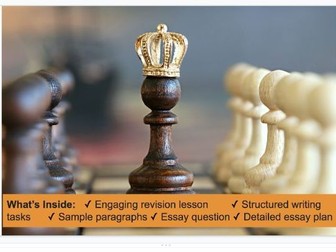
There are plenty of opportunities for short, focused activities by the students to help consolidate skills of language analysis and writing about context. The lesson finishes with an exam question, using an extract from Act 3, with a detailed plan showing how to tackle a GCSE essay.
There are sample responses and indicative content throughout.
This is suitable for the AQA exam board but can easily be adapted for other exam boards.
It has worked really well in the classroom, taking between 1-2 hours depending on how much writing you want your students to complete.
This is a concise guide with some “dos and don’ts” for critical essay writing. It tells pupils how to write an essay on common exam questions, such as turning points, and offers advice on how to structure an overall piece of critical essay writing.
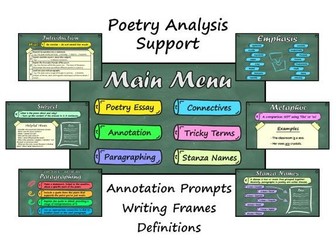
Need to write about poems? Stuck on what to say and how to say it? Not sure about how to organise an essay? This interactive Poetry Essay PowerPoint presentation helps you analyse poems and write essays about them more confidently. It features: structured paragraphing (point, evidence, explain, link); writing frames; sentence starters; annotation prompts; poetic terms simplified with examples; connectives (conjunctions); stanza names and other helpful hints. Poetry Essay PowerPoint presentation is also bundled with a printable poetry essay template.
Poetry Essay PowerPoint application is an ideal accompaniment for Key Stage 3, GCSE and A-Level English Literature; assessment writing; college essay tasks; coursework; and term paper assignments.
This PowerPoint has been adapted from Poetry Essay iOS app that used to be available to download from the App Store. Please note, when using some interactive whiteboards, it is necessary to press ‘Ctrl+A’ on your keyboard when full screen.
For more learning resources, please visit Poetry Essay’s website.
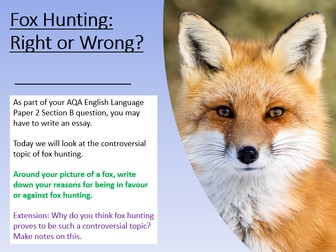
A fully differentiated and resourced set of 2 lessons that looks at the controversial topic of fox hunting. This is ideal preparation for students getting ready for AQA English Language Paper 2 and the writing section. The lesson looks at essay writing but also writing to explain. Although teachers will spend a long time looking at letters, speeches or articles, the essay often gets overlooked. Definitely worth downloading this lesson.
A collection of resources on connectives and other discourse markers and useful phrases suitable for A-level writing revision.Challenging, meant for able A-level students
This resource was made for A-Level students writing comparison essays between ‘The Great Gatsby’ and AQA pre-1900 Love Poetry. This a step by step guide with questions to ask oneself with an example.
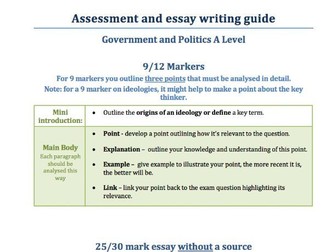
This is an essay writing guide for short and long questions for both AQA and Edexcel specifications. It also notes the difference between how to answer a source question and a normal essay
A comprehensive guide to essay writing. The toolkit contains over 50 activities to help students improve their essays, as well as a wealth of other information, ideas and links. All aspects of essay writing are covered and the material is suitable for use across Key Stages 3,4 and 5.
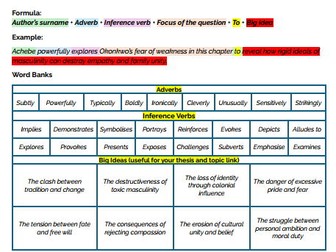
This comprehensive revision and essay-writing pack is designed to help students master analytical writing for Things Fall Apart by Chinua Achebe. It guides learners step-by-step through building high-level responses using the same structure applied in GCSE English Literature assessments.
Includes:
Thesis writing templates with model examples (WHAT + WHY)
Topic sentence builders using inference verbs and key “Big Ideas”
Quote Explosion analysis sheets for five key chapters:
Chapter 1 – Okonkwo’s fear of weakness and his father
Chapter 5 – The Feast of the New Yam
Chapter 7 – Ikemefuna’s death
Chapter 16 – The arrival of the missionaries
Chapter 25 – Okonkwo’s tragic end
10 model quote analysis tables with accurate quotations and guidance on meaning, connotation, and imagery
Perfect for:
KS4 Literature classrooms and revision sessions
Intervention for students needing structured writing support
Teachers seeking ready-to-print, scaffolded resources for analytical essay practice
Essay writing tips. Vocabulary. Academic language. PEE. PEEL. PETAL. All those acronyms you know you love to hate. Just lots of things collected over a few years that I find helpful and which can be used in lessons with a few quick changes.
A comprehensive guide to essay writing. The toolkit contains over 50 activities to help students improve their essays, as well as a wealth of other information, ideas and links. All aspects of essay writing are covered and the material is suitable for use across Key Stages 3,4 and 5.
Useful guideline to A level Coursework with useful Vocabulary, Expressions and a suggested structure for Writing Skills. Good for Writing about Opinions and developing Arguments. Useful for Exams skills and Revision.


 Quick View