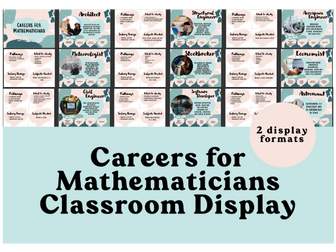
Maths classroom display on the topic of careers for Mathematics students. Display posters show potential careers and pathway for Maths students.
This is a visually appealing collection of 10 careers for mathematicians posters to use as a display to brighten up your classroom.
There are two different formats to download - informational posters as well as more visual posters.
The resource comes as a PDF and will print up to and including A3 size. The resource may be able to be printed in larger sizes without losing print quality.
These business careers posters have been developed using information found on the National Careers Service website. All images have an appropriate license.
Benefits:
Designed by a highly experienced outstanding teacher and former head of careers - the work has been done, so put your feet up!
Stimulating visual design that should appeal to all learners and help support SEN/ EAL learners
Promote careers to your students that build on the skills and knowledge learnt in class
Please check out our other resources – new resources are being added all the time.
Our maths posters have had a revamp and they’re better than ever!
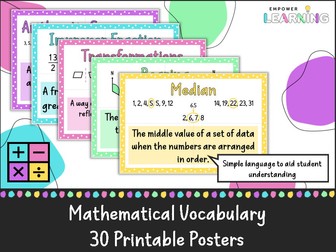
Set of 30 colourful posters featuring a variety of mathematical vocabulary. Posters feature diagrams and examples, as well as clear definitions for each piece of vocabulary. They’re a fantastic addition to any mathematics classroom, or for alternate use, they work great as revision/flash cards!
The following words are included:
Arithmetic Sequence
Acute Angle
Bearing
Chord
Circumference
Coefficient
Congruent
Correlation
Diameter
Formula
Gradient
Improper Fraction
Irrational Numbers
Mean
Median
Mode
Obtuse Angle
Parallel
Perpendicular
Perimeter
Prime Number
Radius
Range
Reflex Angle
Regular Polygon
Scale Factor
Square Number
Symmetry
Transformations
Unit Fraction
Set to be printed on A4 but can be blown up to A3 or shrunk to A5 depending on preference.
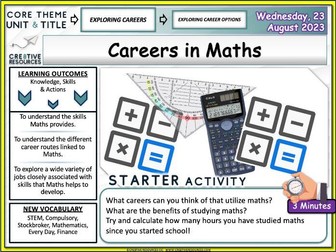
Careers in Maths . A fully-resourced lesson (1 hour +) which can be used by teachers to deliver a detailed lesson on Careers in Maths
Learning Outcomes:
To understand the skills Maths provides.
To understand the different career routes linked to Maths.
To explore a wide variety of jobs closely associated with skills that Maths helps to develop.
Key terms
STEM, Compulsory, Stockbroker, Mathematics, Every Day, Finance
Each Lesson Pack Contains:
1 Fully Editable Careers PowerPoint (Learning Outcomes, Confidence Checkers, Assessment of Learning, Variety of Tasks, Video Embedded URL Clips, Engaging Premium Quality Slides, Extra Support Websites, Challenging & Thoughtful Questioning)
Assessment Opportunity (Confidence Checker)
The lesson includes a detailed PowerPoint, variety of student facing tasks and comprehension tasks These resources have been designed to be engaging, informative and pick up and teach.
Why not check out some of our latest PSHE super bundles below:
Personal Finance as a young adult
Online Safety + Staying Safe
Y12 Survival Kit - Personal Safety
Y11 Survival Kit - Revision + Exam Stress
British Values Explored Bundle
PSHE - Debating Topical Issues
Society, Body Image + Peer Pressure
Finance Risk + Online Safety
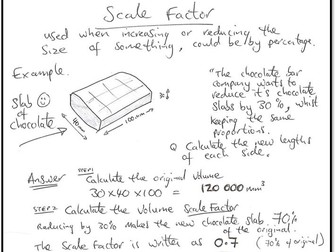
My collection of homework / classwork sheets I use to help students learn how to answer mathematics questions related to GCSE and A-Level specifications.
Sheets cover the basics (area, volume and tessellation) to more complex questions that have appeared in A-Level Product Design papers (e.g. working out pipe bending radius).
Sheets contain a worked example, diagrams and practice questions. Some scans from CGP DT exam-practice guide and booklet download from technologystudent.com
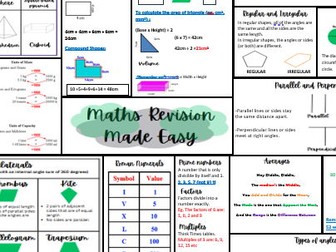
A KS2 Maths revision A3 mat to help children practise key Maths skills and concepts. This is great to use as a revision tool for Year 6 SATs and can be used weekly as a scaffold for retrieval. It covers: Quadrilaterals, 3D shapes, perimeter, area, volume, circle properties, Roman numerals, averages, properties of number, angles, units of length, mass and capacity and more! Also would be a fantastic tool in Year 7 to aid the learning process and recap prior skills.
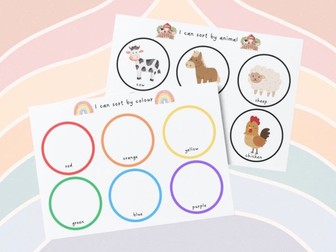
4 mats for sorting.
sort by:
colour
size
animal
type of transport
Can be used with counting bears, counting animals, counting transport, pom poms, buttons, loose parts.
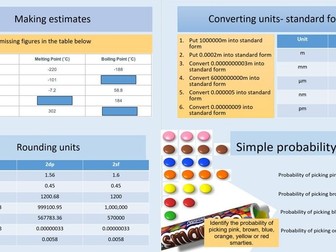
This 100+ page PowerPoint comprehensively covers the maths skills needed to succeed in GCSE science. The powerpoint has explanations, questions and answers for the skills.
Covering:
-Decimals, fractions, ratios and percentages
-Standard form
Estimates
-Order of magnitude
-Converting units
-Appropriate number of significant figures
-Mean, median and mode
-Frequency tables and diagrams, histograms and bar charts
-Scatter diagrams and correlations
-Simple probability
-Mathematical symbols (=, <, <<, >>, >, etc)
-Rearranging equations
-Solving simple algebraic equations
-Translating between graphical and numerical form
-y=mx+c
-Determining the gradient of a graph
-Calculating a rate of change
-Calculating surface areas and volume
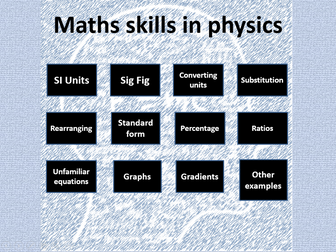
This resource covers maths skills required for Physics GCSE exam questions (combined science physics also). It is a power point with over 70 slides that include; teaching the required skills, practice tasks and selected past exam questions embedded (from EDEXCEL but could be used for any exam board as practice). It is organised in an order that flows from one skill to another with action buttons that take you directly to each skill and home buttons so you can easily return to the home slide.
This resource can be used at the start of the GCSE course (by providing pupils with a copy of the equation sheet) or as revision before the exam when pupils should know the required equations. This cannot be done in 1 lesson and could be spread over a number of lessons or dipped into when a skill is required!
Much of this is relevant to Biology and Chemistry also.
Skills covered are:
Standard index units
Significant figures
Converting units
Equations - Substitution
Equations - rearranging
Standard form
Percentage and efficiency
Ratios
Unfamiliar Equations
Graph interpretation
Gradients
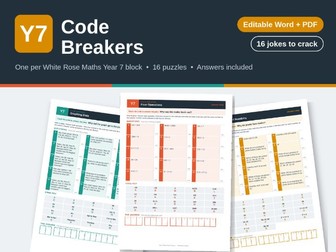
16 Year 7 maths code breaker puzzles, one for every White Rose Maths block. Students solve the questions to crack the code and reveal the punchline to a maths joke. Answers included. Editable Word + PDF.
A fun, self-checking activity that matches exactly what’s being taught: great for starters, homework, cover lessons and end-of-block review.
Every puzzle includes
A maths joke to solve
11–18 questions on that block’s topic
A code key with decoy answers, so guessing doesn’t work
Answer boxes that spell out the punchline
A full answer page with every answer and letter
Blocks covered
Autumn: Sequences, Algebraic Notation, Expressions and Equations, Place Value, Ordering and Rounding, Four Operations, Averages and Range, Rounding and Estimation
Spring: Graphing Data; Fractions, Decimals and Percentages; Directed Number; Fractions and Percentages of Amounts; Perimeter and Area
Summer: Speed, Distance and Time; Properties of Number; Adding and Subtracting Fractions; Angles and Polygons
Files included
Year 7 Maths Code Breakers (.docx and .pdf, 32 pages)
This is an independent resource designed to complement the White Rose Maths scheme of learning. It is not affiliated with or endorsed by White Rose Education.
A detailed and comprehensive maths investigation based on designing and running your own theme park.
Task 1: Planning your site using squared paper on a £500,000 budget
Task 2: Running your theme park
Task 3: Deciding on entry price (revised)
Task 4: Profit on entry fee (revised)
Task 5 - Profit & Loss
Task 6 - Annual Profit
Task 7 - Making Improvements
Task 8 - Running your theme park
Task 9 - Entry Fee
Task 10 - How many visitors?
Task 11 - What are your profits
Task 12 - Taxes and Insurance
Task 13 - Your loan
18 further tasks now included taking you up to the final season (season 3)
The investigation gives the children opportunities to practise key aspects of number including adding, subtracting, multiplying, dividing and finding percentages of numbers.
The investigation takes the children through step by step, they are in complete control of their spending and decide exactly what is included in their park. It also gives the children an insight to running a business with taxes, insurance and running costs all included. They learn about the power of marketing and the effect this has on the visitors to their park and their profit.
We have also included a spreadsheet which children can type into to work out their profit or loss and a smart board file to help with your teaching.
Finally, we have added a ‘design an advert’ competition where the winner wins some spending money for their park.
Master Probability for GCSE Higher Maths with this comprehensive Try, Review, Identify, Practise workbook, designed to support students working towards grades 6–9.
This professionally structured resource provides complete coverage of Probability topics from the GCSE Higher specification using authentic past exam questions. Ideal for classroom teaching, homework, intervention, tutoring, or independent revision.
What’s Included
Full Probability topic coverage for GCSE Higher Maths
Structured Try, Review, Identify, Practise method
Two closely matched exam-style questions per skill
Questions taken from real GCSE past papers
Complete mark scheme (including shadow answers)
RAG (Red/Amber/Green) self-assessment on every question
Print-ready PDF – no preparation required
Topics Covered
Completing and reading frequency trees
Finding probabilities from Venn Diagrams
Calculating probabilities of independent events using P(…) notation
Working out expected values for biased events
Union, intersection, and complements of sets
Determining probabilities of combined outcomes (sample space not given)
Probabilities of chains of outcomes
Successive dependent events
Calculating probabilities using two-way tables
Probabilities from stem and leaf diagrams
Independent events using tree diagrams
Dependent events using tree diagrams
Conditional probability using Venn diagrams
Algebraic expressions for multiple chains of outcomes
The Try, Review, Identify, Practise Approach
Each skill is practised using two parallel exam questions:
Try the first question independently
Review using the mark scheme
Identify mistakes or misconceptions
Practise immediately with the shadow question
This structure builds confidence, accuracy, and exam technique, helping students secure methods before working independently.
Perfect For
GCSE Higher Maths classroom lessons
Homework and weekly revision tasks
Intervention and catch-up sessions
Private tutoring
Independent study
Cover lessons (fully self-contained)
Why This Resource Works
Exam-authentic questions from past papers
Systematic coverage across 14 distinct skills
Structured repetition without overload
Encourages reflection using RAG ratings
Strong focus on logic and multi-step probability problems
Student Benefits
Clear progression through all Probability topics
Practice with genuine GCSE exam questions
Immediate application of each skill twice
Builds confidence and exam readiness
Helps identify strengths and gaps quickly
Part of a complete 28-workbook GCSE Higher Maths revision course. Can be used standalone or as part of a structured revision programme – Week 11 in the Trip Maths sequence.
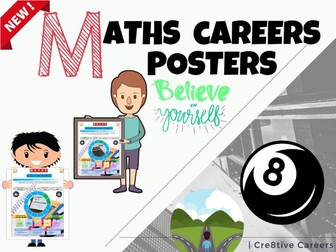
Eight careers linked to **Maths ** A4 display posters. These eye catching and expertly designed careers posters will be great to use in your subject area. They can be displayed or you could use them as stimulus for a careers lesson with a focus on your subject area. We have also included a blank student work sheet your students could use to make their own version of a poster linked to a career that inspires them. We also wanted to provide you as the teacher a blank editable template so you can add to your collection if you wish.
The best thing about this set of careers posters is that we provide them in three different formats:
1.1 x set of 8 PDF’s (Decorated and plain)
2. 1 x set of 8 High Quality PNG’s
3. 1 x set of 8 Fully Editable Portrait A4 PowerPoint Format
We provide them in different formats so its easier for printing and you can add your own school logo to them or amend with local labour Market Information / Update them each year as employment trends change.
Contents included
8 x A4 Careers Posters linked to Maths
1 x Student Worksheet PDF
1 x Editable Blank Teacher Poster Template
Each of the Eight Careers Poster Includes:
Job Title & Subject Area in Scrabble style tiles
Brief Job Description
Skills and Qualities required (4)
Circular Picture Linked to Job
Example Salary Range
Up to date employment opportunities in the UK (& sometimes beyond) (5)
Qualification that may help (but not necessarily always needed)
Career Development Opportunities
Other Linked Careers
✰✰✰✰✰✰✰✰✰✰✰✰✰✰✰✰✰✰✰✰✰✰✰✰✰✰��✰✰✰✰✰✰✰✰✰✰✰✰✰✰
Have a look at some of our highly popular specialist careers units:
☞ Year 7 Secondary Careers Unit
☞ Year 8 Secondary Careers Unit
☞ Year 9 Secondary Careers Unit
☞ Year 10 Secondary Careers Unit
☞ Year 11 Gatsby Benchmark Careers in Context Unit
☞ Year 12 Secondary Finance and Careers Unit
☞ Year 13 Secondary Finance and Careers Unit
✰✰✰✰✰✰✰✰✰✰✰✰✰✰✰✰✰✰✰✰✰✰✰✰✰✰✰✰✰✰✰✰✰✰✰✰✰
Product Code: C8/PO/01


 Quick View