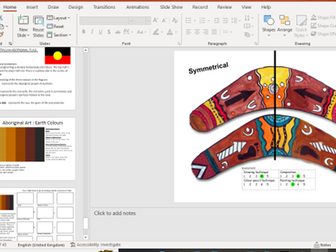
Year 8 PP that explores Aboriginal Art.
Suitable for any KS3 class.
This topics requires students to create a fact page, a boomerang design, a ‘dream time’ story painting and a traditional dot painting.
Powerpoint can last 6 weeks.
Contains visual examples, made by myself and students.
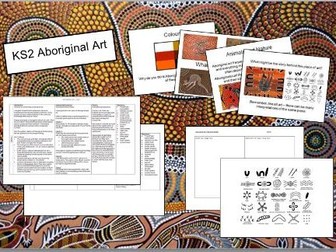
This was a mini topic that I did with a Year 5/6 class but it would work throughout Key Stage 2. It spanned two afternoon sessions and could easily be lengthened to create more of a topic. Pupils discover the key features of Aboriginal art and then go on to explore and record their own ideas before producing a final Aboriginal-style piece. Plenty of opportunity is given to evaluate their own and others work.
The resource includes:
Teaching plans for two lessons
PowerPoint presentation (15 slides)
Simple pupil planning sheet
Aboriginal symbols reference sheet
The topic provides good coverage of the 2013 National Curriculum for Art and Design (links are highlighted in bold on the planning). Planning and resource sheets are Word documents and fully editable.
Makes for a lovely display at the end!
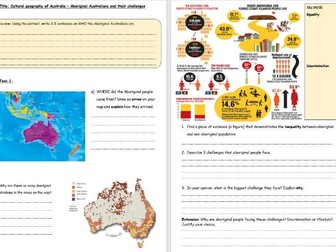
This resource offers an engaging and informative exploration of Aboriginal and Torres Strait Islander peoples, designed for KS3 students but also suitable for KS4. Includes worksheet and powerpoint, as well as a lesson plan.
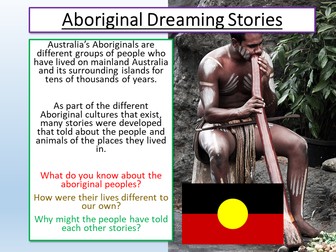
It covers a range of topics, from the cultural significance of Dreamtime stories to the impact of colonialism and the ongoing challenges faced by these communities. The resource includes a variety of activities aimed at developing key historical and geographical skills, such as describing, assessing, and analyzing. With a focus on promoting understanding and critical thinking, this resource is ideal for fostering meaningful discussions on Indigenous Australian history and culture.
Key Features:
Focus on key skills: Describe, Assess, Analyze
Map skills activity
Exploration of:
Social equality and discrimination
Aboriginal Dreamtime stories
The impact of colonialism
Infographic analysis task
Highlights the difficulties faced by Aboriginal communities
Emoji exit ticket for interactive learning assessment
Encourages deeper understanding and discussion of Indigenous Australian history and culture
-THIS LISTING IS AN INSTANT DIGITAL DOWNLOAD – PLEASE NOTE : NO PHYSICAL ITEMS WILL BE SHIPPED!
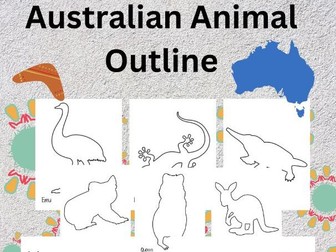
Aboriginal Australian Animals Outline
-Australia is home to an extraordinary variety of wildlife, and this captivating set of animals highlights many of them : Koala, Kangaroo,Echidna,Emu,Platypus,Dingo and Wombat…
You can use these australian animal templates as a life science extension activity when studying either wild or domesticated animals. The coloring pages can help your children learn to recognize and identify different animals. Children can then add the unique features of the animals to the templates. Once the masterpieces are finished, you can view them to check your students’ comprehension of animal characteristics.
Alternatively, why not use these animal coloring pages alongside your lessons to encourage your students to walk on the wild side and explore their creativity?
The Australian Animal Outline Templates are also a helpful way for you to encourage your students to work on different drawing techniques and build fine motor skills.
The completed pictures can then be proudly displayed around the classroom, placed in a science lab journal, or added to an art portfolio.
Files Details :
-10 Image 300 HQ SIZED 8.5X11 INCHES,for easy integration into your projects.
-1 PDF HQ 10 Page in Total .
-with thick black lines for easy resizing and crisp, clear prints at any size.
USE THESE FOR:
-Pencil Control Worksheets.
-Animals Worksheet
-Fast Finishers.
-Morning Work.
-Kangaroo Coloring Pages.
-Cute Animals Coloring Book.
-Homework.
-Distance Learning.
If you’re after an easy way for your students to find out about the achievements of 21 iconic Indigenous Australians who’ve shaped history, this set of PowerPoint and Google™ slides that highlight their contributions to arts, science, culture, politics will be ideal.
The people in this set to show a broad range of contributions across various fields, from young and old, and from the past and present, to honour each person and to inspire our young people.
The text on the slides is editable and you can delete any slides you don’t need. I’ve also included a couple of blank slides so you can add your own photo/text for people you wish to include.
The slideshow can be used as a whole class at the start or end of the day, or during social studies/inquiry. Alternatively, it can be used independently, and can be accompanied by the banners, so students can write about a person for a class display. These can be attached to the wall or hung over string (and stapled or glued together).
Who’s included?
Neville Bonner - politician
Cathy Freeman - athlete
David Unaipon - inventor and writer
Pat Dudgeon - first Indigenous psychologist
Sir Douglas Nicholls - Governor of South Australia
Tom Calma - professor and activist
Marcia Langton - professor and activist
Sally Morgan - author
Michael-Shawn Fletcher - geographer
Faith Bandler - activist
Madeleine Madden - actress
Kyah Simon - football player
Nova Peris - politician and athlete
Jessica Mauboy - singer
Noel Pearson - lawyer
Linda Burney - politician
Lionel Rose - boxer
Evonne Goolagong Cawley - tennis player
Albert Namatjira - artist
Adam Goodes - AFL footballer
Archie Roach - singer
You will receive an editable PPT file (text is editable, images/layout aren’t), a link to the Google Slides version, and a PDF of printable banners.
I hope your students enjoy finding out more about the achievements of these amazing Aboriginal Australians!
If you’re after pre-made banners for a display, you may like this set of iconic Indigenous Australians.
Myths and Legends KS3 English lesson that uses an Aboriginal dreamtime story to help students understand what a moral is and also how to analyse a text for language techniques and their impact on the reader. Useful for looking at Myths and Legends, genre, character , language analysis and moving KS3 students towards English Language exams at GCSE. Includes a model example, differentiated activities and so much more.
Useful preparation for both Section A and Question 5 of GCSE English Language exams, but designed for KS3 students. Includes teacher and student notes.
Check out our English Shop for loads more free and inexpensive KS3, KS4, KS5, Literacy and whole school resources.
This lesson forms part of our KS3 Complete Pack. Find out more here.
AQA English Language Paper 1 and Paper 2 Knowledge Organisers
AQA English Language Paper 1 Section A package
AQA English Language Paper 1 Sections A and B package
AQA English Language Paper 1 package
AQA English Language Paper 2 Question 5 package
AQA English Language Paper 1 Question 5 package
AQA English Language Paper 2 Section A package
AQA English Language and English Literature revision package
An Inspector Calls whole scheme package
An Inspector Calls revision package
Macbeth whole scheme package
Macbeth revision package
A Christmas Carol whole scheme package
A Christmas Carol revision package
Jekyll and Hyde whole scheme package
Jekyll and Hyde revision package
Romeo and Juliet whole scheme package
Power and Conflict poetry comparing poems package
Power and Conflict poetry whole scheme package
Love and Relationships poetry whole scheme package
Unseen Poetry whole scheme package
This powerpoint uses a range of photographs found on the internet.
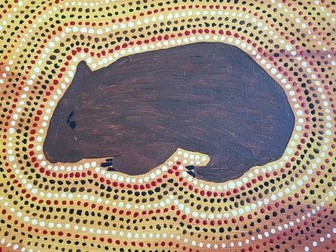
When I taught this lesson, I shared the images, talked about the range of animals which can be found in Australia and then laid out three long sheets of lining paper. Each child was given a thick paintbrush and a pot of paint (white, black, brown, orange, green, red and yellow).
The children walked around each sheet, making long snake-like patterns, surrounded by dots. Once the sheets had dried, they were used as backing paper for a display about Aboriginal Art.
I also gave the children a small canvas board. They planned their image and then painted an Australian animal - surrounded by concentric lines of differing colours.
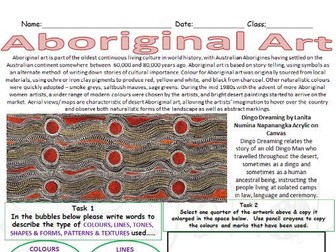
Create your own Aboriginal Art style patterns and critical analysis of an artwork using the formal elements. A4 or A3 sized colour printing recommended. Please leave feedback if you download this resource.
Includes a power point and printable resources
This lesson pack explores colour theory and formal elements with a focus on pattern and mark making.
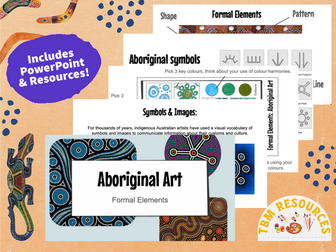
This lesson explores Aboriginal artwork, looking at different styles of dot painting. The focus of the lesson explores the use of formal elements and symbolism seen within Aboriginal art. Learners are tasked to create a series of pattern designs responding to Aboriginal artwork, using 3 key symbols to tell a story along with a limited colour palette, before creating their own piece of aboriginal artwork. This lesson aims to encourage and support learners in building their knowledge of colour, the formal elements and Aboriginal art. This lesson pack is perfect to be used within projects that are exploring the formal elements,colour theory or multicultural artwork.
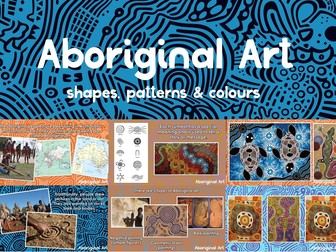
A brief PowerPoint presentation to introduce Aboriginal art.
The presentation touches on origin, style and purpose along with mentioning how colours, patterns and symbols are used in Aboriginal art.
Suitable for KS1 and KS2 but, it could be used with any age group where a simple introduction to Aboriginal art is required.
Aboriginal Symbol Activities - Discover Aboriginal art symbols with this comprehensive 95-page worksheet pack, perfect for primary students worldwide. Activities include ‘Colour and Design Your Own Symbol,’ a word search, cut-and-paste tasks, and creative story writing using traditional Aboriginal symbols. This print-and-go, no-prep resource fosters creativity and cultural learning, making it ideal for teachers seeking to introduce Aboriginal culture in the classroom.
I’m developing a series of these booklets; they are to be used by students who miss regular Art lessons. The idea is to promote independent learning and develop students understanding of art movements. You could use them as a starting point for a larger project.
Prepared for the Eduqas GCSE Geography B 9-1 specification (and applicable to all other boards), with all resources provided and ready to teach straight away. My lessons are interactive and provide a variety of teaching and learning activities. This lesson is part of the ‘HIC Global Cities: Sydney’ scheme of work (available as a bundle) of fifteen lessons about Sydney.
This lesson examines the history of aboriginal peoples in Sydney and provides a historical context for the growth of the city. It uses a carousel activity to develop an understanding of the challenges that aboriginal people have faced and encourages students to relate these to contemporary aboriginal experiences. It also seeks to challenge prejudices on this matter.
Extremely popular project suitable for all ages. Two parts to this project which can be combined as an overall final piece or taught individually. Aboriginal animals including templates ans Aboriginal Art from aerial view.
Aboriginal Symbols PowerPoint - Would you like to teach your students the meaning of Australian Aboriginal symbols? This is a 126 slide PowerPoint lesson that takes you through the essential background information required, the meaning of the symbols and then includes a quick check for understanding. Appropriate for multiple year levels: Year 1-6 (depending on your students knowledge of Aboriginal culture). A clear and straight forward introductory lesson to teach students about Aboriginal culture (art) and explain symbols used in your classroom.
This lesson includes;
126 slides (includes cover pages)
PowerPoint Lesson
Background information on Australia (map of Australia and Aboriginal people)
Explains symbols - briefly with a few words
Briefly explains different art styles
Shows some pictures of real cave paintings
Engaging clipart pictures
A great lesson for beginning knowledge of Aboriginal Culture
Use this lesson alongside the printable Aboriginal Posters and aboriginal symbols worksheet pack!
Discussion point slides added
2 activity suggestion slides
Contents slide included
Digital product - get the product, download it to your computer, save and use in slideshow mode with your students!
My students love learning about the Aboriginal culture and have enjoyed looking at the Aboriginal Posters that I have created. This lesson is a great way to engage in prior to exposing students to this environmental print. Use this lesson in slideshow mode. Press the mouse, arrow or space bar to bring up answers in the check for understanding section.