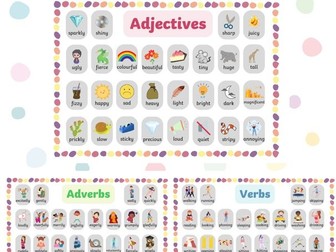
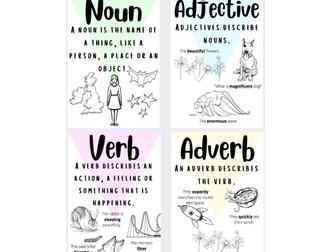
3 x word mats that are illustrated for accessibility containing adjectives, adverbs and verbs.
Perfect to support your children word independently.
Available as a PDF.
#writingsupport #adjectivemat #verbmat #adverbmat #KS1 #KS2
Engage your pupils with this detailed and creative “colour by word type” worksheet, designed to reinforce understanding of verbs, nouns, adjectives and adverbs in a fun, visual way.
Learning Objective:
To recognise verbs, nouns, adjectives and adverbs.
What’s included:
1 high-quality, patterned “colour by word type” worksheet
A clear colour key covering:
Verbs (action words)
Nouns (person, place or thing)
Adjectives (describe a noun)
Adverbs (describe a verb)
How it works:
Pupils read each word within the sections of the intricate design and decide which word class it belongs to. They then colour each section according to the key. The worksheet includes a wide range of vocabulary (e.g. quickly, teacher, beautiful, run, happily), encouraging deeper thinking and discussion.
Why teachers love it:
Combines grammar practice with a mindful colouring activity
Supports retention through visual learning
Encourages independent work and self-checking
Ideal for consolidation, revision, or extension tasks
Perfect for early finishers, homework or cover lessons
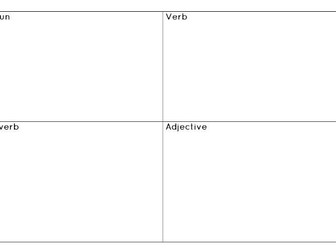
A great activity for small group work to support the teaching of nouns, verbs, adjectives and adverbs. The sorting grid can be enlarged onto A3 paper and then the children can sort the words into the correct categories. It can also be used as a cut and stick activity.
Literacy
Students have to sort the words into the categories of nouns, adjectives, verbs and adverbs using a key and then write their own sentences. Used for KS3 SEN.
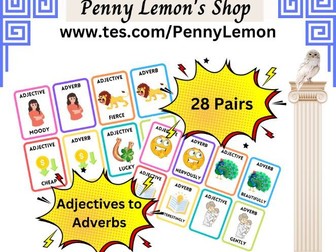
28 pairs of flashcards (or can be kept as a worksheet) where students have to write the adverb or adjective equivalent.
Variety of ily, ally, ly adverbs for students to develop their language awareness.
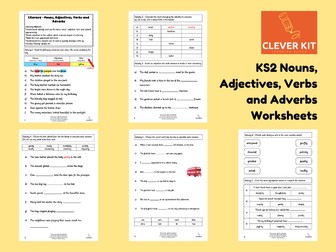
5 worksheets fulfilling the following learning intentions:
Understand, identify and use the terms ‘noun’, ‘adjective’, ‘verb’ and ‘adverb’ appropriately.
Relate adjectives to the suffixes which indicate degrees of intensity.
Select the most appropriate verb form.
Understand how adverbs can be used to qualify dialogue verbs e.g. ‘timidly’, ‘heavily’, ‘gruffly’ etc.
Activities include:
Activity 1 - Highlight the nouns, verbs and adjectives in the sentences.
Activity 2 - Complete the table of comparative and superlative adjectives.
Activity 3 - Insert adjectives to improve the sentences.
Activity 4 - Choose the most appropriate adverbs for the sentences.
Activity 5 - Choose the correct verbs to complete the sentences.
Activity 6 - Match the dialogue verbs to the most appropriate adverbs,
Activity 7 - Choose the best adverbs to complete the sentences.
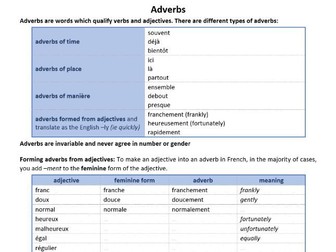
This set of resources is aimed at KS4/KS5 level students or intermediate to advanced learners.
It includes material to go over adverbs in French and the differences between the use of certain adverbs such as ‘encore’, ‘toujours’ and ‘déjà’.
A starter based on ITV's popular quiz - The Chase. Revision on nouns verbs etc. - a bit of fun for a lesson starter.
Choose a Chaser, then try to work you way down the ladder to home - but whatever you do, don&'t get caught!
Lots of adjective cards, which can be used in a number of ways. I have used these to teach children to apply the spelling rules of turning adjectives into adverbs. Can be made into cards or shrunk to make a worksheet. Can be broken into sets to teach spelling rules individually.
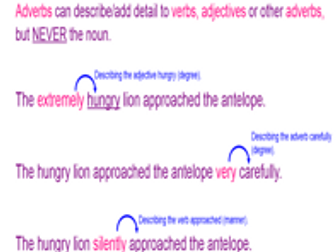
This resource includes a comprehensive teacher Notebook which introduces the fact that adjectives modify nouns whereas adverbs can modify verbs, adjectives or other adverbs. It then goes on to introduce the fact that some words can act as both an adjective and an adverb depending on the word they are modifying in the sentence. The children are given the opportunity to write their own sentences applying this knowledge before taking part in a challenge activity to see whether they can identify whether words are functioning as adjectives or adverbs.
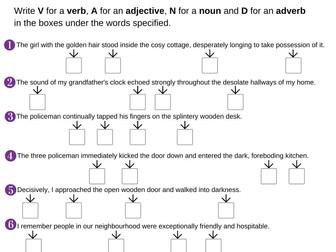
Three-way differentiated worksheets which require children to colour code words according to their wordclass (adjectives, verbs, nouns, adverbs).
This activity is followed by sentences whereby the children can identify word classes in sentences.
Answers also attached.
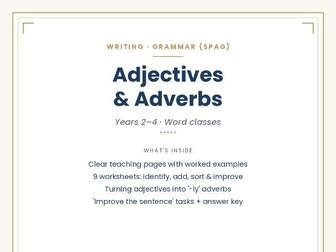
Years 2–4 · Word classes · SPaG
FOR
Children in Years 2 to 4 learning to identify and use adjectives and adverbs to improve their writing.
WHAT’S INSIDE
• Clear teaching pages with worked examples
• 9 worksheets — identify, add, sort and improve
• Turning adjectives into ‘-ly’ adverbs
• ‘Improve the sentence’ writing tasks
• A complete answer key for every question
 Quick View

 Quick View
 Quick View
 Quick View
 Quick View
 Quick View
 Quick View
 Quick View
 Quick View
 Quick View
 Quick View
 Quick View