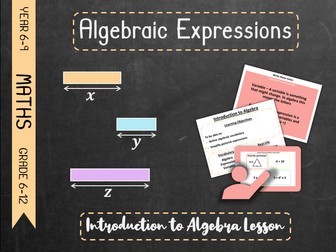
PowerPoint and Slides lesson involving an introduction to algebra and algebraic notation including writing expressions from diagrams.
Please read preview before purchase
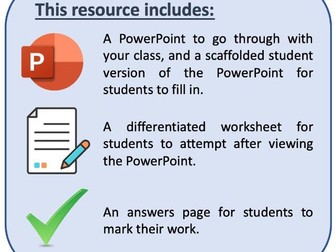
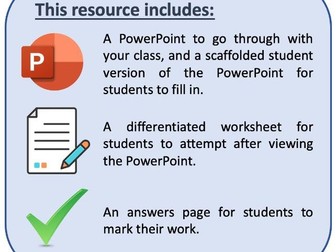
This resource includes:
A PowerPoint that can be used with a class,
A scaffolded student version of the PowerPoint with gaps for the students to fill in,
A differentiated worksheet with answers included.
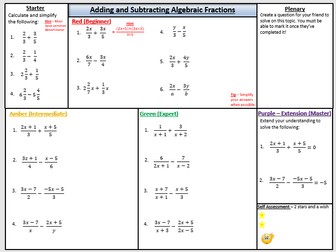
This resource is suitable for Year 7, 8, 9 and 10 students and is linked to the Australian curriculum. This resource focuses on understanding what the lowest common denominator of two fractions is, and adding and subtracting basic and algebraic fractions.
Overview
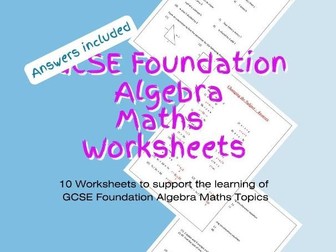
This resource is a comprehensive set of 10 downloadable worksheets designed to reinforce and enhance students’ skills in GCSE Foundation Algebra Maths topics.
Worksheet Structure
It includes 10 worksheets, each worksheet is split into practice and exam questions, one for each of the following topics:
Forming and Solving Equations
Simultaneous Equations
Changing the Subject
Collecting Like Terms
Expanding and Factorising
Indices
Inequalities
Sequences
Solving Equations
Substitution
Answer Key
Accompanying the 10 worksheets are answers to each one. This resource serves as a valuable tool for both self-assessment and facilitator guidance, allowing students to review their work independently or seek assistance when needed.
Printable Format
The GCSE Foundation Maths Algebra Worksheets is available in a downloadable DOC format, making it easy for teachers, parents, or students to print the worksheets and answers for offline use. Clear instructions are provided to ensure a seamless learning experience.
A set of seven lessons (over 80 slides) covering adding, subtracting, multiplying and dividing algebraic fractions. The power points can be used on their own to introduce and provide practice examples on algebraic fractions. They can also be used to provide revision notes or help for pupils who have been absent from class.
A collection of EIGHT FULL LESSONS, on the basic rules of algebra.
Contents of download:
L1 - Simplfying Basic Expressions
L2 - Simplifying Like Terms
L3 - Simplifying Expressions with BIDMAS
L4 - Substitution with Positive Integers
L5 - Substitution with Negative Integers
L6 - Substitution into Formula
L7 - Linear Equations One Step
L8 - One-Step Rearranging of Formulae
Contains I do - We Do You Do Cycles with AFL opportunities via MWB and RAG.
These lessons are a comprehensive look into the unit.
The Powerpoints are 100% animated and does not require the teacher to write, allowing them to circulate with a clicker/ tablet and monitor students.
These lessons works well with LAP students.
The background in all lessons are Dyslexia friendly.
Please provide feedback if you found this useful or find a mistake.
This is a whole lesson on Collecting Like Terms. It is extremely thorough and will really help students to understand the foundations of algebra. The lesson makes the difference between adding and multiplying terms vital explicit. This lesson is ready to go, with no prep required. It is also great for home learning. 20-slide presentation + lots of resources
The lesson includes:
a starter
lesson objectives (differentiated)
keywords
superb teaching slides
lots of examples
embedded questions (with answers)
Worksheet (with answers)
Exam Questions (with answers)
Matching Activity (with answers)
Plenary
ALL LESSONS for teaching all the different topics of ALGEBRA are available as one BIG BUNDLE in the link below:
Algebra: ALL Lessons
For any issues, please email outstandingresourceshelp@gmail.com
and we will aim to respond within 48 hours.
Lessons are flat-packed (with limited editing) to maintain copyright protection.
We would greatly appreciate it if you could leave a rating and feedback.
Thank you for your support, your purchase, and for taking the time to provide feedback!
#mathslessons #maths #secondarymaths #mathscentres #teachingideas #algebra #teacherslife #teachingkids #teachingmaths #mathsactivities #homeschooling #tesresources #teaching #mathsisfun #teachershare #teachertips #teachers #KS3 #KS4 #KS5 #igcse #learning #gcsemaths
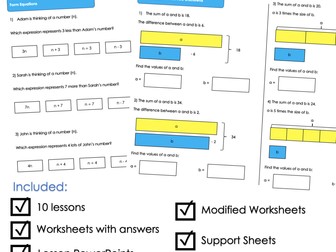
A bundle of fully resourced algebra lessons based on the Year 6 White Rose maths unit for algebra with 10 fully planned and resourced lessons included
Included are lessons for:
Lesson 1 - 1-step function machines
Lesson 2 - 2-step function machines
Lesson 3 - Form expressions
Lesson 4 - Substitution
Lesson 5 - Formulae/ Formula
Lesson 6 - Form equations
Lesson 7 - Solve 1-step equations
Lesson 8 - Solve 2-step equations
Lesson 9 - Find pairs of values
Lesson 10 - Solve problems with two unknowns
All lessons include:
A lesson PowerPoint with starter, vocabulary, modelling (with teacher notes) and guided practice
Lesson plan
Worksheet with answer sheet
Scaffolded worksheet with answer sheet
Modified worksheet for those who need additional changes to access the learning with answers
Challenge tasks
Support strips that can be stuck in books
Everything is included that could be needed to run the lesson successfully, with each resource carefully considered in ensuring accessibility for all as well as ensuring there are plenty of opportunities for challenge to provide depth of understanding.
Two lessons, including worked examples and practise questions.
Topics: 1. Solving Equations
2. Substitution into Expressions
3. Simplifying Expressions
4. Expanding Brackets
5. Factorising Expressions
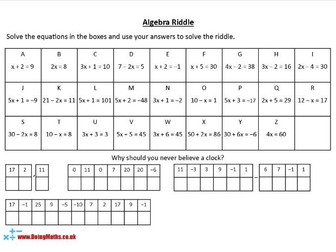
Solve the algebraic equations and use the answers to find the solutions to the codebreaker riddles in these two algebra puzzle worksheets. Fun starter activities or revision exercises for secondary maths lessons.
The set includes pdf versions of two algebra puzzles of different difficulty levels plus full answers.
Factorising Algegraic Expressions for KS3
This individual powerpoint presentation is from the KS3 Maths Topics Series.
It contains 23 slides (Plus a title and end slide), so there are lots of examples. This is an ideal resource which you will enjoy using to explain Factorising Algebraic Expressions to your classes for years to come.
The powerpoint explains:
Factors
Factorising Algebraic Expressions
This PowerPoint is a series of lessons (120 slides), aimed at preparing students for the WJEC Additional Mathematics qualification.
This resource covers:
• Quadratics
• Algebraic fractions
• Surds
• Indices
• Completing the square
• The Factor and Remainder Theorems
• Simultaneous equations
• Proof
These are examples, practise questions and examination level questions.
A fully resourced algebra lesson for being able to substitute in values as part of algebraic expressions to then be able to calculate the answer (e.g. n = 6 so 5n - 3 is the same as 5 x 6 - 3) in Year 6 based on the objective from White Rose Maths.
Included in the resource is:
A lesson PowerPoint with starter, vocabulary, modelling (with teacher notes) and guided practice
Lesson plan
Worksheet with answer sheet
Scaffolded worksheet with answer sheet
Modified worksheet for those who need additional changes to access the learning with answers
Challenge tasks
Support strips that can be stuck in books
Everything is included that could be needed to run the lesson successfully, with each resource carefully considered in ensuring accessibility for all as well as ensuring there are plenty of opportunities for challenge to provide depth of understanding.
**Solving equations to find the missing letters of the alphabet! **
Suitable for the Algebra topic for KS2 children who need a challenge!
Page 1 in the format ‘2x + 3 = 11’
Page 2 is tricker and involves division with algebra.
Could be split in half, with one half of the class on Page 1 and the other on page 2, then coming together at the end to reveal the whole alphabet. I also used this one-on-one with a tutee.
ANSWERS INCLUDED
For Printed and Interactive Use!
Helpful comments embedded.
Perfect for teachers and tutors.
Dyselxia-friendly!
Sans serif font.
Font size 12 minimum
Clear spacing
A fun way to solve algebra equations for children who are excelling with algebra. I actually used this with a Year 3 tutee (!) but this was very unusual. I would recommend it for Y4 and above definitely. Suitable for Y6 and even Y7 as a fun starter.
Page 1 requires knowledge of solving 2-step algebra equations.
Page 2 requires knowledge of dividing 3 digit numbers by 10 and using division in algebra.
Made by Ella (@ellalessons) A full-time tutor and resource creator.
Thanks for downloading!
This resource is a 4 day unit on algebra in year 6. It includes a simple introduction to algebra, area of rectangles and triangles using algebra, and equations. It includes the Activinspire charts to accompany each day, plus the relevant work. Work is differentiated by 3, in line with the maths expectations for fluency, reasoning and problem solving.
**Factorisation - Year 8 Interactive Lesson and Activities | Algebraic Expressions**
This amazing factorisation for year 8 is a completely interactive lesson and activity designed for ks3 learners. In this lesson, learners will understand that factorising is the reverse process of expanding brackets. A factorised answer will always contain a set of brackets. Pupils will be able to factorise an expression fully, take out the highest common factor (HCF) of all the terms. This fun-packed lesson with differentiated questions will give pupils ample opportunities to practice how to simplify and manipulate algebraic expressions by taking out common factors.
The lesson can be used as whole class teaching by teachers and at home for home learning.
With lots of drag and drop activities as well as instant feedback.
Contains 26 interactive slides.
Catchphrase Interactive Game
Interactive whole-class, small group or 1-1 activity to assess knowledge of simplifying algebra.
Slides contain 36 tiles, which remove when clicked. Students take turns to answer questions and teacher clicks to remove each corresponding tile.
Each slide reveals a ‘say what you see’ catchphrase, and the winner is the first to correctly identify the catchphrase.
Catchphrase under the tiles is: A-cute Baby
A few years ago I wrote a set of notes for pupils and put them on my website. The notes were supposed to be written in a pupil-friendly way, and different to notes students might find in textbooks or elsewhere on the internet. I have converted the notes to PowerPoint slides so you can download them, adapt them if needed, use them in revision lessons or perhaps give your students a set to take home with them to help them prepare for exams. The chances are there will be a few mistakes here and there, so if you spot any please email me & I will correct them. Hope they are of use!
A PDF of many of the type of problems that students need for higher level at GCSE,
I originally designed this for Year 11 revision, but often used it when introducing the topic or giving homework.
The sheet is comprehensive and will hopefully cover all that you need.
I hope you find it useful.
Please leave feedback, especially if you like my work - thank you.
Getting students to understand that letters in equations are simply unknown numbers is the first step to successfully teaching algebra, without them stressing too much.