A whole SOW for the Crime Drama unit of study, which is part of the EDUQAS GCSE Media Studies specification. The SOW includes 10 lessons that focuses on the 4 different areas of the theoretical framework; media language, representation, audience and industry. It also includes a mid-term assessment.
This pack contains a 31-slide PowerPoint & student booklet.
Booklet contains a spot test to test key terms from any earlier induction session.
The lesson introduces students to core technical codes, analytical frameworks, and practical camera skills.
Description below was generted by AI after it read the PowerPoint -
** ALL LESSONS ON THIS SHOP ARE HUMAN MADE WITH ZERO AI INPUT - **
Key Content & Topic Areas
Core Media Language Concepts: Introduction to media codes—technical, audio, and visual—alongside key analytical terminology, including denotation vs. connotation, textual analysis, audience response, and representation.
Framing & Composition: Exploring how spatial composition shapes audience perspective through open framing versus closed framing (frame-within-a-frame) techniques.
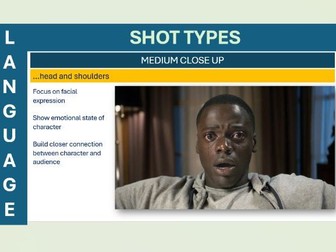
Shot Types & Camera Distance: Comprehensive coverage of framing scales, ranging from extreme wide and establishing shots to extreme close-ups, point-of-view (POV) shots, and over-the-shoulder perspectives.
Angles & Positioning: Theoretical breakdown of how camera height and angle—such as low angles, high angles, canted/Dutch angles, and bird’s-eye views—connote power dynamics, vulnerability, and psychological tension.
Camera Movement: Analysis of dynamic storytelling tools, including tracking shots, pans, and tilts, and how they submerge the viewer into the scene.
Still Photography & Styles: An introduction to still media imagery, exploring genres such as fashion, photojournalism, portraiture, fine art, and landscape photography.
Plenary & Consolidation Tasks
The lesson finishes with interactive, differentiated application activities designed to solidify student understanding:
Storyboard Analysis: Students identify and label various shot types using a 18-frame Star Wars storyboard grid.
Textual Analysis Practice: A written exercise asking students to unpack two specific shots from the sequence, detailing their denotations and analyzing their emotional/narrative connotations.
Creative Planning Exercise: Students review a scenario synopsis and plan the opening three shots of a scene to introduce characters
Practical Photography Application: practical paired task where students head outside to construct and capture their own shot list.
Image Evaluation:
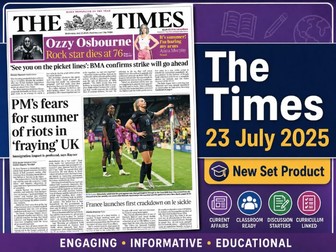
A detailed and student-friendly Eduqas A Level Media Studies Newspapers teaching resource focused on the new set product: The Times, 23 July 2025 front page, which will be assessed from 2028 onwards.
This resource includes two complete booklets:
A student booklet for classroom use, independent study, homework and revision
A teacher booklet with teacher notes and suggested answers included below each task
This complete teaching and revision resource is designed to help students understand, analyse and revise The Times as part of the A Level Media Studies Newspapers section. It breaks down the key areas of the Eduqas theoretical framework in a clear, accessible and engaging way, making it ideal for classroom teaching, intervention, cover work, independent learning and exam preparation.
The booklet covers all the essential areas students need to know, including media language, representation, media industries, audiences, ideology, political bias, ownership, regulation, print newspaper conventions and online newspaper contexts. It also supports students in applying key terminology accurately and developing confident exam-style analytical responses.
Included in the resource:
Clear introduction to the Eduqas Newspapers unit
Background and context for The Times
Focus on the new 23 July 2025 front page set product
Student-friendly notes on media language and layout conventions
Representation analysis of people, issues, events and social groups
Industry notes covering ownership, regulation and production
Audience and readership analysis
Clear explanations of ideology, political bias and social context
Exam-style questions and paragraph practice
Retrieval practice, comprehension tasks and knowledge checks
Pair, group and independent learning activities
Planning grids, sentence starters and revision checklists
Glossary of key newspaper terminology
Suggested answers throughout
This resource is ideal for teachers preparing students for the updated Eduqas A Level Media Studies newspaper set product. It gives students the knowledge, confidence and exam practice needed to analyse The Times effectively, while saving teachers valuable planning time.
This is one lesson from the R097 lesson pack
This lesson pack includes 13 lessons that cover all aspects of the specification and the assessment requirements. It includes the following:
• Lesson PPT’s with discussion based activities and learning in context examples included.
• Workbooks for students to complete theory-based tasks.
• Teachers’ toolkit with some guidance on assessment and exemplars.
• NEA scrapbook for students to record their notes.
• Practice assignment in a format similar to the NEA.
• Scheme of work that includes a lesson-by-lesson break down.
TRIGGER POINT - FULL UNIT
POWERPOINT & PUPIL BOOKLET
Struggling to find the time and energy to create a new scheme for the Trigger Point set text change? This fully planned, ready-to-teach resource has done **all **the hard work for you!
Written by a consistently outstanding teacher with 25+ years of experience, this 10-lesson scheme for Trigger Point Series 2, Episode 1 is fully aligned to Eduqas Component 2: Investigating the Media – Contemporary British Crime Drama.
Includes:
326-slide PowerPoint with complete lesson content, fully animated and with detailed notes in the slide notes
35-page pupil booklet accompanying the PowerPoint
10 detailed lessons covering:
Introduction to Crime Drama
Episode Study
Social, Cultural & Political Contexts
Media Language
Character Analysis – Propp & Barthes
Representation – Stuart Hall
Narrative – Todorov & Barthes
Industry, Ownership & Regulation
Audience – Hall, Blumler & Katz
Marketing & Promotion**
Exam-style tasks and scaffolded support for mixed-ability groups
Pedagogy & Teaching Approach:
Built around direct instruction and the best-practice strategies from Doug Lemov’s Teach Like a Champion, lessons include:
Silent and Solo / Do Now tasks
I say, you say & choral response
Clear lesson aims and structured starters
Mini-whiteboards
I do / We do / You do
PEAL paragraph structure
Introductions, hinge questions, and cold call questioning
Duel coding
Turn & Talk activities and Think, Pair, Share.
Visualiser for modelled exemplars
Mini-Plenaries and Exit Tickets
And many more techniques to ensure active engagement, scaffolding, and exam-ready analysis.
Save hours of planning, reduce stress, and deliver engaging, high-quality lessons that build students’ analytical confidence and exam skills.
Save 30% on this Crime Drama bundle!
Everything you need to teach Component 2, Section A: Television (Crime Drama) in one bundle - both the contemporary and historical crime drama set products, fully covered, in one purchase.
This bundle combines:
Trigger Point (2024)
10-lesson scheme of work, 326-slide PowerPoint, 35-page pupil booklet, covering media language, representation, industry and audience for the contemporary set product.
The Sweeney (1975)
5 fully resourced lessons (PowerPoint + pupil booklet) covering genre and predecessors, media language, industry and historical context, representation, and audience theory, PLUS a genuine 30-mark Section A-style assessment with full teacher mark scheme, real Eduqas band descriptors, and DIRT reflection and target-setting pages.
Together, these give pupils the complete historical-versus-contemporary comparison the exam actually demands - including genuine practice at the “how typical of the genre” question style, using the correct product for each skill.
Built using Direct Instruction and Teach Like a Champion pedagogy (Cold Call, No Opt Out, I Do/We Do/You Do, Turn and Talk, Show Call) and fully scaffolded for mixed-ability KS4 classes with word banks, sentence stems, and pupil-friendly exemplar answers at every band. Designed by a specialist Head of Department and T&L coordinator with 26 years’ experience.
Ideal for: GCSE Media Studies, Eduqas Component 2 Television, crime drama topic, historical/contemporary product comparison, exam practice with authentic mark schemes.
Perfect for classroom display or student revision!
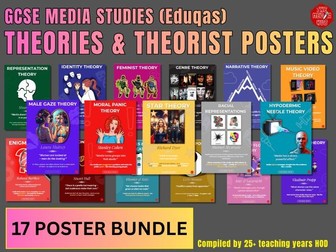
Bring Media Studies to life with this vibrant and accessible set of Media Theory Posters designed specifically for the Eduqas GCSE Media Studies course. These eye-catching posters simplify key media theorists and theories into student-friendly summaries, memorable quotes, and bold visuals – ideal for helping learners understand and recall core concepts.
What’s Included:
17 full-colour posters (A4 or A3 printable)
Each poster features:
• Name of the theory and theorist
• Simple one-sentence explanation
• Direct quote from the theorist
• Bold image for dual coding
Covers theories on representation, narrative, identity, media language, gender, race, and audience
Theorists Included:
Stuart Hall, Roland Barthes, David Gauntlett, Levi-Strauss, Propp, Dyer, Andrew Goodwin, Alvarado, , Dyer, Goodwin, Propp, Todorov, Blumler & Katz, Katz and Lasarsfield, Stanley Cohan, Steve Neale, Levi-Strauss, Mulvey, Van-Zoonan, and more!
Designed by a Media Studies teacher with over 25 years teaching experience, for use with mixed-ability groups – perfect for displays, revision walls, theory lessons, or student folders.
Printable PDF – ready to download and print at home or school.
Aligned with the Eduqas GCSE Media Studies glossary and exam content, but also suitable for other specifications (AQA, OCR) or KS5 introduction.
Written by a Media specialist HOD, with over 26 years teaching experience, T&L team member and Instructional Coaching lead.
Love this resource? Please leave a review! Massive thank you!
Lessons guiding students through analysis of existing teen dramas (need access to clips on youtube/Netflix) to then storyboarding their own. Looks at narrative structure, character types etc with examples given for both. Doesn’t cover statement of aims. Probably span over 3 or 4 lessons. Storyboard tempate from OLD spec used - can be access through exam board website.
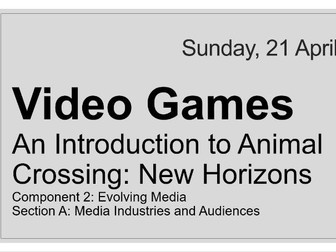
A scheme of work for the OCR A Level Media Studies video games unit, as part of the Evolving Media, Media Industries and Audience assessment.
This scheme of work focuses on Nintendo’s Animal Crossing: New Horizons.
Included are lessons exploring -
An Introduction to Video Games
A History on Animal Crossing
Ownership and production
Marketing and production
Audience
Regulation
Theories
The following resource includes:
Lesson PPT with activities that are integrated into the student workbook.
Information slides to support teachers, including non-specialists.
Student workbook that includes four sections:
Task 1: Knowledge and Understanding (linked to activities in the PPT)
Task 2: Guided practice - The main task to exemplify/contextualise the core content with your support.
Task 3: Independent practice - A homework style activity for students to complete without the need for teacher support. It consolidates/extends their learning of that topic.
Task 4: Exam-style question - A exam style question linked to the OCR style including the use of appropriate command words, including a mark scheme, indicative content and model answers.
A teacher version of the workbook is included with answers.
OCR Cambridge Technicals in Digital Media 2016 - Unit 3 - Create a Media Product
In this package you get all the lessons for Unit 3 as Powerpoints
Fully animating presentations
Updated for 2020
All 14 lessons included with built in assessment time
Hours of specially recorded video by industry professionals
Even a model brief included.
This scheme follows the audio/visual pathway but would require only minor adjustments for the other pathways!
Fantastic value!
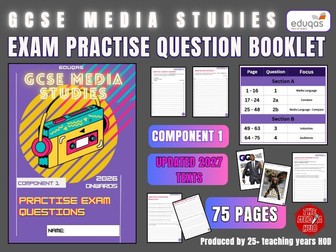
Get your students exam-ready with this 75-page GCSE Media Studies practice booklet designed for the Eduqas 2027 specification. This comprehensive, student-friendly resource includes full exam-style questions for Component 1, Section A and Section B, focusing on the types of questions learners will face in the final paper.
Perfect for use in class, for homework, revision sessions or independent study.
Includes Practice for:
Section A
Question 1 – Media Language
Question 2a – Contexts
Question 2b – Media Language Comparison
Section B
Question 3 – Media Industries
Question 4 – Media Audiences
Covers All 2027 Eduqas Set Products:
Section A and B Set Products:
Quality Street advert
NHS 111 advert
Vogue magazine
GQ magazine
The Guardian
The Sun (front page, website and social media)
The Man With the Golden Gun
No Time to Die (film poster, website and social media)
Fortnite
Desert Island Discs (radio programme and website)
No Time to Die (James Bond franchise, MGM, Universal)
Format: PDF
Length: 75 pages
Photocopy or upload to your school platform
Save yourself a load of time and effort!
Written by a Media specialist HOD, with over 26 years teaching experience, T&L team member and Instructional Coaching lead.
If this resource worked for your class, please leave a review. It takes one minute and makes a huge difference! Thank you SO much for supporting The Media Hub.
This fully editable worksheet is designed to match the specification and is perfect for homework, cover lessons, or independent study. Each task is carefully structured to help students consolidate key content, deepen understanding, and support effective revision. Ideal for home learning, retrieval practice, flipped learning, or in-class support. Ai was used to help create these accessible and engaging, this no-prep resource helps boost progress while saving teacher time.
Full lessons and tasks on:
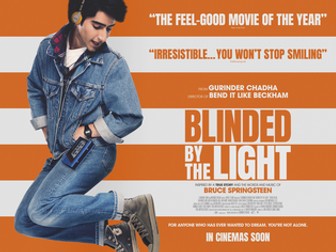
Film – Blinded by the Light: (Gurinder Chadha, UK, 2019)
This is a Targeted Close Study product for which you will need to focus on the following areas of the Theoretical Framework:
• Media Industries
Students are not required to watch the film for the assessment
Film: Blinded by the Light is an example of low-medium budget film making. Students do not need to watch the film but will need to be familiar with the production context and distribution materials including:
o website(BenditNetworks) o website(Warners)
o posters
o trailer
osocialmediapresence(twitter,Instagram,facebooketc). The film should only be studied in relation to Media Industries.
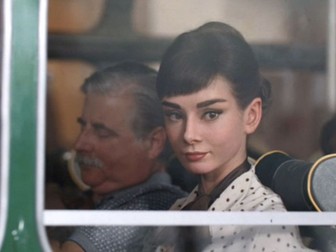
This resource focuses on the theoretical framework of media (media language and representation in relation to the Galaxy Advertisement (Audrey Hepburn). This lesson includes:
media language
theoretical approaches
exemplars
exam questions
group activities
independent work// student agency
representation
production activity
Fortnite - Set Text
A complete, fully resourced unit on Fortnite for Eduqas GCSE Media Studies Component 1, Section B.
What’s included:
Five PowerPoint lessons, each paired with a 27-page pupil booklet (used across all five lessons). Pupil booklet included as a PDF and editable word document.
Lesson 1
Industry: Epic Games’ business model, ownership, and production context. Covers free-to-play economics, in-game purchasing, and the media industries framework.
Lesson 2
Audiences: Target audiences, audience engagement, and how Fortnite constructs and maintains a global audience through cross-platform play, events, and updates.
Lesson 3
Regulation: PEGI ratings, age appropriateness, loot box controversy, and the role of regulatory bodies including ASA and PEGI.
Lesson 4
Ethics: Impact on children, social and cultural impacts, moral outrage.
**Lesson 5 **
Theory: Application of key media theories including Hall’s Representation, Cultivation Theory, and the Uses and Gratifications framework to Fortnite as a digital media product.
Teaching approach:
Fully animated PowerPoints, with individual slide teaching notes.
Each lesson uses direct instruction methodology informed by Doug Lemov’s Teach Like a Champion, strategies including:
Cold Call questioning built into slides to maximise participation and hold students accountable
No Opt Out structures so every student engages with the material
Check for Understanding checkpoints throughout each lesson
I Do / We Do / You Do scaffolding for complex exam skills
Stretch It prompts for higher-attaining students
Chunked, sequenced content to reduce cognitive overload
Exam-style questions with model answers and mark scheme guidance
The pupil booklet accompanies all five lessons with structured note-taking frames, key terminology, exam practice questions, and theory application tasks - ready to print or use digitally.
Created by an experienced Head of Media Studies with over 25 years in the classroom. This is not a basic lesson plan - it’s a teacher-proof, exam-ready teaching sequence built around evidence-based direct instruction principles.
Who is this for?
GCSE Media Studies teachers delivering the Eduqas specification, particularly Component 1 (Section B). Suitable for Years 10 and 11. No extra preparation needed - open and teach.
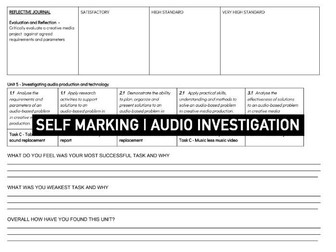
Self making sheets to check criteria covered for Unit 5 - Investigating audio production and technology UAL SPEC. This resource can be used in lessons, ONLINE, REMOTE, VIRTUAL, HOME, LEARNING or as HOMEWORK. It can be digitally sent to students as a PDF or printed and used within a lesson.
All resources have been tried and tested in both a college and school setting and been met with enthusiasm by students. They are designed to fully explain the tasks, with terminology, keywords, sections and a clear explanation for students to complete independently. It can be delivered in a classroom with a teacher or as a tool for independent learning remotely.
CREATIVE THINKING RESOURCES specialises in Media Studies, Film Studies, Graphic Design, Theatrical and SFX Special Effects Makeup, Design Technology, Architecture and Three Dimensional Design 3D. A wealth of free and purchasable resources including Full unit schemes of work, Teacher Powerpoints, student handouts, Home Learning booklets to revision materials, covering Key Stage 5, 4, 3 and 2.
Please rate this resource and leave any feedback for improvements, or suggested add ons, that both you and your class would like to see.
For extra help and inspiration visit CREATIVE THINKING RESOURCES Pinterest. For a range of boards from Sketchbook Inspiration, Architecture and Typography to Media Theorists, Packaging, Mask Making and Magazine Design.
PowerPoint guide to introduce GCSE Media Studies using horror films, including the opening sequence to The Ring (2002) and the marketing campaign around The Woman in Black (2012).


 Quick View