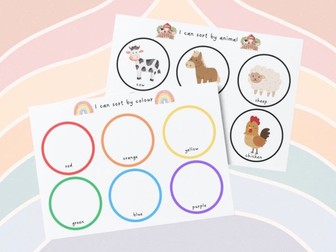
4 mats for sorting.
sort by:
colour
size
animal
type of transport
Can be used with counting bears, counting animals, counting transport, pom poms, buttons, loose parts.
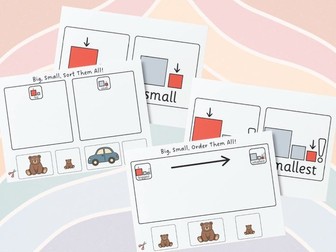
Simple big and small and ordering biggest to smallest cut and stick with matching visuals
Visuals for, big, small, bigger, smaller and biggest, smallest included
Visuals are great to support teaching and support accessing the activity. Can be used for physical hands on sorting activities.
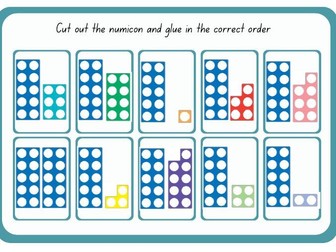
This colourful resource is great for understanding number order.
Using the numicon shapes, children should cut out the numicon cards and glue them onto the other sheet in the correct order from 11.20
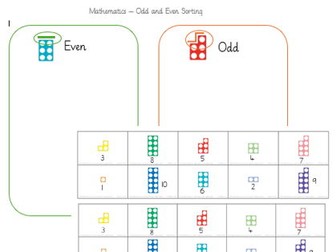
A cut and stick activity where children need to sort the Numicon / numbers into ‘odd’ or ‘even’. There is a visual scaffold for children to aid them in their assessment - even numbers have a ‘flat top’ and odd numbers do not.
Perfect for EYFS Mathematics, developing fine motor/cutting skills, sorting skills.
A lesson ideal for Year 4 although could work easily across KS2. Clearly differentiated and a very practical maths lesson which the children will enjoy.!
Year 3 programme of study - Number – number and place value - Compare and order numbers up to 1000
Pupils are expected to compare and order numbers up to 1,000 as part of their learning about number and place value. This includes recognizing the place value of the digits in a 3-digit number, using comparison vocabulary, applying ordering strategies. use the mathematical symbols for comparison.
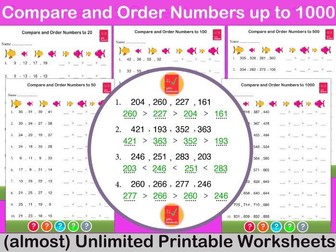
Print out as many unique worksheets as you need choosing from five different ranges of numbers up to 1000. Your students will never run short of new worksheets to practice with.
Students are asked to compare a set of four 2-Digit numbers or four 3-Digit numbers and place them in order between inequality signs.
You can choose to order numbers in the range:
1 to 20
1 to 50
1 to 100
1 to 500
1 to 1000
This will give you a choice of differentiating from the very start.
How many worksheets are in each set ?
(Almost) Unlimited. At the click of a button all numbers are randomized, so you can create as many different worksheets for classwork, homework, revision, preparing for assessment, etc and the numbers will change every time.
Answers are automatically generated every time.
Digital Teaching Material
These are designed to help you introduce the content of the worksheets to the whole class on an Interactive Whiteboard, or on a PC or Mac for 1-1 tuition and again you have (almost) unlimited examples to practice with.
Note
These resources work with the official Adobe Acrobat Reader on Windows or Mac computers.
Australian Curriculum - ACMNA013 - order numbers to at least 100
Compare and Order Numbers
Complete Lesson on Comparing and Ordering Numbers
A complete maths lesson to explain comparing and ordering numbers. Children will practice the lesson as a class and then complete independent activities to embed knowledge. Differentiated game instruction sheets are included to allow children to develop understanding.
Included in this download:
• Full lesson plan
• Lesson PowerPoint
• Example anchor chart
• Three differentiated number card packs
• Three differentiated game instruction sheets
Please ask if you have any questions
Please don’t forget to leave feedback and follow me for updates on products and offers
*****************************************************************************
My other math products:
Grid Method Multiplication Complete Lesson
Complete week on fractions
Decimal Lessons Bundle
***************************************************************************
Customer Tips:
Follow me for news about my new discounts, freebies and product launches: here
***************************************************************************
On this assessment, students will answer twenty five questions related to greater than, less than, equal to as well as ordering numbers based on place value from least to greatest and greatest to least.
2.NBT.A.4, 3.NBT.A.1, 4.NBT.A.2
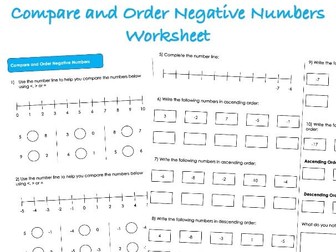
A worksheet that provides a variety of questions linked to being able to understand negative numbers by being able to compare and order numbers (including using the inequality symbols to compare and sorting numbers in ascending and descending order). This is based on the Year 5 objective based on White Rose Maths but can easily be used in other year groups.
Included as part of the worksheet are 10 different questions that provide variation to check pupils understanding of being able to compare and order negative numbers.
Answers are also included for all questions.
This worksheet can easily be used as a worksheet when teaching the objective or used for recap/ revision or even to be sent home as homework.
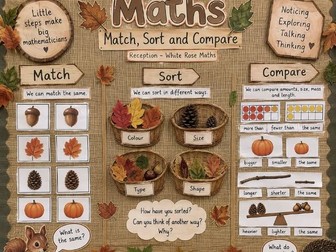
Bring your Reception maths learning to life with this beautiful autumn-themed Match, Sort and Compare classroom display, inspired by the White Rose Maths Autumn sequence.
Designed to support young children in developing early mathematical language and reasoning, the display provides a visual reminder of key concepts and vocabulary.
The display includes:
Match – matching objects that are the same
Sort – sorting objects in different ways
Compare – comparing amounts, size, mass and length
Visual examples using familiar autumn objects
Friendly woodland characters to engage Reception children
Open-ended questions to encourage mathematical thinking and discussion
Rustic wooden vocabulary cards including count, match, sort, compare, more, fewer, bigger, smaller, longer, shorter, heavier and lighter
Autumn-themed leaves, pumpkins, acorns and pinecones throughout
The resources are designed to create a warm, inviting maths environment while giving children opportunities to see, hear and use important mathematical vocabulary throughout the day.
Perfect for a Reception classroom, maths area, working wall or continuous provision display.
A lovely way to encourage children to notice, explore, talk and think mathematically!
#ReceptionMaths #WhiteRoseMaths #MatchSortCompare #EarlyYearsMaths #EYFSMaths #ReceptionDisplay #MathsDisplay #AutumnMaths #ContinuousProvision #MathsWorkingWall
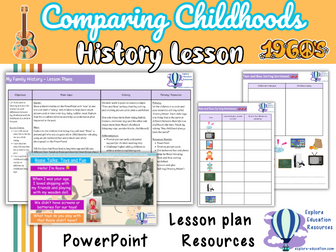
This KS1 history lesson helps pupils compare their own childhood with the childhood of a child in the past. Children identify similarities and differences between toys, school, food and daily life, while learning to use simple timelines and sorting activities. The lesson encourages speaking, listening and comparison skills through role-play, discussion and practical tasks.
What’s Included:
✔ Editable PowerPoint presentation with timeline and role-play prompts
✔ “Then and Now” sorting worksheet with picture cards
✔ Detailed lesson plan
Lesson Overview / Structure:
★ Starter: Children build a simple timeline (baby, toddler, now) to understand how time is ordered.
★ Main Activity: Teacher role-plays “Rosie,” a 6-year-old child from 1962, describing her toys, school and food. Children compare Rosie’s life to their own and sort picture cards into “Then” and “Now.”
★ Differentiation: Pre-cut cards and paired support for lower ability; challenge task for higher ability children to write a sentence explaining one similarity or difference.
★ Plenary: Pupils share one similarity or difference between their life and Rosie’s, using a circle activity with ‘History Helper.’
Why It’s Useful:
✔ Supports KS1 history objectives on changes within living memory
✔ Encourages speaking, listening and comparison skills
✔ Differentiated for a range of abilities
✔ Practical, discussion-based lesson with engaging props and activities
Suggested Use Cases:
KS1 history | Changes within living memory | Past and present comparisons | Whole-class or paired activity | Speaking and listening development
Search Tags:
KS1 history | childhood then and now | past and present lesson | Year 1 history | Year 2 history | comparing toys and school KS1 | changes within living memory KS1 | outstanding KS1 history lesson | history sorting activity | timeline lesson KS1
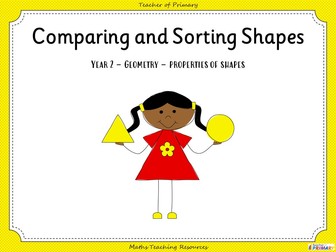
Comparing and Sorting Shapes - Year 2
In ‘Comparing and Sorting Shapes - Year 2’ common 2-D and 3-D shapes and everyday objects are compared and sorted as per the curriculum objective of the year 2 maths programme of study (Geometry - properties of shape).
Content includes:
* Animated PowerPoint presentation
* Activities to support the teaching of this objective
* 2 worksheets with answers
‘Comparing and Sorting Shapes - Year 2’ is editable allowing teachers to adapt the resource to meet the needs of each class they teach.
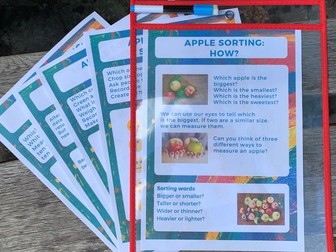
KS2 Primary school maths activities. Comparisons and ordering.
Five worksheets. Fragonwood series of outdoor maths activities.
Suitable for KS2. Can be adapted for indoor use with loose parts.
Ordinal words and their abbreviations.
Taste test survey.
Information on different types of charts.
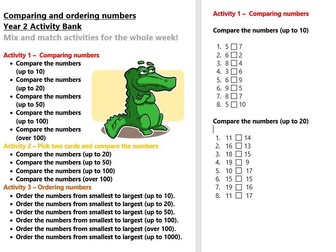
15 comparing and ordering activities all in one place, mix and match them to teach the combination of skills suited for each of the ability groups in your class.
 Quick View

 Quick View
 Quick View
 Quick View
 Quick View
 Quick View
 Quick View
 Quick View
 Quick View
 Quick View
 Quick View
 Quick View
 Quick View
 Quick View
 Quick View
 Quick View
 Quick View