Newly updated in April 2025.
A document showing the progression through nursery and reception in the seven areas of learning.
Links are also shown to KS1 subjects in relation to understanding the world and EAD to enable subject leaders throughout school to see how their subject is being taught in reception and nursery.
Observational checkpoints are included for nursery to help to assess if children are ‘on track’ and ELGs for reception.
Newly updated in June 2026.
A document showing the progression through nursery and reception in the seven areas of learning.
Links are also shown to KS1 subjects in relation to understanding the world and EAD to enable subject leaders throughout school to see how their subject is being taught in reception and nursery.
Observational checkpoints are included for nursery to help to assess if children are ‘on track’ and ELGs for reception.
Please let me know what you think of the grid. I have separated ELGs as I would want to use them. Type very small but I will enlarge to A3 which makes it more readable.
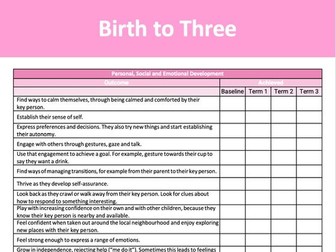
Track EYFS development from baseline to Term 3, covering Birth to ELGs. A clear, structured sheet for monitoring individual child progress.
This EYFS Progress Tracking Sheet is designed to help early years practitioners systematically observe, record, and reflect on each child’s development throughout the academic year, from initial baseline assessments to end-of-year outcomes aligned with the Early Learning Goals (ELGs).
The sheet is organized to cover all seven areas of the EYFS framework, allowing practitioners to track progress from birth-to-three milestones through to the Reception-level ELGs. It includes clearly defined columns for recording development at four key checkpoints:
Baseline (start of the year)
Term 1
Term 2
Term 3 (end-of-year review)
Each area of learning is broken down for targeted observations and assessment.
The format supports ongoing formative assessment, ensuring practitioners can identify gaps in learning, plan next steps, and communicate progress effectively with parents and carers. It’s also valuable for internal moderation and inspection readiness, providing a clear visual journey of each child’s developmental path.
Now revised to include Expected!
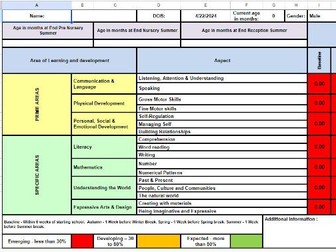
I made this tracking grid for our EYFS, with a view to highlighting it in four colours (baseline + terms) to demonstrate progression. I have included SOME, MOST and ALL within each ELG as this enables progress to be demonstrated to parents, even when children have not moved up to the next age band.
A data tracking system for EYFS which details and tracks children’s level of development typical of their age. A child is placed into the term of their birth (Autumn, Spring, Summer) and progress is recorded in accordance with this. This ensures progress is detailed and precise. This system is recognised by ofsted as shows clear detailed progress. On the individual tracking sheet I have created three examples for illustration and to help with understanding how it works. The second sheet records the whole class as a percentage. Hope these are useful in tracking your children's progress.
**An absolute time saver for data collection and number crunching
**
An excel document with 4 spreadsheets for on-entry, autumn, spring and summer data collection points.
Each workbook is formatted to automatically calculate the number of children and % that are on track/not on track for ELG in each strand of the curriculum. It also calculates number of children and % on track/not on track for GLD and for RWM.
There are also filter tabs for gender/term of birth/class/SEND/EAL and on-track/not on track
A fully formulated spreadsheet for tracking progress towards the new UK EYFS (2021) standards for ‘Children in Reception’.
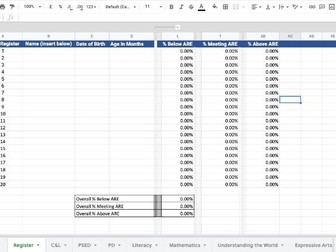
Enter class names on the ‘register’ sheet and it will populate student names across all other sheets, automatically calculate age in years and months when date of birth is entered (dd/mm/yyyy).
As each data for each standard is entered (either beginning, developing or secure) a percentage for each child is calculated for the area of learning (percentage ‘beginning’ percentage ‘developing’, percentage ‘secure’). In addition, an overall percentage is calculated for the class for that area of learning.
Finally, on the ‘register’ sheet, a percentage is calculated for each child across the EYFS (percentage ‘beginning’ percentage ‘developing’, percentage ‘secure’) as well as an overall percentage for the class across the EYFS.
This might be useful in this format as it gives equal space for dating evidence. I have separated ELGs as I would want to use them. Let me know what you think and compare to my other grid. I will enlarge to A3 for each child as type is very small.
A full policy on assessment and tracking in EYFS.
Includes:
aims and principles
learning journey
formative assessment
termly tracking
moderation
data analysis
pupil progress
reporting
A summary of EYFS profile points which can be used to track the progress of individual child. One summary sheet for nursery (from 22-36 months +) and one for Reception (30-50 months +)
This tracker allows you to assess the children throughout their journey with you.
With this easy to use spreadsheet you can monitor progress and interventions taking place.
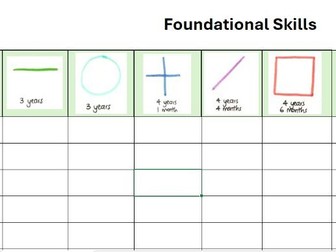
Pencil grip
Pre writing shapes
One handed tools 2-3 - Reception
Name writing
Letter formation
Simple enter the children’s name down the left hand side.
If they can do the statement put a Y in the cell it will turn light green.
If they cannot do the statement, put a N in the cell and it will turn red.
You can then right click and add comments in to explain the skills they do or do not have and evidence you have seen. You can also add it what intervention they have had.
Once they have had intervention and they can do the statement, delete the N and replace it with an S. This will turn it dark green so you can see this child now knows it, but needed support to get there.
I have found this tool helpful for assessment and tracking exactly what foundational skills the children have in terms of fine motor and mark making.
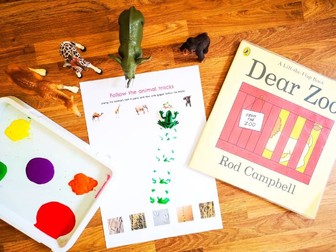
For this activity you need animal toys (monkey, camel, frog, giraffe and elephant) and paint.
Dip the animal’s feet in the paint and stamp on the paper. Children need to identify which footprint belongs to which animal and then follow the track. There is also an opportunity for the children to have a discussion about the differences between the footprints and what they look like. Example: A monkey’s footprint looks like our hand print, and elephant’s footprint is round like a circle…etc.
Data tracker for EYFS.
Uses Development Matters statements.
Birth to 3 (Pre Nursery)
3 and 4 year olds (Nursery)
Reception Children (Reception)
ELGs
Automatically calculates Emerging, Developing and Achieved percentages.
Can be used to track a child throughout the EYFS.
Baseline, Autumn Term, Spring Term and Summer term assessment points.
Yearly objective tracking document for EYFS - reception
PITA Statements (Progress in Time Assessments) for a termly tracking.
Used as a tool to aid planning!
Highlight Baseline / Autumn / Spring and Summer in a different colour so you can cross off objectives throughout the year and see the journey.
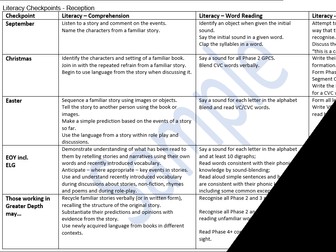
A set of checkpoint descriptors (Baseline/Christmas/Easter/EOY/GD) for all areas of learning. Use these as an aid to decide if a child is on/off track to reach ELG at assessment points throughout the year.
These are designed to be in line with the revised curriculum (starting Sept 2021) and to be particularly supportive to ECTs and staff new to EYFS. They are not intended to be used as ticklists but as a general guide to support practitioners in knowing whether a child is broadly in line with reaching the ELG at the end of the year.
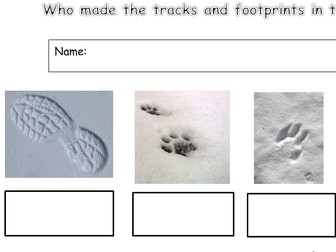
EYFS/KS1 Identify the footprints and tracks worksheet. Set of eight images for pupils to identify with an identification box at the bottom of the worksheet for pupil spelling support. Useful to use for seasonal topics, weather, Christmas, snow, animals and transport .
I have put together a document that allows me to track my pupils progress over the academic year. It includes the 22-36, 30-50, 30-60+ months, ELG and Exceeding descriptors.