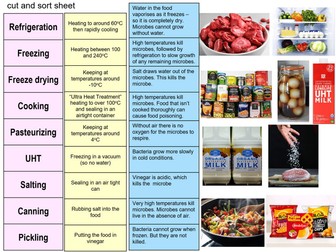
Here you have a Food, Preparation and Nutrition Quiz, tried and tested with KS3 and GCSE students studying Food. The quiz is interactive throughout using Hyperlinks navigating to the correct and incorrect answers which appear clearly on the screen for students to see.
The quiz contains 23 questions and covers:
Food and Kitchen Safety
Food Types, Nutrients and Diets
What’s Hidding
Cultural Foods
This Quiz has been tried and tested and has had fantastic feedback from students and teachers. It is great for a specialist teacher or a non-specialist teacher during a Food cover lesson.
Additional high quality resources
Eduqas Coursework and NEA 1 & 2 BUNDLE
AQA Coursework and NEA 1 & 2 BUNDLE
Food Written Exam/Mock Questions and Revision suitable for all exam boards (Larger Bundle
GCSE Food Exam/Mock Questions with Model Answers BUNDLEsuitable for all exam boards (smaller Bundle)
Food Cover Worksheets
GCSE Food Cover BUNDLE
KS3/KS4 Food Cover BUNDLE
Christmas Food Quiz, suitable for Food, Technology, Tutor Time, PSHE, Christmas season and cross-curricular. This cheery Christmas quiz will bring Christmas Cheer to your classroom this season.
The quiz is divided into two round.
Round 1: Multiple Choice Answers Relating to Food
Round 2: Hidden Christmas Foods
There are 21 questions included in this quiz in total, with the answers featured separately. Each question has an answer, along with clear visuals.
Merry Christmas! - bringing
You may also find these other resources handy:
**Food - **
Interactive Food Quiz KS3/KS4
Complete Food Lesson Bundle
Food Coursework and Exam Preparation Bundle
EDUQAS Food Preparation and Nutrition NEA 1 & 2 Coursework Guidance & Exam/Mock Questions Preparation
AQA Food Preparation and Nutrition NEA 1 & 2 Coursework Guidance & Exam/Mock Questions Preparation
Food Written Exam/Mock Questions and Revision suitable for all exam boards (Larger Bundle
GCSE Food Exam/Mock Questions with Model Answers BUNDLEsuitable for all exam boards (smaller Bundle)
**DT - **
DT Project - 31 Template Pages - Understand the Design Process -
DT KS3 Mini Project - Collapsible Bin Store
DT KS3 Mini Project - Seat Belt Protector
DT KS3 Mini Project - Magnetic Wrist Band
DT Lesson Bundle
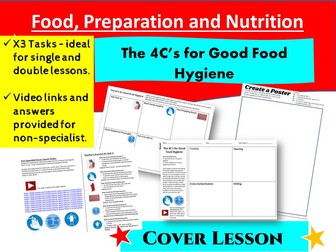
This Food Cover Work is suited for key stage 3 students studying food. It has been tried and tested with year 7 and year 8 classes. The resource includes three tasks and is three sides of A4.
Tasks:
To watch the 10 videos (provided) and jot down notes. The videos relate to - Cross-Contamination, Cleaning, Cooking and Chilling.
Students are provided with a table showing 6 Health and Safety rules that need to be followed in the food room. Students are tasked to write down at least one reason why this rule should be followed and 1 hazard for each. (Answers have been provided for the non-specialist teacher to follow and encourage self-marking)
Create a poster on the worksheet provided.
This resource also includes a helpful teacher guidance page. It includes simple instructions for the lesson, video links and answers (for task 2) to encourage self and peer marking - saving you extra time later!
Try before you buy - A lesson with 5* Reviews
Types of Eggs
Interested in purchasing more lessons, coursework and revision resources from this authorMade for teachers Shop. Then why not try before you buy with this great 5* lesson. Fellow teachers have reviewed stating that they purchased further lessons off the back of this resource - saving them lots of time!
Other helpful resources:
If may also be interested in:
Made for teachers Shop
Complete Food Lesson Bundle
Food Coursework and Exam Preparation Bundle
AQA Food Preparation and Nutrition Nea 1 & 2 Coursework Guidance & Exam/Mock Questions Preparation
EDUQAS Food Preparation and Nutrition NEA 1 & 2 Coursework Guidance & Exam/Mock Questions Preparation
Food Written Exam/Mock Questions and Revision suitable for all exam boards (Larger Bundle
GCSE Food Exam/Mock Questions with Model Answers BUNDLEsuitable for all exam boards (smaller Bundle)
A bundle of 9 worksheets on the topic of Food for French GCSE/KS3 which will support pupils to talk about the food they like and eat in the present, past & future tenses.
Resource 1: Introducing types of food and the partitive article
Resource 2: Food routine and adverbs of frequency
Resource 3: Food and the immediate future tense
Resource 4: Types of food & cuisine and preferences
Resource 5: Adjectives and describing food
Resource 6: Food and le passé composé
Resource 7: A scaffolded writing task and model answer on food (past, present and future)
Resource 8: A revision worksheet on all aspects of this topic.
Resource 9: 4 pages of writing activities on food and fast food and a longer GCSE writing question with a model answer.
Format: Word and PDF documents with answers.
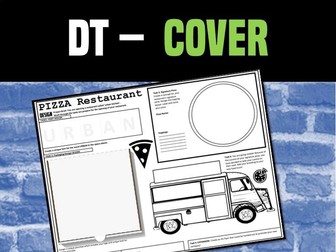
This A3 Design sheets is an ideal task for a cover lesson within DT - especially Food Technology or Graphic Design.
Students need to work to a design brief to create the branding for a new pizza restaurant which is due to open.
Project Brief: You are opening a restaurant called ‘Urban kitchen’.
Work through the tasks wo prepare for the opening of your restaurant.
End of term fun but educational food quiz. Suitable for KS3
6 rounds in total.
Please note, this has been re-uploaded and does open as a readable and editable file.
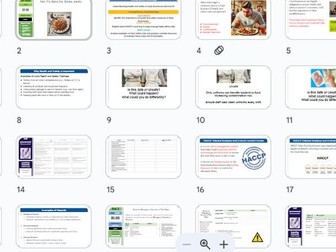
Introduction to HACCP and Food Safety
Understanding HACCP: Managing Food Safety in Food Businesses
Lesson Overview:
This lesson introduces students to the importance of health and safety in food businesses and the role of HACCP (Hazard Analysis and Critical Control Points) in managing food safety risks. Students will explore the 7 principles of HACCP, recognize different types of food hazards, and understand how these principles are applied to ensure safe food handling. Through guided activities, discussions, and critical thinking tasks, students will gain insight into real-world applications of food safety management.
Key Topics Covered:
Why Health and Safety is Important in Food Businesses:
Legal requirements to protect customers.
Examples of safe and unsafe practices.
Introduction to HACCP:
Definition and purpose of HACCP.
Simplified explanation of the 7 principles:
Hazard Analysis.
Determine Critical Control Points (CCPs).
Set Critical Limits.
Monitor CCPs.
Take Corrective Actions.
Verify the System.
Keep Records.
Types of Food Hazards:
Biological hazards (e.g., bacteria in raw meat).
Chemical hazards (e.g., cleaning agents in food).
Physical hazards (e.g., glass or nails in meals).
Practical Applications of HACCP:
Identifying risks in food handling.
Matching hazards to their types.
Real-life scenarios and corrective actions.
Learning Objectives:
All: Identify the importance of health and safety in food businesses.
Most: Explain what HACCP is and describe its 7 principles.
Some: Analyze real-world food safety risks and propose solutions using HACCP principles.
Activities:
Safe vs. Unsafe Practices Worksheet:
Pupils categorize examples of food handling practices as safe or unsafe and suggest improvements.
HACCP Principle Matching Activity:
Pupils match hazards (biological, chemical, or physical) to the corresponding HACCP principles.
Scenario-Based Critical Thinking Task:
Groups analyze food safety risks in real-world situations and present HACCP-based solutions.
Assessment Methods:
Participation in discussions and group tasks.
Accuracy in worksheet and matching activities.
Clarity and depth of scenario presentations.
Resource Summary:
The lesson resource includes:
A worksheet on categorizing safe/unsafe practices.
Simplified definitions and examples of HACCP principles.
A table of food hazards and matching activity.
Scenario cards for group work.
Teacher guidance notes and answer keys for activities.
This lesson provides an engaging and practical approach to understanding food safety and the HACCP system, helping students connect theory to practice.
If you are looking for a Food Technology based team-building activity to keep your students engaged during the last few days (or week) leading up to Christmas, then this KS3 Food Technology ESCAPE ROOM is for you! There are seven Christmas inspired - but subject themed (trivia) challenges included in this file. Students will complete a variety of tasks using different skills including: problem-solving, critical thinking, reading comprehension,literacy challenges and some clever deduction.
The puzzles, bonus questions and challenges are a fun way to assess a topic or subject area. This resource covers a variety of different elements including: vocabulary, key terms. key themes, general subject knowledge, literacy and much more…
Escape Room is fully editable and are easy to set up - Just follow our step by step teacher instructions.
The Escape room lasts just under an hour depending on how quick students can solve each puzzle! If a team finishes early don’t worry we have built in another hidden challenge for them.
Students will start in the Snowfield and solve puzzles along the way through 7 different rooms (Snow field, Scarf, Top Hat, Forest, Carrot and Coal, Wrap A present & a final secret Location) As they solve each Christmas themed puzzle they will collect 1 Piece of the Snowman Puzzle and have to solve the Christmas Cypher.
Food Technology Christmas Escape Room Contents
☞Interactive Tracker PowerPoint - Keeps the competitive nature on display
☞ Escape Room Keys (Six Sets for up to Six Teams) Print two copies for up to 12 teams
☞ Escape Room Puzzles (7 Rooms = 7 Different styles of Puzzles)
☞ Teacher Answer Sheet - We do the hard work for you!
☞ Teacher instructions to run the escape
☞ Successful Escape Certificates for those that complete the entire challenge (There is a difficult bonus escape for any quick finishing teams :)
☞ The 7 Rooms each have subject specific Puzzles that have been adapted to suit the topic of this Escape Room and are suitable for a variety of students.
☞ A fun, five-minute ★introductory video★ has been included, which will help to set the scene before the escape room is to begin! The video outlines the plot of each escape and provides alternate endings…
Subscribe to the Cre8tive Resources free YouTube channel to access hundreds of educational videos for free!
Common FAQ’s
★Group sizes: 3-5 students per team (This can also be completed as an individual and/or pair activity)
★Time: Approximately 50-60 minutes (Provide hints along the way if time is a factor!)
★Materials: Aside from the materials that you would already have in your classroom (pencils, pens, 6 pairs of scissors), no additional resources are needed!
These escape room-style games were created as a print-and-go resource.
French KS3 worksheet for cover, revision, homework etc.
Recap food and drink with EPI-style activities.
Match up vocab
Add the spaces
Choose and circle the correct word
Gapfill - write the missing word
Who said (reading)
Choose ‘je mange’ or ‘je bois’
Tick the verb in the past tense
Anagrams writing
Add the missing vowels
Answer the questions about the text in English
The first question of each task is done as an example.
With a suggested ‘challenge task’ extension at the end.
Great for last minute cover work, revision leading up to a test, or for retrieval and consolidation of learning over the last few topics.
A suite of lesson resources covering sources of food, including farmed, wild, home grown, farm reared, etc. Processing of foods which include primary, secondary and manufacturing products. Origin of foods also covered. Some independent research tasks included as well as a start and end point assessment activity. Power point presentation corresponds to the workbook provided for pupils. Should take two or three lessons, depending on ability and lesson length. Suitable for the New GCSE FP&N and also VCERT level 2.
AQA GCSE Geography lesson for the 2016 specification Unit 2C, the optional unit on food management: In this third lesson we look at how food supply and productivity can be increased.
We start with a short multiple-choice quiz based on some of the content taught in the previous lessons. We then look at the five main methods for increasing food productivity (irrigation, aeroponics and hydroponics, the ‘new’ green revolution and technology, biotechnology and appropriate technology. The students are given some information cards and a hexagonal notes sheet to record the information in a structured way. They can then highlight the advantages and disadvantages of these methods. We then look at irrigation schemes and the students have a ‘matching’ activity where they have to match the description to the method and the picture. We have a brief look at the use of AI in India where the students answer some questions from a video clip . We then answer a GCSE-style 4 mark question on irrigation and appropriate technology with some guidance on the structure and some points they may wish to use.
Hope this saves you some valuable planning time.
https://www.tes.com/teaching-resources/shop/markthegeographer
Here you have a LARGE bundle of Whole lessons covering a variety of food topics and suitable for GCSE students studying Food. All of the resources featured in this bundle are complete lessons and structured with Starter, Main and Plenary; with targeted Learning Objectives. A Food Tracker booklet has also been included.
These lessons are clearly presented and include reliable subject knowledge. Students can approach learning via reliable content, videos, fact sheets, worksheets, recipes, readiness charts, assessment criteria and class discussions. Answers are also provided where necessary.
TRY BEFORE YOU BUY! A lesson with 5* reviews -
Types of Eggs - Food Lesson
Students thoroughly enjoy this interactive, student friendly Food Quiz. suitable for specialists or non-specialists as part of a cover lesson.
Interactive Food Quiz KS3/KS4
You may also be interested in:
Made for teachers Shop
Complete Food Lesson Bundle
Food Coursework and Exam Preparation Bundle
EDUQAS Food Preparation and Nutrition NEA 1 & 2 Coursework Guidance & Exam/Mock Questions Preparation
Food Written Exam/Mock Questions and Revision suitable for all exam boards (Larger Bundle
GCSE Food Exam/Mock Questions with Model Answers BUNDLEsuitable for all exam boards (smaller Bundle)
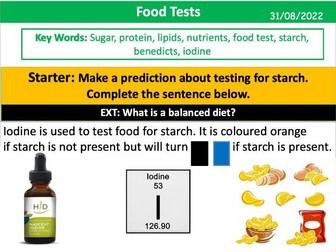
Complete No-Prep lesson with exam style questions, tasks and answers for AQA GCSE (9-1) Science / Biology. This double lesson resource covers two of the Required Practicals for AQA GCSE Biology / Combined Science Biology: food tests and investigating the effect of pH on amylase. I have written each as a separate lesson with its own starter, lesson objectives and questions.
As a Secondary Science teacher, Deputy Headteacher, writer and examiner for many years I make high quality no-prep lessons so busy teachers can teach outstanding lessons without spending hours planning. This high quality lesson includes explanations, different types of in-lesson assessment (all with answers) and unique exam-style questions.
My lessons are designed to take learners on a journey that builds up their understanding step by step, while still going into a lot of depth. The preview video shows a representative sample of slides from the resource so that you get a good idea of what it includes before you buy.
What’s Included:
• Teaching notes
• Two Starter / Do Now Activities.
• Explanation slides in “chunked” sections with animated diagrams.
• Multiple questions in different question styles and difficulties - no need for worksheets. Each “chunked” explanation section typically includes a set of “learning check / quick questions” followed by a set of in-depth questions on the learning from that “chunk” of the lesson. All questions have answers.
• Exam-style questions on the whole lesson at the end of the lesson- these are unique, based on real exam questions but not just copied from exam boards.
• Answers for all questions
• All easily editable to adapt to your teaching or to use in existing lessons.
• Slightly humorous, at points, if you like that sort of thing.
The lesson was written for AQA GCSE Science / Biology but is very likely to be applicable to other exam specifications.
Please leave a rating / review and all other feedback gratefully received!
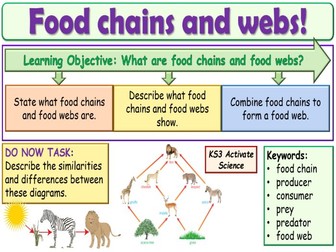
Perfect lesson resource for KS3 Biology! A fully differentiated and resourced lesson that assists students in learning about food chains and food webs. Students will describe the features of food chains, and compare and contrast food chains with food webs.
The resource includes a detailed and engaging lesson PowerPoint with differentiated activities and quizzes for students to complete. This resource is part of the Ecosystem processes topic and has been created for the delivery of the Activate KS3 Science course. Also great for KS2 Science.
17 slides in total for the lesson PPT
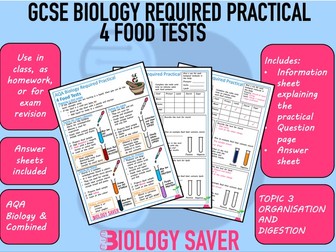
This resource covers a Required Practical for GCSE Biology of Food Tests which is taught in Topic 3 Organisation and Digestion
Included:
Biology Practicals summary checklist
Information page explaining the practical
Worksheet of questions
Answer sheet
This resource can be printed as a double sided A4 sheet perfect for in class activity or a homework. Recommended for year 9/10 to learn the skill during the topic or for year 11 as recap of skills as exam preparation.
Skill is required for AQA GCSE Biology. Skill is also applicable in other exam boards such as Edexcel and OCR.
A bundle containing all practicals can be found here:
https://www.tes.com/teaching-resource/gcse-biology-practicals-bundle-13143873
All individual Biology Practicals for GCSE Biology can be found below:
1 Microscopy (Required Practical)
2 Microbiology (Required Practical) (Biology Only)
3 Osmosis (Required Practical)
4 Food Tests (Required Practical)
5 Enzymes (Required Practical)
6 Photosynthesis (Required Practical)
7 Reaction Times (Required Practical)
8 Plant Responses (Required Practical) (Biology Only)
9 Field Investigations (Required Practical)
10 Decay (Required Practical)
11 Osmosis Models (Extra Practical)
12 Potometers (Extra Practical)
13 Testing a Leaf for Starch (Extra Practical)
14 Effect of Exercise on the Body (Extra Practical)
5 PDF double-sided cover work sheets on artists for a topic on Food. Each double-sided work sheet focuses on a different artist. Each work sheet will last an hour. Artists included:
Ben Frost
Vitali Komarov
Andrew Joyce
Lisa Maltby
Ron Magnes
A mixture of drawing and written tasks for students to complete. Worksheets have been tried and tested by my own KS3 students.
A description of food chains and food webs with a finding Nemo food web to keep them interested. I normally show a clip of the movie (the bit with the sharks) during this lesson
A comprehensive series of multimedia materials to support the teaching of the GCSE Design and Technology Food Technology course. The materials can be downloaded as a complete Moodle course or as individual elements. The bilingual resources include video clips, animations, text and quizzes within Moodle and can be used on an interactive whiteboard for whole class teaching or by students on individual computers. The images included in this work, to the best of our knowledge, are from sources that their use do not breach any copyright rules. Please visit the NGfL site, linked below.
Organisms need to be cut and pasted into their correct places in a food web. Two differenciated versions of this activity here - one with clues. I then give the students a number of questions based around the completed web.