A 29 page A4 booklet of grammar explanations and activities to practice grammar for GCSE French.
This booklet could be used at the start of year 12 as well as through the GCSE course. It is ideal for independent learning, cover work, homework, revision or a useful resource for tutoring French.
The following grammar is covered:
definite and indefinite articles, connectives, time frequencies, opinions, adjectives, exclamations, questions, the present tense, the perfect tense, the immediate future tense, the simple future tense, the conditional tense, idioms, expressions with ‘avoir’, direct object pronouns, indirect object pronouns, the pluperfect tense, the future perfect tense, the imperative and the present subjunctive.
A revision or study pack, for pupils, reviewing nearly aspects of all A Level grammar points through exercises and translation. There is a total of 12 Grammar Challenge sheets which target different topics. Each sheet also contains a translation activity focusing on a particular linguistic topic. Suggested answers are also included. The sheets are ramped in terms of difficulty and linguistic complexity and this can be given to pupils as a revision booklet, for homework or independent study.
(I have also included some separate previews of some of the pages).
The grammar topics include:
present tense
perfect tense
future tense
imperfect tense
pluperfect tense
conditional perfect tense
subjunctive mood
negation
nouns & gender
adjectival agreement
possessive adjectives
relative pronouns
interrogatives
verbs with prepositions
conditional sentences
adverbs
Year 6 Grammar Knowledge Organiser.
Included is a PDF of the knowledge organsier, a blank version for pupils to use when quizzing themselves and an editable version of the knowledge organsier.
A double-sided worksheet resource created to target the common errors students make in writing / speaking work. Was meant for foundation students to boost the accuracy of their work, but equally as handy for higher tier students who need to revisit the basics: adjective agreement, muy vs mucho, es vs son, as well as common past & future tense verbs and a proof-reading activity. Answer sheet also attached.
A 9 lesson unit comprising a 68 slide PowerPoint, 9 different worksheets (8 include a text or texts for analysis) and a summary terminology and theory sheet, exploring the topic of grammar. This unit can be used for any of the major exam boards.
Each lesson includes a starting discussion prompt which acts as a learning objective, detailed notes on the terminology listed below, a worksheet containing a text (or revision cards for lesson 9), and a homework task. The following terminology is covered:
-Linguistic rank scale – morpheme, lexical item, phrase, clause, sentence, utterance and text
-Morphology – free and bound morphemes, suffixes, prefixes and affixes, derivational and inflectional processes
-Phrases - noun phrases, verb phrases, adjectival phrases, adverbial phrases and prepositional phrases
-Noun phrases – head word, pre-modification, post-modification and qualifier
-Verb phrases – main verb, auxiliary verb, negating participle, extension, primary, modal and semi-auxiliaries and catenative verbs
-Clauses – subject, verb, object, complement, adverbial
-Main and subordinate clauses, coordinating and subordinating clauses, relative clause
-Active and passive voice
-Sentence types – simple, compound, complex and compound-complex
-Sentence functions – declarative, interrogative, exclamative and imperative
The final lesson is a consolidation activity complete with guided revision cards. Alternatively, you could use an app such as Quizlet so that the students could produce digital revision resources.
Check out some of my most popular English Language A Level resources!
Phonetics, Phonology and Prosodics
Lexis and Semantics
Grammar
Pragmatics
Graphology
Analysing Discourse - Spoken Language
Language and Gender
Language and Power and Occupation
Language and Global and World Englishes
Language Change
Language Discourses
Child Language Acquisition - Speech
AQA Paper 1 Revision
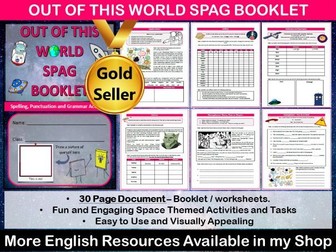
A fun and engaging space-themed booklet - designed to help students practice their key spelling, grammar and punctuation skills. This 30 page booklet contains activities and tasks covering:
word classes
prefixes / suffixes
plurals
verb tenses
capital letters
speech marks
high frequency words
proofreading
comprehension
end/ beginning sounds
synonyms/ antonyms
and more!
This document can be used as a booklet or printed off as individual worksheets. Perfect for whole class use, SEND/EAL/Lower ability interventions, homework, home learning and more.
Check out my shop for loads more free and inexpensive KS3 & KS4, Literacy and whole school resources.
A very fun lesson to boost grammatical understanding in Spanish following the popular Escape Room format. Barely any preparation time is required from the teacher. It includes a series of tasks covering a range of GCSE topics (school, local area, holidays and world of work) where students need to apply their knowledge of the present, preterite, present perfect, imperfect, conditional and future tenses of both regular and irregular verbs whilst developing their reading and translation skills covering different CGSE themes.
This Escape Room has the perfect level of challenge to prepare them well for their exam and develop their grammatical skills. The lesson includes a vocabulary bank and a grammar knowledge organiser, to support students, making it accessible to all KS4 and AS students. A very enjoyable lesson to develop team work, which includes regular progress checks so that teachers can consistently check understanding and progress. Instructions in English and Spanish for both teachers and students as well as answers included.
Spanish A Level Grammar Booklet. This booklet (120 pages) provides a very comprehensive study of the main grammar points needed at A level (sections of the booklet can also be used at GCSE level). Each section includes an explanation of a grammar point and a variety of activities to consolidate knowledge and understanding. The booklet is divided into the following sections:
1. Nouns
1a. gender
1b. number
2. Articles
3. Adjectives
4. Comparatives and superlatives
5. “Por” and “para”
6. Contractions
7. Negatives
8. Questions
9. Personal a
10. Relative pronouns
11. Possessive adjectives and pronouns
12. Demonstrative adjectives and pronouns
13. Direct object pronouns
14. Indirect object pronouns
15. Direct and indirect object pronouns used together
16. Apocopation
17. “Ser” and “estar”
18. Conjugating verbs
19. Present tense
19 a. regular verbs
19 b. irregular verbs
19 c. stem-changing (or radical-changing) verbs
19 d. reflexive verbs
19 e. “gustar”
19 f. back to front verbs
20. Preterite tense
21. Imperfect tense
22. Preterite vs imperfect
23. Present perfect
24. Past perfect (or “pluperfect”)
25. Future simple
26. Conditional
27. Commands (the imperative)
28. Present progressive (or “present continuous”)
29. Present subjunctive
30. Passive voice (and how to avoid it)
31. Conditional clauses
Verb tables
EDIT 23/05/2025
This is one of my best selling resources, with literally hundreds of sales. Some of you have mentioned that the resource could be improved by adding the answers to the activities, so I have.
If you have bought this resource in the past but, for whatever reason you cannot download the answers, you will find them all as a free resource on my shop (https://www.tes.com/teaching-resource/resource-13262872).
Thanks everyone for your kind feedback and continued support, and I hope this addition to the resource will make it even more useful.
Fifty-one multiple choice questions and one writing task designed to give you valuable insights into your students’ language abilities.
This test covers a range of topics including:
Basic Language Skills: This section assesses the students’ knowledge of the English language by testing their understanding of the alphabet, adjectives, verbs, nouns, adverbs, and connectives.
Sentence Structure Identification: This section tests the students’ ability to identify different types of sentences, including simple, compound, and complex sentences.
Noun Types and Modifiers: This section tests the students’ ability to identify collective nouns, plural nouns, fronted adverbials, expanded noun phrases, concrete nouns, and abstract nouns.
Figurative Language
This section tests the student’s understanding of figurative language, including similes, metaphors, personification, oxymorons, descriptive language, sensory details, alliteration, and assonance.
Punctuation Usage: This section tests the students’ knowledge of common punctuation symbols, such as full stops, question marks, exclamation marks, commas, quotation marks, and apostrophes.
Creative Writing Techniques: This section assesses the students’ ability to structure and organise their creative writing, as well as their ability to use different writing techniques to capture the reader’s attention.
Reading Comprehension
This section of the test helps you assess a student’s reading comprehension abilities. It can also help you to identify if your students may need additional support or instruction in this area. Additionally, this exercise can help you to gauge how well your students are able to extract and comprehend information from written material, which is an essential skill in many academic areas.
Creative Writing
This section is designed to help you assess your student’s ability to communicate their ideas in a clear and organised manner, their ability to engage and maintain the interest of the reader, and their ability to use appropriate grammar, punctuation, and vocabulary. This information can help the you tailor your instruction to meet the needs of individual students and to help them improve their writing skills.
------------------------------------------------------------------------
Not only will this test help you identify areas where your students need additional support, but it also comes with a mark scheme that includes low, mid, and high-ability example answers for the writing section. This makes it easy for you to quickly evaluate your students’ work and track their progress over time.
A series of posters to be used as display or put into a mini revision guide for 8 tenses (present, present continuous, present perfect, preterite, imperfect, near future, simple future and conditional). Each poster includes the endings for each tense, the most common time phrases/ adverbs it is used with, irregular verbs and examples. The colourful format makes it visual and eye-catching.
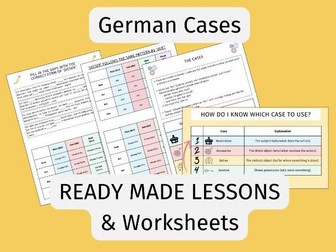
German Cases Made Easy: 2 Fun & Interactive Lessons on ‘Dieser’ and the cases.
Struggling to get your students to actually understand German cases?
This 2-hour lesson pack breaks down nominative, accusative, dative, and genitive using dieser in a way that actually sticks.
Here’s what you get:
110-slide presentation (yep, everything is covered – no prep needed!)
Super clear explanations with worked examples that make sense
Loads of interactive activities
Accompanying worksheets to reinforce learning
Fun plenaries to keep them engaged right till the end
Honestly, this lesson takes the pain out of teaching cases. Your students will get it—and maybe even enjoy it! Perfect for KS3, KS4 & GCSE German.
Goes superbly with:
German Cases - including adjective endings (lesson)
German Cases - 50 page grammar booklet
Any questions of feedback: TutorAlexandraABC@gmail.com
26 grammar tests for your A Level students on tenses and moods. (see previews for all aspects covered)
the .zip folder includes:
pdf and editable .docx versions of the 26 tests
Answers
a booklet with all the test combined (+ answers at the back): should you wish to give this to your students as an independent revision booklet
Note that a feedback grid is included on each test to facilitate your marking, but can be removed/ modified using the editable versions if necessary.
After downloading, save the file in the “my documents” area of your computer, then right-click and extract all to access all the resources
The first 3 files are a preview of what is included in the .zip folder
If you have any questions or if you are interested in more resources like this one, you can check this Facebook page: @frenchresources, where updates, links and freebies are posted regularly.
A useful grammar sheet containing a whole list of different tenses that students need to master for success at GCSE in Spanish.
Ways in which to use:
Print on A4/A3 and use as a handout
Print on A4/A3 and laminate - use as a ‘reference point’ in your lessons.
Print and use as a poster/display in your classroom
Upload to your Google Classroom/class page to help students with their revision
Many more!
Tenses covered:
Present Tense
Present Continuous Tense
Present Subjunctive Mood
Imperfect Tense
Preterite Tense
Perfect Tense
Near Future Tense
Simple Future Tense
Conditional Tense
For each tense, the following is included:
An explanation about what the tense is used for i.e. context
How to conjugate (i.e. keep the infinitive or take off the AR/ER/IR ending etc).
Common irregulars (note: not all irregulars could fit on the sheet, so just key irregulars included)
A verb conjugation table (i.e. AR/ER/IR verb endings)
A help box with a useful tip/trick - e.g. time expressions for that tense; trigger phrase examples; top tip for using that tense.
Follow my Instagram @thelanguagesteacher for more.
DESCRIPTION:
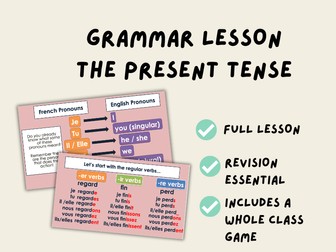
A clear and engaging PowerPoint lesson introducing the French present tense, designed to help students understand pronouns, verbs, and how to conjugate regular and irregular verbs.
The lesson guides learners step-by-step through –er, –ir, and –re verb conjugations, showing how to remove the infinitive ending and add the correct present tense endings. Key irregular verbs (avoir, être, aller, faire) are also introduced and practised.
Activities include pronoun matching, verb translation, guided conjugation practice, and a fun “Unfair Quiz” plenary game to reinforce learning.
Perfect for learning or recapping the present tense with CfE Level 3/4 or National 4/5 or indeed KS3/early GCSE, and ideal for grammar lessons, revision, or cover work.
This resource file contains a PowerPoint Presentation with a description of each tense/ mood covered at A-Level, practice activities and answers.
A total of 58 slides.
The powerpoint is hyperlinked so students can select the tense they want to view and practise from the first slide.
**PLEASE NOTE: This is targetted at A Level students. All the descriptions are written in French.
**
If you have any questions or if you are interested in more resources of this type, you can check this facebook page: @Frenchresources where links, updates and freebies are posted regularly
Each slide in this PowerPoint focuses on a different grammatical element. There is a section explaining the rules of the grammatical element to the student and another section with a task that allows the student to practise the usage. These slides can be slotted in to any PowerPoint as a starter task, used as an extension task, used as targeted feedback when marking or as extra revision for students. Or, they could be printed out and given to students as a SPaG booklet to work through. The aim being to improve students’ AO2, AO5 and AO6 skills.
Elements covered:
Adjectives
Adverbials
Apostrophes
Clauses
Colons
Commas
Complex Sentences
Compound Sentences
Coordinating Conjunctions
Discourse Markers
Modal Verbs
Nouns
Parenthesis
Past Tense
Perfect Tense
Prepositions
Present Tense
Pronouns
Relative Clauses
Semi Colons
Sentence Starters
Simple Sentences
Speech Marks
Subject Verb Object
Subordinate Clauses
Subordinating Conjunctions
Verbs
Please also take a look at my other resources.
Any feedback would be greatly appreciated. Thank you.
A booklet with a collection of basic spelling and grammar activities and spelling tests. Ideal for low level students, homework or tutor time/extension activities.
Made by our Spanish assistant, this powerpoint has cloze test style exercises and sentence translations (to and from Spanish)
I've found it really useful for individual revision work.