A graphic organiser that helps students to generate ideas in order to plan the writing of a climax for a narrative. This has been designed for the new AQA GCSE English Language paper 1 section B exam.
This is a series of worksheets and information sheets that I have created for the boys I work with in the Young Offenders Institute.
They are designed to be self-directed, but can also be used as part of classroom teaching.
This is perfect for learners studying Graphic Design, Art, or Design & Technology, at KS3-KS4.
This set:
Info - Logos
Task 04 - Logo Quiz
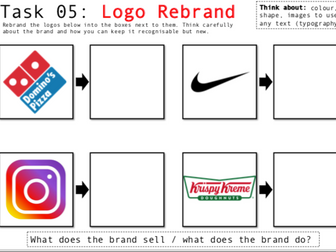
Task 05 - Logo Rebrand
Set 1
Task 01 - Colour Theory
Info - Colour Theory
Task 02 - Colour Schemes
Set 2
Info - Visual Language & Visual Elements
Task 03a - Visual Elements
Task 03b - Visual elements
Set 4
Info - Elena Gumeniuk
Info - Peter Judson
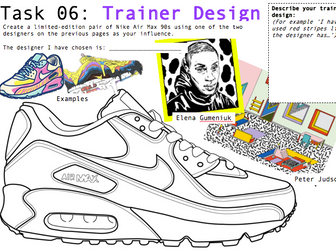
Task 06 - Trainer Design
Set 5
Info - Graffiti & Tags
Task 07 - Create a Personal Tag
Example graffiti fonts to trace
Inspiration sheet
Set 6
Info - Memphis Design
Task 08a - Memphis Style (with images to decorate)
Task 08b - Memphis Style (stretch & challenge task)
Set 7
Case Study - BAPE X2 pages
Task 09a - BAPE Designs
Task 09b - BAPE Designs (stretch & challenge task)
This list is not exhaustive, I will be creating worksheets regularly and will update the list as and when.
I have numbered the tasks to eventually collate them into a full booklet. I will be uploading the tasks and info in subjects (see above). Once I have created and uploaded them all I will create a bundle as well. I will also be creating a checklist so that as each sheet is completed, they can be ticked off.
Feel free to contact me with any questions and feedback!
I will be continually adding similar resources as I produce them.
**I have uploaded these as PDFs due to the large file sizes and to avoid any of the elements moving on the designs. If you require an editable copy, please email me nataliesheldon86@outlook.com **
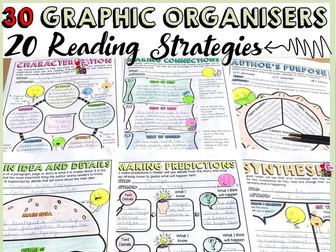
Teach your students 20 essential reading strategies. The 30 graphic organisers (colour and blackline) will help your students practise key reading strategies with any text they read.
Each graphic organiser provides an explanation of the reading strategy in focus. Students will be able to successfully document their findings via the writing prompts. The eye-catching graphics and student-friendly organisation will surely motivate the most reluctant.
ITEMS INCLUDED
✅ 30 BLACK AND WHITE graphic organisers to document the application of the reading strategies
✅ 30 COLOUR graphic organisers to document the application of the reading strategies
✅ 1 cover sheet (featuring name and grade) to compile all organisers into a booklet
✅ 2 page writing template
The reading strategies in focus are:
⭐ Author’s Purpose
⭐ Asking Questions
⭐ Cause and Effect
⭐ Characterisation
⭐ Compare and Contrast
⭐ Context Clues
⭐ Determining Importance
⭐ Drawing Conclusions
⭐ Fact and Opinion
⭐ Main Idea and Details
⭐ Making Connections
⭐ Making Inferences
⭐ Making Predictions
⭐ Problem and Solution
⭐ Setting
⭐ Sequencing
⭐ Story Elements
⭐ Summarising
⭐ Synthesising
⭐ Visualising
SUGGESTED USE:
Focus on one reading strategy at a time. Have students record their responses on the specific graphic organiser as they read. Use the writing templates if you would like students to write a paragraph/page from information documented in the organiser.
This resource will also be very useful to teach, review and apply the reading strategies in preparation for Naplan.
THIS RESOURCE IS INCLUDED IN THE BUNDLE:https://www.tes.com/teaching-resource/reading-strategies-bundle-11614333
this graphic organizer is very helpful to student teachers because it has 13 different methods that a teacher can use in her classroom when teaching language arts. Each method has its brief description.
A useful tool for after analysing the poem. Students would fill this in with the examples gathered in the analysing stage and unpack the specific effect of the language features/techniques and structures. They can also apply the Authors Purpose and their own Personal Response.
Suitable for senior students and exam prep.
Poetry Graphic Organizer. This poetry graphic organizer helps students understand the difference between sensory language and figurative language when used in poetry. Figurative language includes Metaphor,Simile, Personification, Hyperbole, and Idioms. Sensory language or poetic devices include Alliteration, Onomatopoeia, Assonance, Consonance, and Rhyme. Print out or project. - HappyEdugator
A Level English Language and Literature OCR EMC Anthology Non Fiction
A bundle of Non Fiction texts from the A Level English Language and Literature Non Fiction Anthology including Feel Good Review, Luke Healy Americana Graphic Non Fiction, Off Menu Podcast with Motsi Mabuse and the John Locke essay.
A complete pack is included for Feel Good Review, Luke Healy Americana Graphic Non Fiction, Off Menu Podcast with Motsi Mabuse and the John Locke essay.
Each pack includes:
• A two page student worksheet with a selection of activities and questions.
• A teacher’s suggested answers version of the worksheet.
• A 20+ slide activity PowerPoint reflecting all activities on the worksheet. Includes activities for the paired text.
• A paired text that can used as a comparative activity or timed writing or homework with the non fiction text from the anthology.
• A ten question PowerPoint comprehension quiz that can be shown on a whiteboard and students can mark their own answers.
• A lesson plan guide with the tasks split into three 30 minute sections. Work can, of course, be extended for longer sessions or 30 minute sessions can be put together for an hour lesson.
Each resource encourages close reading, critical writing, discussion and retention of important ideas and quotations from the review of the non fiction compulsory text from OCR’s EMC English Language and Literature A Level anthology. Students can be set the work independently or the work can be presented in a more collaborative class atmosphere.
The text is available in the OCR English Language and Literature Non-Fiction Anthology. Digital and print copies are provided by the OCR examining board for the teaching of this resource on the English Language and Literature A-Level.
All the images and texts used in the pack are available for commercial use. Please note, this resource does not reproduce the OCR examination questions as examination questions are the copyright of OCR.
Also available:
Bundle of Desert Island Discs with Liz Carr, Art Lab YouTube video, Roxane Gay speech and Lady Ann Fanshawe letter.
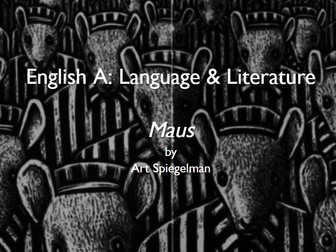
IB Diploma Programme English A: Language & Literature Literary Work unit guiding students through Art Spiegelman’s classic 1991 graphic novel Maus: A Survivor’s Tale. Around 20 lessons on a wide range of topics, using original source material and has student-centred tasks fully integrated. Go at your own pace, tasks can roll across lessons easily. Lots of assessment-oriented essay-writing material and comparison opportunities (here with Tennessee Williams’ A Streetcar Named Desire). TOK integrated. As a graphic novel, it is a great box-check for different text type, and is ideal for non-native students. Plenty of multimedia to make the classroom environment varied and engaging.
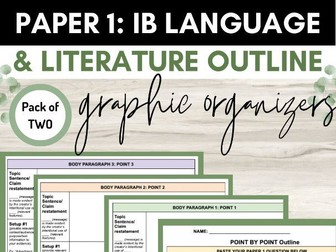
Looking for a zero-prep IB Language & Literature Paper 1 outline graphic organizer? Both outlines in the set are chunked by paragraph and contain prompts, sentence stems, and models to support the analysis of a non-literary text.
The outlines guide students in analyzing any non-literary text by examining the context, audience, purpose, and stylistic features. The outlines can be applied to any paper 1 question. Each outline is universally designed to meet the needs of all students.
INCLUDED:
TWO non-literary text analysis outline options.
Option 1: Block outline (body 1= feature 1, body 2= feature 2, body 3= feature 3). Recommended for students who need more writing support.
Option 2: Point by Point outline (each body addresses a different point while analyzing multiple features in each paragraph).
Additional information:
This resource is universally designed: differentiated outline options, scaffolded, chunked, sentence stems, prompts, and graphic organizer.
This resource can be used as print PDF and digital Microsoft Word.
These paper 1 outlines are aligned with IB Language & Literature, International Baccalaureate.
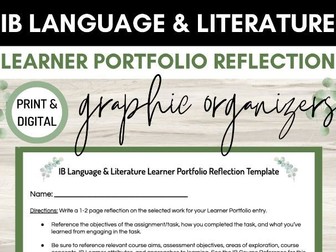
Looking for a zero-prep IB Language and Literature Learner Portfolio Reflection graphic organizer? This Lang and Lit reflection template prompts students to reflect on their coursework, learning, and experiences while incorporating an understanding of L&L course concepts, course aims, approaches to learning, assessment objectives, and IB Learner profile attributes in their response.
Stay consistent with your learner portfolio and save yourself time. This reflection organizer can be used for every reflection throughout Lang & Lit year 1 and year 2. All outlines are visually structured the same way with prompts, sentence stems, and model responses. All organizers are aligned to IB criterion and the Philpot rubric. All organizers use consistent IB Lang & Lit course language.
INCLUDED:
IB Learner Portfolio reflection directions
Reflection response template
Scaffolded & chunked graphic organizers for structured reflection
Reflection prompts, sentence stems, & model reflections
Lang & Lit course reference sheet (detailed: course concepts, aims, areas of exploration, assessment objectives, approaches to learning, & IB learner attributes).
Print PDF and digital Microsoft Word
Additional information:
This resource is universally designed: scaffolded, chunked, sentence stems, prompts, models, reference sheet, and graphic organizer.
This resource can be used as print PDF and digital Microsoft Word. (make a copy of the digital version to EDIT).
Aligned with IB Language & Literature, International Baccalaureate.
Aligned to Philpot rubric.
This expertly designed resource is tailored for IGCSE Edexcel English Language students, focusing on George Alagiah’s A Passage to Africa. It offers a comprehensive breakdown of the text, covering all essential aspects to support students in mastering analysis and exam preparation.
Concise Summary: A clear overview of George Alagiah’s reflections on human suffering and the ethical challenges of journalism during the Somali Civil War.
Language and Structure Analysis:
Language Devices: Analysis of graphic imagery, juxtaposition, metaphor, and alliteration, showcasing how Alagiah evokes emotion and reinforces his narrative.
Structural Features: Examination of techniques such as one-sentence paragraphs, juxtaposition within the narrative, chronological reflection, and cyclical structure, ensuring a deeper understanding of how the text is organised.
Ideal For:
IGCSE Edexcel English Language Students: Perfect for lessons, homework, or independent revision.
Teachers: A time-saving, ready-to-use resource to aid in lesson planning and student engagement.
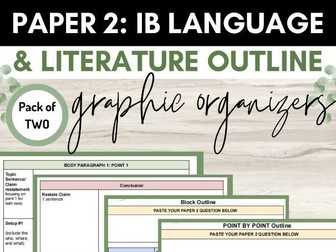
Looking for a zero-prep IB Language & Literature Paper 2 outline graphic organizer? Both outlines in the set are chunked by paragraph and contain prompts and sentence stems to support syntheses of literary texts.
The outlines guide students in synthesizing two literary texts. The outlines can be applied to any paper 2 questions. Each outline is universally designed to meet the needs of all students.
INCLUDED:
TWO literary text synthesis outline options
Option 1: Block outline (body 1= text 1, body 2= text 2, body 3= synthesis). Recommended for students who need more writing support.
Option 2: Point by Point outline (each body addresses a different point while synthesizing both texts in each paragraph).
Additional information:
This resource is universally designed: differentiated outline options, scaffolded, chunked, sentence stems, prompts, and graphic organizer.
This resource can be used as print PDF and digital Microsoft Word.
These paper 2 outlines are aligned with IB Language & Literature, International Baccalaureate.
This resource is something I designed to help embed literacy within my qualification.
The front of the resource contains a highly colourful range of examples to demonstrate the formal elements in Art and visual elements in Graphic Design.
The back of the resource contains:
Support for annotating work (with bullet points to encourage thinking)
Sentence starters to help reflect on positives about a piece of their design/art
Sentence starters to help reflect on areas to improve about a piece of their design/art
Sentence starters to help reflect on things the learner does not like about about a piece of their design/art
I chose to laminate these (double sided) and each learner has one in their folder to use as a point of reference if required. They would also work laminated and stuck to tables or even made larger and displayed on classroom walls.
This 35 term worksheet will help to introduce your students to designing a yearbook. Terms include: proof, orphans, bleed, ladder, caption, template, proofreading, and other relevant terms.
Can be used as a classwork assignment, quiz, or review. Word bank and answer key provided.
Revision infographic that provides learners with top tips and tricks for each question on AQA English Language Paper. Providing them practice and extra links to different revision resources.
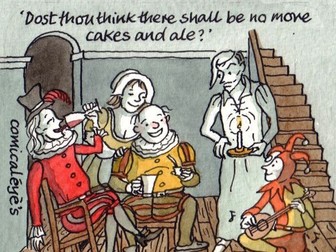
Romeo and Juliet, the whole play in a fun, stimulating graphic poster. Shakespeare’s themes of young romantic love pitted against meaningless, entrenched conflict, is one of the most moving stories ever told. Constantly adapted over hundreds of years, it is a story whose mix of joyfulness and tragedy touches us all.
Comical eye’s posters draw exclusively on the original poetry of the play to stimulate curiosity and conversation among students. They can be used as posters to make Shakespeare ‘cool’ or as aids to structure and support group discussion.
Our posters can also be bought from our website, comicaleyes.com, for £11.32 for A3 or £13.32 for A2, printed on semi-gloss 170 gsm (65 lb) FSC-certified sustainable paper.
Create an engaging, student-centered working wall with this Persuasive Writing Display and Graphic Organiser Pack. Designed to support your persuasive writing or opinion writing unit, this resource helps students build a deep understanding of persuasive texts while giving them ownership of the classroom display.
TEACHER CREATED/STUDENT TESTED!
This pack encourages active learning and critical thinking as students contribute examples, identify language features, and explore the purpose and audience of persuasive writing. The display grows alongside your unit, becoming a visual anchor chart and reference tool that supports learners at every stage.
What’s Included:
Display Headings to structure your persuasive writing working wall
Features of a Persuasive Text posters with clear explanations
Purpose & Audience Posters to guide student understanding
Graphic Organisers for exploring audience and text layout
Interactive Display Banners (e.g., “Add any connectives you have found in a mentor text”)
Headings for Displaying Model Texts
Critical Thinking Question Cards to deepen analysis of persuasive language
Sample Topics to spark ideas for persuasive or opinion writing pieces
Diverse Clipart included to reflect and represent all learners
This pack contains: 25 pages in colour & 25 pages in the B&W version
How to Use:
This pack is designed to work flexibly in your classroom. Use it to create a working wall that evolves throughout your persuasive writing unit. As students learn about persuasive language, arguments, and text structure, they add their ideas and examples to the display. The graphic organisers can be used as whole-class tools, small group activities, or independent reference sheets.
Why Teachers Love It:
✔ Supports both persuasive writing and opinion writing units
✔ Encourages active participation and student voice
✔ Provides clear visuals to scaffold understanding of features, structure, and purpose
✔ Doubles as a classroom display and teaching resource
✔ Adaptable for different grade levels and learning needs
This resource is perfect for making persuasive writing visible, interactive, and meaningful in your classroom.
Spice up your lesson overviews with 30+ Powerpoint slides and templates with funky, eye-catching designs. Add your own text and edit existing lesson objectives. Film, TV, Sci-Fi and different design themes.
Uniquely designed KIM Charts in portrait and landscape. Great for your student's vocabulary development.
Purpose: Identify and explain word meaning the meaning of key words and concepts; create visual representation of words and learn new words.
The KIM chart is a simple strategy for teaching vocabulary words and new
concepts.
A KIM chart has three columns:
K-Key Word or Concept
I- Definition of the word or information that matches the key idea M-Memory clue, a picture or visual representation of the concept
_________
These uniquely designed graphic organisers are licensed for use in your classrooms, home schools, sewing circles and revolutionary enclaves etc., (^_^)
__________
They are not for commercial use or redistribution but feel free to leave me message on TPT should you have a request.
KIM Chart Set by Michael Allen Kelly is licensed under a Creative Commons Attribution-NonCommercial-NoDerivatives 4.0 International License
__________
Source: Literacy for Learning: A Handbook of Content-Area Strategies for Middle and High School Teachers by Berry, Gregory, Ed.D pg. 264.