Are you learning Gujarati? Are you looking for a fun way to learn Gujarati? I have developed a way to learn different languages based on my experience as an ESL teacher. This pack has 57 different settings for students to talk about in Gujarati. The worksheets themselves are in English and the students do need to translate the places and objects they see into Gujarati. At the end of the session, the students can play a fun game of word bingo to show they have mastered that day's vocabulary. Try it, it is a lot of fun for everyone!
* Please note - these resources provide visual prompts, not specific language instruction.
Gujarati Bingo pack: This is a simple starter game for students. There are 114 different pictures to choose from. Select a single picture and project the image on the wall or share it with the class as a hand-out.
Let's Talk in Gujarati!: This set of cards looks at 57 different settings. The teacher describes something in the top card. The students then use this to model a sentence using the bottom set of pictures. There are lots of things to see and describe in every picture. When the students have completed this task, they can repeat it by working in pairs to discuss each picture.
Let's Write in Gujarati pack: There are lots of ways of using this teaching pack. It could be used as writing assessment for students learning Gujarati. The students could write about a topic in Gujarati before and then after a topic, using the second worksheet at the end of the topic.
Are you learning Gujarati? Are you looking for a fun way to learn Gujarati? I have developed a way to learn different languages based on my experience as an ESL teacher. This pack has 57 different settings for students to talk about in Gujarati. The worksheets themselves are in English and the students do need to translate the places and objects they see into Gujarati. At the end of the session, the students can play a fun game of word bingo to show they have mastered that day’s vocabulary. Try it, it is a lot of fun for everyone!
Welcome to the Gujarati Bingo pack.
This is a simple starter game for students.
There are 114 different pictures to choose from. Select a single picture and project the image on
the wall or share it with the class as a handout.
Talk about the picture and then ask your students to select and write down 5 items from the
picture. Then look at the picture and pick out all the key vocabulary you want them to talk about.
The first student to have all their items read out is the winner.
With 57 different settings and 114 different game cards, there are plenty chances for great
vocabulary.
***** Please note - these resources provide visual prompts and support to the students, not direct language instruction **************
This is a set of GCSE First Languages Speaking exam questions for General Conversation for Edexcel Exam Board: Arabic, Bengali, Chinese, Gujarati, Greek, Japanese, Persian, Punjabi, Portuguese, Russian and Turkish, Urdu.
When printed double sided, these flashcards of dolch sight words have English on one side, and the Gujarati translation on the back. It is helpful if you are trying to give meaning to sight words to students who are learning to read English while simultaneously beginning to learn English.
Welcome to the Let’s Talk in Gujarati! pack.
This set of cards looks at 57 different settings. The teacher describes something in the top card. The students then use this to model a sentence using the bottom set of pictures. There are lots of things to see and describe in every picture. When the students have completed this task, they can repeat it by working in pairs to discuss each picture.
What works very well is for the two pictures to be directly projected on a wall. The teacher talks about the top picture, such as 'In my picture, I can see two seagulls flying.'... then the students model their responses, using the sentence structure provided by the teacher.
There are lots of different ways you could use this pack. You could laminate them into two cards and get each student to talk about what they had seen in their picture.
*Please note - these resources provide visual prompts and support to the students, not direct language instruction
This publication has been produced in response to frequent requests for translated British Sign Language (BSL) materials for speakers of URDU, GUJARATI and BENGALI.
The translation work was carried out initially in 2004 with the help of the National Deaf Children’s Society and the original publications were printed and in poster/mat format.
Contains 40 signs in four topic pages translated into the three languages with fingerspelling alphabet borders.
GREETINGS
HELLO, WELCOME, GOOD, MORNING, AFTERNOON, EVENING/NIGHT, ALL RIGHT?, NAME, WHAT?, PLEASE/THANK YOU.
FAMILY
FAMILY, MOTHER, FATHER, SISTER, BROTHER, GRANDMOTHER, GRANDFATHER, HUSBAND/WIFE, FRIEND, NEIGHBOUR.
FEELINGS
FEEL, SAD, HAPPY, SCARED, ANGRY, FED UP, DON’T LIKE, HURT, UPSET, LOVE.
QUESTIONS
QUESTION, WHY? WHAT? WHEN? WHO? HOW? HOW OLD?, HOW MANY?, WHERE? WHICH?
The English meanings have been added below each sign and written descriptions for the sign movements have been added at the back of the publication to assist teachers and carers working in this field.
Supported by the Let’s Sign BSL collection of books, dictionaries, posters, flashcards, reward stickers and ebook/kindles.
I discovered a lot of my users bought my work and wanted more help on how to use it, and so I have extended my materials to now include a 31 page PowerPoint presentation on different ways you could use these language flashcards.
***** Please note - these resources provide visual prompts and support to the students, not direct language instruction **************
Welcome to the Let’s Write in Gujarati! pack.
There are lots of ways of using this teaching pack. It could be used as writing assessment for students learning Gujarati. The students could write about a topic in Gujarati before starting a unit, and then write again about the topic, using the second worksheet at the end of the topic to see how much they have progressed.
It could also be used as an introduction to guided writing. Students can write sentences as a class and share the sentences together and they can then write them on their own. Alternatively, students could work in pairs - one student dictates to the other what to write down about what they see in the picture.
These pages could also be used to write different stories, using the pictures as a stimulus.
Master the full Pearson Edexcel GCSE Gujarati 1GU0 course with this comprehensive 91-page revision bundle, covering all five prescribed themes through vocabulary, grammar, reading, translation, speaking and extended writing.
The 50-page student workbook is organised into ten structured 5-page units. Each unit includes a full-page topic and vocabulary guide, a full-page grammar masterclass and three pages of varied exam-focused practice.
Students revise identity and relationships, daily life, cultural life, holidays, travel, school, future ambitions, work, international events and environmental issues.
Gujarati grammar is developed systematically throughout, including gender and number, possessive agreement, pronouns, postpositions, verb agreement, aspect, present/past/future time frames, habitual and completed past, conditionals, passive structures, participles, gerunds, compound verbs and comparisons using કરતાં and સૌથી.
Practice includes:
Vocabulary retrieval
Grammar manipulation
Possessive agreement
Postposition practice
Tense and aspect control
Sentence reconstruction
Error correction
Reading comprehension
Inference
Gujarati-to-English translation
English-to-Gujarati translation
Authentic-style texts
Role-play practice
Picture-based speaking tasks
General conversation
80–90-word Higher writing
130–150-word Higher writing
Grade 8–9 Challenges
Examiner Report: Common Error guidance
Formal and informal register
Extended justification and complex structures
Speaking preparation reflects the Edexcel structure through Role Play, Picture-Based Task and Conversation, with original visual stimuli designed to support description, inference and spontaneous speaking.
A separate 41-page marking scheme provides complete answers, model translations, acceptable alternatives, Gujarati speaking models, extended-writing responses and task-specific assessment guidance.
Ideal for classroom teaching, homework, intervention, revision, mock preparation, independent study and examination preparation for Pearson Edexcel GCSE Gujarati 1GU0.
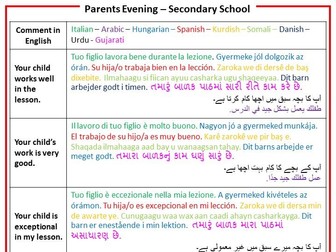
A super helpful resource to use at parents’ evenings with parents who have little to no English.
Stock phrases translated into Urdu, Arabic, Italian, Spanish, Kurdish, Gujarati, Hungarian, Danish and Somali.
Translated using Google Translate.
What’s Included
Detailed Summary – A clear explanation of the poem’s narrative and how it explores the tension between languages and identity.
Contextual Analysis – Insight into Sujata Bhatt’s background, migration from India to the USA, and her experience of linguistic and cultural conflict.
Themes & Key Ideas – Focused discussion of identity, displacement, bilingualism, personal growth, and resilience.
Language & Structure – Analysis of the poem’s extended metaphor, bilingual structure, imagery of growth and decay, and shifts in tone and form.
Comparative Links – Connections with Half-Caste by John Agard, highlighting shared ideas of cultural identity, pride, and misunderstanding.
Key Literary Features – Examination of metonymy, natural imagery, repetition, and the symbolic use of the Gujarati stanza.
Exam-Style Questions – Practice prompts to strengthen comparison and analysis skills in preparation for IGCSE exams.
Why Use This Resource
Exam-Focused – Designed specifically for Edexcel IGCSE & AQA GCSE Anthology study, meeting key AO2 and AO3 criteria.
Engaging & Accessible – Clear explanations with precise terminology, ideal for student revision or classroom discussion.
Flexible Use – Perfect for lesson planning, independent study, or homework consolidation.
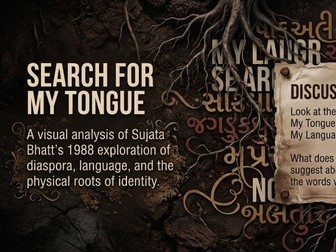
A discussion-first deck exploring Bhatt’s Search for My Tongue, covering its context of bilingual, bicultural identity, its distinctive three-part structure incorporating untranslated Gujarati script, and its themes of language loss and reclamation. Examines extended metaphor, code-switching, and structural mirroring through discussion questions and hands-on activities throughout.
File information: Non-editable PDF, Not an editable PowerPoint / How to use: Upload to your LMS for digital learning / Print selected pages for classroom use / Display pages to guide discussion and activities / Adapt in presentation or design platforms if desired (formatting may vary)
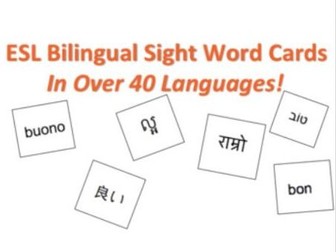
When printed double sided, these flashcards of dolch sight words have English on one side, and a translation on the back in sets of various languages. It is helpful if you are trying to give meaning to sight words to students who are learning to read English while simultaneously beginning to learn English.
Language sets Include:
Albanian
Amharic
Arabic
Bengali (Bangla)
Burmese (Myanmar)
Chinese (Simplified)
Czech
English only
Farsi (Persian, Dari)
French
German
Greek
Gujarati
Haitian Creole
Hebrew
Hindi
Hmong
Indonesian
Italian
Japanese
Khmer (Cambodian)
Korean
Lao
Nepali
Pashto
Polish
Portuguese
Punjabi
Romanian
Russian
Somali
Spanish
Swahili
Tagalog (Filipino)
Tamil
Telugu
Thai
Turkish
Ukrainian
Urdu
Vietnamese
Yoruba
This PPT helps to clearly show progress in the lesson. It is designed to be taught after the first reading and exploration of the poem. This lesson uses Padlet and a graphic organiser.
Use this whizzy loop by pressing the 's' key on your keyboard to start and stop it spinning super fast. You can change the text on the slides quite easily to suit your purposes - there is one here with numbers, one with dates and one with sentences on and several other ideas - at its simplest you can just ask pupils to translate the slide it stops on but you can use it in many, many different ways - put pupil names on it as a name selector, or sentences starters and a connective to build sentences - you choose. I have put several examples on here to help with ideas, but the concept of randomising things is the same throughout. Enjoy! The pupils LOVE coming to press the 's' key.....the simplest of things seem to please them.
This planning is deigned for a class of SEN students who are at Entry Level 1 and 2 in Maths. The planning includes lesson objectives, success criteria, links to game and ideas to games accessible on a laptop, includes lesson starters, PowerPoint’s, worksheets. The planning is differentiated.
I added extra lessons on ‘time’ as I like to teach what is meaningful to the students and the majority of students in this class are unable to tell the time.
Thanks for looking and happy teaching.


 Quick View
 Quick View
 Quick View
 Quick View
 Quick View
 Quick View
 Quick View
 Quick View
 Quick View
 Quick View
 Quick View