Instruments of the Orchestra - SOW & ResourcesQuick View
mdomine

Instruments of the Orchestra - SOW & Resources

(2)
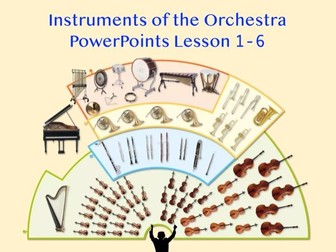
This a 5 lesson scheme of work to teach students about the instruments of the orchestra. This scheme can be used for KS2, KS3 or KS4. The aims of the scheme are: - To understand that the instruments are classified into 4 different families - To be able to identify the different instruments found in the orchestra - To understand how instruments produce, manipulate and amplify sound - To design and make their own musical instruments - To compose a piece of music using their own instruments - To complete a written assessment which also includes listening questions This resource includes the Scheme of work, detailed PowerPoints including pictures and audio to teach all the instruments, a homework task to produce an instrument and a final topic assessment (audio also included). This resource includes opportunity for both teacher and self-assessment.
GCSE Music – Revision – Sonority (Instrument Recognition)Quick View
NPTJ

GCSE Music – Revision – Sonority (Instrument Recognition)

(2)
Sonority – Instrument Recognition Questions The GCSE Music Specification includes many terms that students need to know, and be able to identify, but which aren’t covered by many of the styles of music studied. Using only music from Popular Music, this revision resource brings together every instrument, voice and ensemble (apart from “basso continuo”, for obvious reasons!) from the sub-menu “Sonority”, ie instruments, voices, and ensembles. In order to be accessible to students who really struggle with such things, there are 50 simple, 1-mark questions, which ask students to identify an instrument, voice type, or ensemble. In addition, there is also a bonus question alongside every simple question, for students who find such things easier – so 100 questions in total! So that the first group of students don’t feel like they’re underachieving, there are two different PDFs: one with just the 50 simple questions, and one with the bonus questions as well, so teachers can choose which to give their students. The questions are in ten sections: Strings Woodwind Brass Percussion Keyboards Rock and Pop Indian Voices Miscellaneous Ensembles The resource comes with a link to FREE audio, running for 1h15’, either as one file or ten separate files: perfect for a revision lesson, or as homework. The extracts cover a wide range of Popular Music, and features music by the likes of Eva Cassidy, Led Zeppelin, Björk, Yes, Primus, Tanita Tikaram, The Meters, Minnie Riperton, Tom Waits, Genesis, Jamiroquai, Badly Drawn Boy, Freak Power, Blood, Sweat & Tears, and The Cure! The bundle includes the full paper and mark scheme, plus two PDFs of questions (50, or 100), and mark scheme separately, in case you want to set it remotely. Please have a look at my shop for a wide variety of resources to support the GCSE Music course. www.tes.com/teaching-resources/shop/NPTJ
Standard Orchestral Instruments and VoicesQuick View
c_holdich

Standard Orchestral Instruments and Voices

(0)
A 2 page handout listing standard orchestral instruments, the clefs they use, their ranges and how they transpose. Great for use with the ABRSM Hints, Tips and 'Need to Know's sheet. for preparation for a theory examination or in the music classroom.
Autumn - A Quartet for Voices and InstrumentsQuick View
mariacollings

Autumn - A Quartet for Voices and Instruments

(0)
This resource is intended to be used as flexibly as possible by teachers and their students. It may be used as a stand-alone piece for performance, as a warm-up to a music or singing lesson or as a unit of work. Instrumentation The notation is for voices and any instruments. Any instruments which use the treble clef including tuned percussion may be used. Choose percussion instruments that evoke the atmosphere of the season of autumn. Crotchet and minim rests are included as I believe that students should learn the value of rests from the beginning and if so wished untuned percussion could be played during the rests to create different effects. ‘Autumn’ is intended to be the first of a series of short compositions for each season. Each increases in difficulty. ‘Spring’ and ‘Summer’ are already available. ‘Summer’ is the most difficult (which explores indeterminacy). ‘Autumn’ uses a repeating descending scale from ‘A to D’ against a repeating triad ‘C, E, G’. Using glockenspiels and xylophones will make it easily accessible. **Aims ** This quartet meet the aims and develop the skills set out in the National Curriculum for Music for Key Stages 2 and 3. (2013) and ABRSM music medals. This unit of work also supports ‘A national Plan for Music Education’ (2022, pp.15 -34). The set includes Teacher Notes; Full score in 4 parts for voices and instruments; Creative planning grid for Key Stage 2 with ideas for lessons and activities.
Group, voice or instrumentQuick View
NGfLCymru

Group, voice or instrument

(0)
This is a series of interactive appraising activities available to use with Area of Study 1; Music for Wales (WJEC) or general appraising. The activities have been divided into two sections with eight activities in both. * Style and tonality * Group, Voice and instrument This resource has been designed primarily to encourage discussion / group work.
Woodwind Instruments Work Sheet PackQuick View
EMSchooley

Woodwind Instruments Work Sheet Pack

(0)
A collection of 10 worksheets on woodwind instruments. Five different activities involved in the worksheets. Factfile writing Wordsearch Word unscramble True or False Quiz Times table coding sheet Fact files: Five fact file writing frames are provided in total; one for each of the following woodwind instruments - flute, oboe, clarinet, bassoon, saxophone. The fact file writing frames are structured with subheadings to guide student’s ideas. The worksheet works to promote student’s ability to research independently and transfer their research into their own words as well as organising their ideas… Wordsearch: wordsearch covering 12 key words regarding woodwind instruments. Answer sheet provided. Great for helping with spelling. Word unscramble: Focus on the five main woodwind instruments; flute, oboe, clarinet, bassoon, saxophone. True or False Quiz: 12 question quiz on the woodwind family. Answer sheet provided. Times table coding sheet: combining skills of times tables and woodwind instrument knowledge. Students solve the times table sums to crack the code and spell out the names of woodwind instruments. Worksheets could make great starter or plenary activities, or in the case of the writing frames - great inner-lesson activities. Worksheets work well in conjunction with the woodwind family lesson presentation, also available. Worksheets are presented in an easy-to-read, appealing format with a musical border and large text.
Africa by Toto (Eduqas) - Lesson 2 - Instrumentation & RhythmQuick View
NPTJ

Africa by Toto (Eduqas) - Lesson 2 - Instrumentation & Rhythm

(0)
EDUQAS GCSE MUSIC - AFRICA BY TOTO LESSON 2 - INSTRUMENTATION AND RHYTHM 34-page PPT and accompanying PDF workbook. Second in a series of six lessons designed to cover every aspect of the set work, Africa by Toto. Lesson 2 focusses on Instrumentation and Rhythm, looking at the usual, and more unusual instruments used in the song, such as recorder, marimba and gong. Clear examples and videos of each are given. The numerous rhythms features are presented clearly, with practical exercises to help students understand cross-rhythms and syncopation. There is a 10-mark exam-style question at the end, to consolidate the learning. Please see my TES shop for other resources designed to support the Eduqas GCSE course.
4 SONGS 4 CHORDS 4 INSTRUMENTSQuick View
musource

4 SONGS 4 CHORDS 4 INSTRUMENTS

(0)
KEYBOARD, GUITAR, UKULELE, BASS USING C F Am G in different orders. Songs have been transposed to suit the purpose of the learning, focusing on moving between those four shapes. On one occasion, you move to the G chord for one beat which is a great challenge for kids! Drums can easily be added and then used in a band setting so have also added a sheet of 4 drum beats to of varying difficulty. Enjoy!
Instruments of the Orchestra PowerPointsQuick View
keirfarrier

Instruments of the Orchestra PowerPoints

(0)
This resource only includes detailed PowerPoints. This is a six lesson scheme of work to teach students about the different instruments in an orchestra. It is targeted at KS2 or lower stage KS3. The aims of the scheme are: To study the four families of the orchestra. To recognise different instrumental timbres. To perform a piece of classical music on the keyboard. To complete an end of topic written appraisal assessment. Additional resources including an assessment worksheet, a scheme of work overview and homework can be purchased separately. This resource includes opportunity for the teacher and can easily be adapted for differentiation. Music is an integral part to the whole curriculum.
Instruments of orchestraQuick View
sonerersen

Instruments of orchestra

(0)
Powerpoint presentation, starter activity naming the instruments, orchestral families activity putting the instruments into the right families and listening activity identifying instruments from their sounds.
Instruments of the OrchestraQuick View
atyner

Instruments of the Orchestra

(0)
The booklet and other resources are the basis for a scheme of work on the Instruments of the Orchestra. This is aimed at year 7 pupils, but can be catered to work with other year groups.
Instruments of the Orchestra : PostersQuick View
AussieMusicTeacher

Instruments of the Orchestra : Posters

(2)
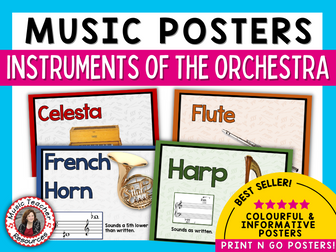
32 beautifully bright and colorful Instruments of the Orchestra cards that will make a stunning and educational addition to your music classroom. PRINTABLE FORMAT. Print, laminate and display on your classroom bulletin board. WHAT’S INCLUDED: One TITLE Card: Instruments of the Orchestra Four CATEGORY cards, each in a different color: The Percussion Family The Woodwind Family The String Family The Brass Family One card for each family showing all the instruments together. Included on each card are: The name of the instrument in bold, colorful letters A picture of the instrument The range of the instrument and A colored border matching that of the category it belongs to, i.e. all string family instruments have a green border. Double click on the images above for a closer look of what’s included in the resource! ♥ CLICK here to check out more quality, ready-to-use resources from the MTR store! You may also like this Key Signature Posters All rights reserved by the author. Permission to copy for single classroom use only. TES-Paid License
Instruments of the orchestraQuick View
AndrewHLee4994

Instruments of the orchestra

(0)
This includes an introduction to families and instruments of the orchestra, with lots of listening and appraisal throughout, a ‘keyboard orchestra’ performance (with parts for flute, clarinet, glockenspiel, violin, and trombone, all transposed into the key needed for keyboards), and a composition task and accompanying worksheet for noting ideas. I have taught this to year 7 for the last 3 years and they have always enjoyed it and the listening is particularly meaningful.
Musical Instruments and Instrumental Families LessonQuick View
EMSchooley

Musical Instruments and Instrumental Families Lesson

2 Resources
Lesson One of a series of 6 lessons designed to teach children about musical instruments and instrumental families Lesson one focuses on an introduction to different musical instruments and instrumental families with lessons 2, 3, 4, 5, 6 going into more detail on each individual instrumental family. The idea of these lessons is to enable children to learn about musical instruments, instrumental families, and music more generally without the need for any specialist musical knowledge or practical music resources like instruments. Lesson consists of a presentation and two worksheet packs. One worksheet pack on musical instruments and the other on instrumental families. There are more worksheets and activities as is necessary for one lesson to allows teachers and support staff to choose the most appropriate worksheets/activities for your students, and to allow the activities to cover a range of lessons and circumstances if need be. Some worksheets would make great starter / plenary tasks. Presentation covers each of the instrumental families in brief detail, covering key features of each, instruments belonging to each family. It also explains how instrumental families are assigned and why. Activities and questions are embedded throughout the presentation to encourage students to have an active part in their learning. Animations and colour are used in a subtle way to engage children’s attention without being over-stimulating. Worksheets involve a range of activities including: wordsearches, riddles, times tables, cut-and-stick, colour coding, unscrambling, matching, reading, and writing activities. Total of 15 worksheets included with answers where appropriate. Worksheets presented in a friendly manner with musical borders, simple instructions, and some images.
INSTRUMENT COLORING PAGES: WORLD INSTRUMENTSQuick View
jeisler250

INSTRUMENT COLORING PAGES: WORLD INSTRUMENTS

(0)
These coloring pages include three different versions of each page. One blank, one with boxes to label and one with boxes already labeled. The instruments featured in these coloring pages and not what you would typically find in an orchestra and can their origins can be traced back to several different areas around the world. The 4 family instruments include: Brass - Didgeridoo, serpent, sousaphone, bugle String - Banjo, erhu, ukulele, mandolin Woodwind - Bagpipes, ocarina, saxophone, tin whistle (Irish whistle) Percussion - Dulcimer, shekere, steel pan drum, djembe
Instruments of the Orchestra UnitQuick View
melody86

Instruments of the Orchestra Unit

(0)
I have created a full unit on Instruments of the Orchestra. This includes: Lesson format Powerpoint including video clips Quizzes with audio clips 3 Homework activities (with differentiated versions) Families flashcards Individual instrument flashcards Carnival of the Animals task with audio tracks In the Hall of the Mountain King sheet music for keyboard (three differentiated levels) Powerpoint learning about Conducting patterns End of unit assessment with audio clips
Name these InstrumentsQuick View
sbarrett05

Name these Instruments

(0)
Actually used this for an ICT lesson. Using Virtual Keyboard online and got children to listen to the sounds then choose the correct name. Also used for timbre.