Internal EnergyQuick View
BrainJar

Internal Energy

(0)
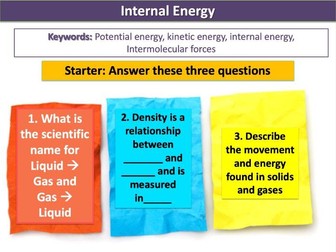
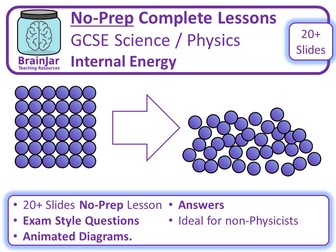
Complete No-Prep lesson with exam questions, tasks and answers on Internal Energy for AQA GCSE (9-1) Science / Physics. This lesson covers all of AQA GCSE Physics 4.3.2.1 / Combined Science 6.3.2.1 As a Secondary Science teacher and Deputy Headteacher for many years I make high quality no-prep lessons so busy teachers can teach outstanding lessons without spending hours planning. This high quality lesson includes explanations, different types of in-lesson assessment (all with answers) and unique exam questions. My lessons are ideal for non-Physicists - as a Biologist who retrained as a Physics teacher I know how to take learners on a journey that builds up their understanding step by step, while still going into a lot of depth. The preview video shows a representative sample of slides from the resource so that you get a good idea of what it includes before you buy. What’s Included: • Starter / Do Now Activity • Explanation slides in “chunked” sections with animated diagrams. • Multiple questions in different question styles and difficulties - no need for worksheets. Each “chunked” explanation section typically includes a set of “learning check / quick questions” followed by a set of in-depth questions on the learning from that “chunk” of the lesson. All questions have answers. • Exam-style questions on the whole lesson at the end of the lesson- these are unique, based on real exam questions but not just copied from exam boards. • Answers for all questions • All easily editable to adapt to your teaching or to use in existing lessons. • Slightly humorous, at points, if you like that sort of thing. Learning objectives: Define Internal Energy. Explain why heating a substance increases its internal energy. Explain why heating a substance until it changes state increases its internal energy. Written for AQA GCSE Science and Physics but likely to be applicable to other exam specifications. Please leave a rating / review and all other feedback gratefully received!
P6.4 Internal EnergyQuick View
OuttheBoxScience

P6.4 Internal Energy

(0)
New for the AQA GCSE 1-9 Combined Trilogy Unit ‘P6 Molecules and Matter’. Full lessons ready to use straight ‘out of the box’. Lesson meets the full criteria for this unit Similar structure to my other power points following the input - activity - review phasing Plenary sections for progress checking Clear learning objectives and outcomes Modern and engaging layout Little adaptation needed Each lesson covers at least an hour of lesson time 36 ppt slides Please leave constructive feedback :D
Topic 3 Edexcel International AS LevelQuick View
GregMcCullough

Topic 3 Edexcel International AS Level

11 Resources
Complete coverage of the Pearson Edexcel International AS/A Level Specifications topic 3. Learning outcome: 3.1 Know that all living organisms are made of cells, sharing some common features. 3.2 Understand how the cells of multicellular organisms are organised into tissues, tissues into organs and organs into organ systems. 3.3 (i & ii) Know and understand the function of the ultrastructure of eukaryotic cells, including nucleus, nucleolus, ribosomes, rough and smooth endoplasmic reticulum, mitochondria, centrioles, lysosomes and Golgi apparatus. 3.4 Understand the role of the rough endoplasmic reticulum (rER) and the Golgi apparatus in protein transport within cells, including their role in the formation of extracellular enzymes. 3.5 (i) & (ii) Know and understand the function of the ultrastructure of prokaryotic cells, including cell wall, capsule, plasmid, flagellum, pili, ribosomes and circular DNA. 3.6 Be able to recognise the organelles in 3.3 from electron microscope (EM) images. 3.7 (i) Know how magnification and resolution can be achieved using light and electron microscopy. 3.7 (ii) Understand the importance of staining specimens in microscopy Core Practical 5: 3.8 (i) Use a light microscope to make observations and labeled drawings of suitable animal cells. 3.9 (i) Know that a locus is the location of genes on a chromosome. 3.9 (ii) Understand the linkage of genes on a chromosome. 3.10 Understand the role of meiosis in ensuring genetic variation through the production of non-identical gametes as a consequence of independent assortment of chromosomes in metaphase 1 and crossing over of alleles between chromatids in prophase 1. 3.11 Understand how mammalian gametes are specialised for their functions (including the acrosome in sperm and the zona pellucida in the egg cell). 3.12 Know the process of fertilisation in mammals, including the acrosome reaction, the cortical reaction and the fusion of nuclei. 3.13 Know the process of fertilisation in flowering plants, starting with the growth of a pollen tube and ending with the fusion of nuclei. 3.14 Understand the role of mitosis and the cell cycle in producing genetically identical daughter cells for growth and asexual reproduction. 3.15 Prepare and stain a root tip squash to observe the stages of mitosis. 3.16 Be able to calculate mitotic index. 3.17 (i) Understand what is meant by the terms stem cell, pluripotent and totipotent, morula and blastocyst. 3.17 (ii) be able to discuss the ways in which society uses scientific knowledge to make decisions about the use of stem cells in medical therapies. 3.18 Understand how cells become specialised through differential gene expression, producing active mRNA, leading to the synthesis of proteins which, in turn, control cell processes or determine cell structure in animals and plants. 3.19 Understand how one gene can give rise to more than one protein through post-transcriptional changes to messenger RNA (mRNA). 3.20 (i) Understand how phenotype is the result of an interaction between genotype and the environment. 3.20 (ii) Know how epigenetic modification, including DNA methylation and histone. modification, can alter the activation of certain genes. 3.20 (iii) Understand how epigenetic modifications can be passed on following cell division. 3.21 Understand how some phenotypes are affected by multiple alleles for the same gene, or by polygenic inheritance, as well as the environment, and how polygenic inheritance can give rise to phenotypes that show continuous variation. Content: Lesson 1: Observing Cells History of the microscope and cell theory Light microscope Sample staining Magnification and Resolution Drawing scientific diagrams Electron microscopes Advantages and disadvantages Lesson 2: Eukaryotic Cells Recap of GCSEs Cell organelles There functions What the look like under a microscope Protein transport Lesson 3: Prokaryotic Cells All ultrastructures and their functions Classifying bacteria (including gram staining, shape and oxygen needs) Lesson 4: Cell Organisation Types of tissues Types of epithelial cells Plant and human organs GCSE recall of organ systems and their functions Lesson 5: Cell Cycle and Mitosis. All steps of the cell cycle Mitotic Index Core practical 6 Lesson 6: Sexual Reproduction, Gametes Structure and Function, and Meiosis Importance of sexual reproduction on variation Gamete structure, function and location The steps of meiosis I & II Variation from recombination and independent assortment Lesson 7: Fertilisation in Plants and Animals Internal and external fertilisation Pollination Plant fertilisation Human fertilisation Lesson 8: Cell Differentiation: Gene Expression Cell Differentiation Effect of Multiple Alleles Co-dominance Dihybrid Inheritance Linked Genes. Lesson 9: Interaction Between Genes and the Environment: Environmental effects on Phenotype (Including enzyme activity) Operons Studying Variation in Humans. Lesson 10: Controlling Gene Expression: Transcription Factors RNA Splicing Epigenetics (Including DNA and Histone Methylation, and Histone Acetylation) Non-Coding RNA Lesson 11: Stem Cells and Using Stem Cells: Blastocyst Development Types of Stems Cells Where Stem Cells are collected Epigenetic Control of haemoglobin development Stem Cell Therapy (including Therapeutic Cloning and iPS Cells) Examples of potential treatable conditions Ethics
International Men's Day 2025 AssemblyQuick View
thejennii

International Men's Day 2025 Assembly

(0)
Brand new International Men’s Day assembly featuring: -Famous quotes -Reflection questions -An explanation for why we need an ‘International Men’s Day’ -Definition of ‘Toxic Masculinity’ -Video clips exploring the themes of ‘how to be unapologetically you’ and ‘not being afraid to show emotions’. Should take between 10-17 minutes. Could be used as a year or house group assembly, during form time or as part of a PSHE lesson.
Global Interdependence Cambridge InternationalQuick View
TheGeographyShopOriginal

Global Interdependence Cambridge International

12 Resources
Global Interdependence Cambridge International Topic 13: Global Interdependence Free Lesson 1 - https://www.tes.com/teaching-resource/-12762074 This SoW has been created to meet the teaching requirements of Topic 13 Global Interdependence , which is a component of the Cambridge International A-level course. This SoW is designed in detail and is both differentiated and engaging, and allows you to move pupils through content efficiently. As a result, lessons take around two hours to deliver and hit the required components of the syllabus (see syllabus code). Made to the highest standard and constructed using current research, both dual coding and retrieval practices are at the heart of this unit. A colour scheme also runs throughout to ease both your delivery and students comprehension. This resource is a part of a scheme that covers the entire A-level topic (Global Interdependence), which can be viewed using the link below: SoW: Global Interdependence L1: How do Goods and Services Create Economic Prosperity? L2: What Factors Affect Levels of Trade in an Area? L3: How is Global Trade Regulated? L4: What are the Causes and Effects of International Debt? L5: What are the Characteristics of International Aid? L6: What are the Cause and Effect of the Growth of International Tourism? L7: What is Driving Global Trends in Tourism? L8: Tourism Case Studies - Jamaica and Ecuador L9: Machu Picchu thegeographyshoporiginal@gmail.com Best FREE Resources (The Geography Shop) https://www.tes.com/teaching-resource/-12899088 (Climate Change SoW) https://www.tes.com/teaching-resource/-12899440 (Development SoW) https://www.tes.com/teaching-resource/-12638984 (Waste SoW) https://www.tes.com/teaching-resource/-12451443 (Britain Globalisation SoW) https://www.tes.com/teaching-resource/-12741793 (Local Area Investigation SoW) https://www.tes.com/teaching-resources/bundler/12949461 (Cambridge International) https://www.tes.com/teaching-resource/-12922653 (Israel & Palestine) https://www.tes.com/teaching-resource/resource-12485457 (What is Geography?) I hope you find this SoW useful. If you have, I have created a series of resources. You can check them out here. https://www.tes.com/teaching-resources/shop/TheGeographyShopOriginal
GCSE Physics Internal Energy: Complete LessonQuick View
Malachite44

GCSE Physics Internal Energy: Complete Lesson

(1)
**Save 61% with the Complete Temperature and Heat Transfer Bundle! ** Get this lesson as part of our GCSE Temperature and Heat Transfer Bundle and enjoy a huge discount! Instead of buying lessons individually, grab the entire unit with 9 lessons, including the required practicals, for just £7.00. Click here to get the bundle now: https://www.tes.com/teaching-resource/resource-13155109 This PowerPoint resource provides an in-depth explanation of the concept of internal energy and its relationship to particle motion and changes of state. It is designed to help students grasp key physics principles about energy transfer, particle dynamics, and phase transitions. Key learning objectives include: Understanding what internal energy is and its components—kinetic energy and potential energy of particles. Describing how internal energy changes with temperature and during changes of state. Explaining the role of particle arrangement and energy transfer during melting, boiling, condensation, and freezing. The resource begins with an engaging starter activity to activate prior knowledge, such as defining specific heat capacity and exploring the effect of energy on temperature change. Students are introduced to the definition of internal energy as the sum of kinetic and potential energy in a substance. Through clear explanations, diagrams, and interactive tasks, students learn how particle energy changes with heating and how this impacts states of matter. The presentation also covers the increase in potential energy during phase transitions like melting and boiling and emphasizes the constant temperature during these changes, supported by heating graphs. Students practice applying these concepts through guided questions, gap-fill activities, and scenario-based problems. This ‘.pptx’ file is fully editable, making it suitable for customization to specific class needs. It aligns with high school physics curricula and supports key exam topics. This resource is an essential tool for teaching the principles of internal energy and particle behavior.
International A Level Sociology CambridgeQuick View
xhagan

International A Level Sociology Cambridge

(0)
The Family Paper 2- with exam questions, PPT’s and worksheets applicable for face to face teaching and online learning. • Theories of the family and social change. • Perspectives on the role of the family • Diversity and social change • Family roles and changing relationships. • Gender equality and experiences of family life • Age and family life
Cambridge International AS & A Level PhysicsQuick View
geoffreyosuri

Cambridge International AS & A Level Physics

9 Resources
This Cambridge International AS Level Physics Complete Bundle (Topics 1–11) is a comprehensive set of classroom-ready PowerPoints designed to fully cover the syllabus with clear explanations, worked examples, practice problems, and visual aids. Perfect for teachers and students, this bundle provides structured content for lessons, revision, and exam preparation. The bundle includes all 11 core topics: Physical quantities and units – SI units, measurement techniques, uncertainties. Kinematics – motion graphs, equations of motion, projectiles. Dynamics – Newton’s laws, momentum, impulse, collisions. Forces, density and pressure – equilibrium, moments, torque, density and pressure. Work, energy and power – conservation of energy, efficiency, KE, GPE, power calculations. Deformation of solids – stress, strain, Young modulus, Hooke’s law. Waves – wave properties, reflection, refraction, diffraction. Superposition – interference, standing waves, diffraction patterns. Electricity – current, resistance, resistivity, electrical energy and power. D.C. circuits – Kirchhoff’s laws, potential dividers, practical applications. Particle physics – atomic models, fundamental particles, interactions. Each presentation is designed for effective teaching, revision, and independent learning, with theory, worked examples, and exam-style questions to strengthen understanding.
Internal energyQuick View
TomatoStrawberry

Internal energy

(0)
The lesson includes Do it now task, a starter, a game, differentiated questions and a true or false plenary. The snakes and ladders game is a brilliant way to revise or to consolidate the kinetic theory of particles with AQA GCSE classes. It includes questions about states of matter, changes of state and internal energy. All you need is to print Game on A3 paper and answer sheets to check the answers. You will also need diced and counters. It’s engaging, collaborative, fun and memorable to students. The lesson is suitable for an observation.
Edexcel International AS Geography - Going GlobalQuick View
mollydurnall

Edexcel International AS Geography - Going Global

(2)
This Going Global scheme of work is designed for the Edexcel International A-Level Geography syllabus, covering key themes of globalization, interdependence, migration, and global governance. With fully resourced lessons, this pack ensures a structured, engaging, and exam-focused approach to teaching. What’s Included? Full lesson PowerPoints with engaging visuals and structured activities Do Now retrieval activities to activate prior knowledge Varied tasks including case study analysis, and independent research Flipped learning activities to encourage student-led inquiry Exam practice with past paper-style questions and model answers Plenaries to consolidate learning and check understanding Week 1: Global Economic Connections Week 2: Organisations and Globalisation Week 3: Winners and Losers Week 4: Population and Resources Week 5: Migration Week 6: Urbanisation
Nigeria: The Impacts of International AidQuick View
markthegeographer

Nigeria: The Impacts of International Aid

(1)
AQA GCSE Geography Lesson for the Nigeria: A Newly Emerging Economy unit. The lesson is at lest one hour long, but is easily extended into two lessons. The lesson begins with a photo interpretation starter to introduce the pupils to some of the poverty in Nigeria. We then look at two families in Nigeria, the pupils investigate their living conditions and access to safe water, sanitation and electricity before deciding if the family would benefit from aid and if they represent the majority of Nigerian families. We the look at the benefits of International Aid and the reaons why aid may not be used effectively. We use a GCSE-style question to investigate the latter. Included in the lesson is: Photo interpretation starter Families task: comparing living standards (how will aid benefit them?) Hexagon factor task explaining how aid benefits Nigeria. GCSE style question on how aid might not be used effectively. Hope this helps. https://www.tes.com/teaching-resources/shop/markthegeographer
Reading & International Literacy DayQuick View
Cre8tive_PSHE

Reading & International Literacy Day

(1)
New Primary Assembly - Assembly Topic: International Literacy Day. The theme this year is Literacy in a digital world and it starts September Each Assembly Contains: 1 Fully Editable PowerPoint (Clear structure, Assessment of Learning, Beautiful presentation, Video Embedded URL Clips, Engaging Premium Quality Slides & Thoughtful Questioning) Designed by a PRimary School Teacher and DHT. Mapped against Latest DfE Guidance, PSHE Association Core themes and Requirements The Cre8tive Curriculum way! Our shared vision at Cre8tive Curriculum is to help teachers to equip students with the knowledge and skills to take ownership of their own learning and become independent critical thinkers. Products come ‘Ready-to-Teach’ with everything you need for educational, fun and creative lessons. Be Ofsted and DfE PSHE ready with our resources! Product Code: RSE/C8/APT/06 Why not check out our other popular PRIMARY resources here: Assembly - Back to School After Lock down Assembly - Importance of Expressing yourself Assembly - Powerful Women + Role Models Assembly - Recycling Assembly - Coping with Change Assembly - International Literacy Day Assembly - Importance of Helping Others Assembly - Healthy Eating Habits Assembly - Bullying Prevention Week Assembly - Being Thankful and Grateful
GCSE Physics: Internal EnergyQuick View
TeachScienceBeyond

GCSE Physics: Internal Energy

(0)
A whole lesson including starter activity, AfL work tasks and main work task all with answers on Internal Energy By the end of this lesson KS4 students should be able to: Describe the particle model of matter Understand what is meant by the internal energy of a system Describe the effect of heating on the energy stored within a system The teacher will be able to check students have met these learning objectives through mini AfL tasks for students to complete All tasks have worked out answers, which will allow students to self assess their work during the lesson
2025 International Day of Education AssemblyQuick View
wilfredsw

2025 International Day of Education Assembly

(0)
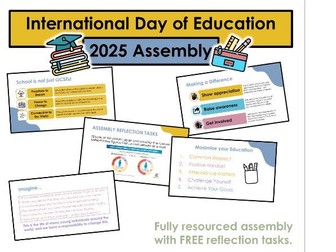
This fully resourced assembly is packed with information, videos and discussion points around UNESCO’s International Day of Education which takes place on the 24th January 2025. This assembly includes: an engaging hook/situation statistics and vital figures quotes to explore and reflect on information about the event discussions about the theme embedded videos with questions links to importance of school school values/rules how to make a difference assembly reflection including- statistics reflection questions writing a pledge The assembly is designed for KS3/KS4 students and should hopefully offer a fresh perspective on key ideas such as ethical discussions around AI and allow students to compare their situations with those of others and consider the importance of education. If you find this resource useful then please leave a review and email me for your free assembly. Please contact me if you have any troubles and I will do my best to resolve it for you!
International Conflict - Citizenship RevisionQuick View
Cre8tive_Resources

International Conflict - Citizenship Revision

(0)
GCSE Citizenship 9-1 Revision Cards x20 keyword topic revision cards International and Domestic conflicts This resource includes: x20 keyword topic revision cards with Included pictures x20 keyword topic revision cards with a drawing activity instead Each key word topic revision card includes. Key Term, Definition, Synonym, Example of the word in a sentence, Picture or Icon and two or three GCSE 9-1 Exam Technique Qs��� You have two version one with Pictures and one without. (Allowing students to draw their own image to represent the key terms) These are designed to help your students learn the new vocabulary required for the new GCSE CITIZENSHIP 9-1 This resource is also useful for PP / EAL / SEN students and those with literacy needs. They will also help your most able students with exam technique and remembering ‘wow’ words to boost their responses in extended essay questions. If you find these useful, check out our other revision sets suitable for GCSE Citizenship 9-1. How can they be used? Here are just a few examples of how our exam classes use them. Student complete the Q’s and draw in the pictures. -Hide them around the room and have students find them before introducing a new topic (Find links between different topic cards) Matching up activity. Cut the topic cards in half and have students find the matching pairs. -Encourage students to come up with their own extra key term topic cards or extra sentence they can use to include several key terms. -Literacy support when writing essays. -Revision material before exams. Have a set laminated and cut out at the back of the classroom in a box for extension activities. Search ‘Cre8tive Resources’ for support with our library of resources or send us an email. Leave a review and email TheCre8tiveResources@gmail.com for a free resource as a thank you!! Explore all our resources on TES
International A Level English A* GuideQuick View
preetgabria11

International A Level English A* Guide

(0)
I have noticed that there aren’t enough resources available for Edexcel Pearson International students, especially for humanities subjects. Which is why I curated this guide that is useful for Units 1, 2, 3 and 4. Contains a breakdown of analysis techniques, theories and buzz terminology. Also features my sample answer for Unit 4. _I scored an A* as my final grade and my answer was featured in the Unit 4 2022 Examiner Report as level 5- just to galvanise some credibility for the guide :)
International Day of Women and Girls in ScienceQuick View
tcb89

International Day of Women and Girls in Science

(2)
A short PowerPoint on five different women in history who made significant contributions to Science. A link to a piece of Richard Strauss' Also Sprach Zarathustra is provided. Should last some 15 Minutes.
Maths Murder Mystery International ChallengeQuick View
andrewchambers

Maths Murder Mystery International Challenge

(1)
Uses Caesar shifts, Pigpen, binary, mirror writing, transposition ciphers and more to solve a murder in the maths department! Follow the web link to play online free - students who solve will be added to the international leaderboard. Solutions added here for teachers to be able to provide hints where required.
Internal EnergyQuick View
Chrisbsn

Internal Energy

(10)
A simple presentation to aid basic understanding of internal energy (Thermal Physics)