This KS3/4 physics worksheet explores the fundamentals of waves, light and sound through a mix of clear explanations, engaging questions and real-world applications. Students will classify transverse and longitudinal waves, label and describe key wave properties, and use the wave equation to calculate speed, frequency and wavelength. They will work with amplitude–time graphs, link pitch and loudness to frequency and amplitude, and apply their understanding to everyday examples such as lightning and thunder, colour filters, and why black clothes feel warmer in sunlight. The electromagnetic spectrum is covered in detail, with ordering by frequency, wavelength relationships, and calculation of frequencies for red and blue light, alongside a research-style challenge on practical uses for each type of wave. The worksheet contains recall, application, and calculation questions, encouraging independent thinking and problem-solving. Full answers are included to support marking, peer assessment, or self-checking. Designed to take around 40–50 minutes, it is ideal for classwork, homework, or targeted revision.
If you found this resource valuable, consider exploring my other maths and physics worksheets!
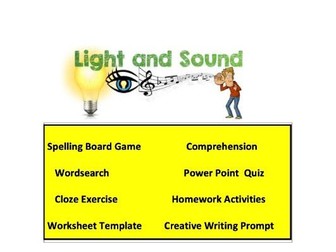
A unique set of activities that will engage your students focus, ignite their learning and strengthen your L & S unit of work.
**Spelling Board Game **- L & S themed words
2x A4 playing boards - join together. Enlarge to A3 for best results
54 squares on the playing board.
16 Game words - In addition, use the Game Word Template option to create your own words for the Spelling Game
Game instructions
Game Life Cards
**Spelling Worksheet Template **- Type in your own Daily Themed Target word - 10 questions on each sheet. Edit the questions to suit your own targets
**Homework Activities x 3 ** to take around 30 minutes for each activity based on the L & S theme
**Creative Writing Prompt **- L & S Adventure
Crossword - L & S theme
**Powerpoint Quiz **- L & S theme
**Comprehension x2 **worksheet- L & S theme
**Cloze **Exercise worksheet- L & S theme
**Word Search **worksheet- L & S theme
**Certificate Template **- edit and use as necessary
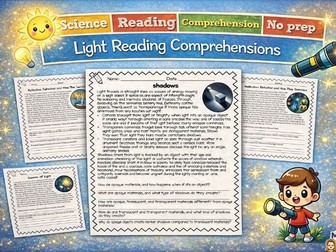
Engage young learners with this comprehensive Light Reading Comprehension Pack, designed to explore the fascinating world of light, shadows, and sun safety. Perfect for ages 7-10, this educational resource blends science with literacy to build knowledge and comprehension skills.
T includes analyzing shadow patterns, understanding transparent, translucent, and opaque materials, and learning essential sun safety tips, like the role of sunglasses and sunscreen. Beautiful illustrations enhance learning, keeping readers interested and excited.derstanding, encourage critical thinking, and expand vocabulary.
The reading comprehensions include analyzing shadow patterns, understanding transparent, translucent, and opaque materials, and learning essential sun safety tips, like the role of sunglasses and sunscreen. Beautiful illustrations enhance learning, keeping readers interested and excited.
Ideal for classrooms, homeschooling, or independent study, this pack helps children master light-related concepts while boosting reading confidence. Illuminate learning with this must-have resource!
Differentiated for different levels: 6 short readings or 1 long reading (2 pages) with answer sheets (2 pages) for older children.
Take a peek at the preview for a better picture of what is included!
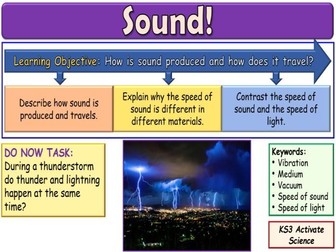
Perfect lesson resource for KS3 Physics! A fully differentiated and resourced lesson that assists students in learning about how sound is produced and how it travels. Students will describe how sound is produced, explain why the speed of sound is different in different materials, and contrast the speed of sound and the speed of light.
The resource includes a detailed and engaging lesson PowerPoint with differentiated activities and quizzes for students to complete. This resource is part of the Sound topic and has been created for the delivery of the Activate KS3 Science course. Also great for GCSE Science.
18 slides in total for the lesson PPT
Thankyou for looking at my resource
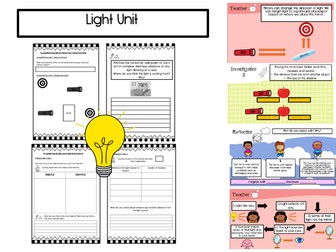
This unit is made up of five lessons.
Each lesson Includes a fully comprehensive powerpoint and word resources catering a range of abilities.
Lesson 1 - To identify examples of natural and artificial light sources
Lesson 2 - To explain how light is reflected by different materials
Lesson 3 - To understand how light is reflected by different mirrored surfaces
Lesson 4 - To explain how the Sun can be helpful and harmful
Lesson 5 - To explain why objects cast shadows and explain how they change
All lessons start with active rewind (recap) tasks. These provide an informal assessment for teachers, remind children of their prior learning to help learning go into their long term memory and put relevant prior learning in the forefront of children’s minds as they acquire new learning.
Children will have stem sentences to support oracy and enable children to focus on the learning rather than forming sentences.
Independent task
In each lesson children will be built up to completing an independent task/s.
Every task has a helping hands task which aims to remove barriers to children accessing the main task such as using stem sentences to allow children to focus on their learning not the structuring of sentences.
The chilli challenge should be provided to all learners the ’ differentiation ’ will be based on how children complete the task.
Please click here for the complete Year 3 Science Posters resource.
This is a poster to reinforce the year 3 science topic: Light. The beautifully designed poster is packed full of information and can be either used for revision or as part of a display in your classroom. PLEASE NOTE: The misalignment in the 2nd preview (the Word version) is not a reflection of how it looks, but a TES issue with generating previews.
Objectives covered:
Recognise that they need light in order to see things and that dark is the absence of light
Notice that light is reflected from surfaces
Recognise that light from the sun can be dangerous and that there are ways to protect their eyes
Recognise that shadows are formed when the light from a light source is blocked by an opaque object
Find patterns in the way that the size of shadows change
Media studies GCSE Lighting and Sound lessons including interactive clips and station exercise.
Differentiated station sheets.
Speaking and listening skills through presentations.
Challenge links to Barthes, Propps and Maslow.
A fully differentiated lesson on frequency, that fits with the AQA Light and Sound KS3 Scheme of Work and could also be used for GCSE. All activities have the resources included.
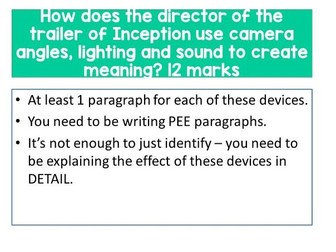
A fun and interactive double lesson learning about different camera angles, lighting and sound. Can also be used for revision purposes.
Students learn about a range of different camera angles, lighting choices and their effects. Students also learn the different between diegetic and non-diegetic sound and consider how all of these choices create meaning. Students then apply their learning to independently answer an exam style question before reviewing their learning.
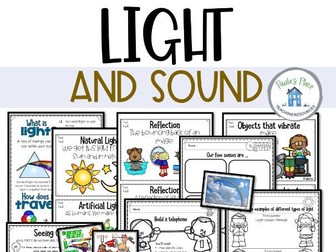
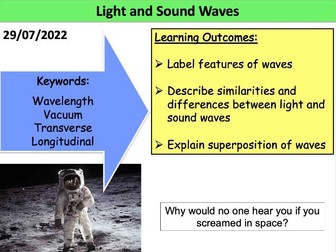
PowerPoint Presentation introducing light and sound.
Content:
What is light and sound?
How do they travel?
How are they different?
Measuring both?
Included:
Activities
Definitions
Visual representations
Diagrams
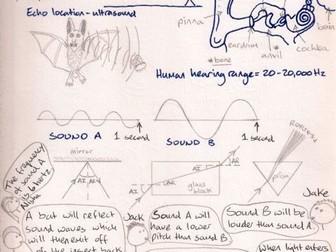
Scanned from my sketch book.
This activity is a great way to summarise a topic and challenge pupils on a range of concepts covered. Pupils should write the name of each character, decide whether they agree or disagree with the statement and justify their decision. This can be used to promote pupil discussion in the classroom. The imagery in the middle of the sheet can be used to help pupils make their decisions.
Tips:
Replace the names of the characters with pupils in your own class by putting a sticky note over the top and writing in :)
After printing, trim the bottom and side for a perfect fit for pupil exercise books :)
4x Drama Puzzle Activities for Lighting and Sound . A set of engaging no preparation editable puzzles for your students to practice their Drama skills
Each differentiated puzzle has a complete answer set and a muddled puzzle set ready to print. Each set also comes with an optional placeholder template which can be used to help differentiate downwards.
Students love this engaging and entertaining style of learning. Tarsia puzzles are a great way to reinforce learning on a topic or to assess learning either before starting a topic or after teaching a topic.
**Contents of this Tarsia Puzzle Set **
☞ 1 x Lower Ability 6 piece Puzzle
☞ 1 x Lower Ability 6 Piece Puzzle
☞ 1 x Middle Ability 16 Piece Puzzle
☞ 1 x Higher Ability 24 Piece Puzzle
☞ 4 x Placeholders with marking criteria
☞ 4 x Full set of Answers Sheets for all puzzles
☞ 1 x Set of three blank templates for students to make their own Tarsia Puzzles
☞ 1 x Set of simple teacher and student instructions
✰✰✰✰✰✰✰✰✰✰✰✰✰✰✰✰✰✰✰✰✰✰✰✰✰✰✰✰✰✰✰✰✰✰✰✰✰
How could you use it?
Assess Prior knowledge
As a class based activity / Team activity
An educational ‘Treat Activity’ For your students.
Top Tip
Laminate your own class set and you can use them year after year…
✰✰✰✰✰✰✰✰✰✰✰✰✰✰✰✰✰✰✰✰✰✰✰✰✰✰✰✰✰✰✰✰✰✰✰✰✰
Who are Cre8tive Resources?
We are a not-for profit Community interest social enterprise made up of Teachers. We invest in developing more free and paid resources for students.
Product Code: C8/TA/34
✰✰✰✰✰✰✰✰✰✰✰✰✰✰✰✰✰✰✰✰✰✰✰✰✰✰✰✰✰✰✰✰✰✰✰✰✰
Search ‘Cre8tive Resources’ for support with our library of resources or send us an email.
Leave a review and email TheCre8tiveResources@gmail.com for a free resource as a thank you!!
Explore all our resources on TES
Save time, increase student interest and review related vocabulary with this bingo game. Full version includes multiple clues for each concept and 25 total bingo cards. No two bingo cards are alike. Each card contains a statement, definition, example, graphic or fill-in-the-blank which corresponds to a clue.
Includes transverse and compression waves, telescopes, microscopes, refraction, reflection, opaque, transparent, translucent, ultrasound, sonar, electromagnetic spectrum, amplitude, wavelength, frequency, concave/convex lenses and more. Markers include graphics which help students visualize concepts.
To make long lasting cards, run on card stock and laminate. It is easy to add in your own clues or even use student generated clues, worksheets or workbooks for additional clues.
Teacher can choose which cards and clues for specific topics or use all the cards for review or introducing a unit to assess student background knowledge.
DIFFERENTIATION NOTE: Card titles vary slightly so the teacher can differentiate instruction by level of difficulty. See directions for a full explanation.
Teaching suggestion: Have students silently or with a partner read over their cards before beginning and allow them to ask questions before starting. Teacher reads the marker chip and students must find their corresponding marker and place it on the appropriate spot. Allow students to mark any square/spot/answer that fits the marker. Some cards contain pictures which might fit multiple concepts. Base your acceptance on their rationale. (The pictures match is not a good rationale.)
When a student has 4 in a row and calls bingo, they must read aloud the marker and square chosen. If they are correct, they win. Clear cards, trade cards (teacher's choice) and play again. If they are incorrect, the first student who raises their hand and corrects the mistake gets to cover any square of their choice as a bonus (promotes listening). Game continues.
Light loop card game. Light and sound RAFT activity, (students have to choose which activity/row they would like to complete) and lights and sound venn diagram.
 Quick View

 Quick View
 Quick View
 Quick View
 Quick View
 Quick View
 Quick View
 Quick View
 Quick View
 Quick View
 Quick View
 Quick View