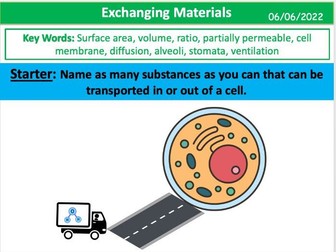
New for the AQA GCSE 1-9 Combined Trilogy Unit ‘B1 Cell Structure and Transport’.
Full lessons ready to use straight ‘out of the box’.
Lesson meets the full criteria for this unit
Similar structure to my other power points following the input - activity - review phasing
Plenary sections for progress checking
Clear learning objectives and outcomes
Modern and engaging layout
Little adaptation needed
Each lesson covers at least an hour of lesson time
26 ppt slides
Please leave constructive feedback :D
Includes a PP designed to teach different questions (own words, word choice, sentence structure, tone and the final question) as well as supplementary materials to test pupils’ understanding of what they’ve been taught. Includes practice materials for the final question as well as full practice papers.
This bundle contains 4 lessons and an end of unit assessment
Each lesson follows the AQA Physics: A Level Year 1 and AS textbook https://amzn.to/3BGFsD5
The lessons are complete and designed to be taught over a period of 90 minutes. They are fully animated and contains fully worked out answers to every question.
The format
A recall starter activity to help store key definitions and ideas to long term memory.
Clear slides presented in a logical order, which can be used to talk through and explain the key concepts of the lesson.
Questions and example slides, which can be used to model perfect exam ready answers.
Summary questions to practice and consolidate the new knowledge gained from the lesson.
Material Reference Mats
Materials included:
Papers and Boards
Timbers
Polymers
Textiles
Metals
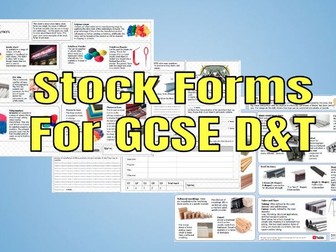
Our material reference mats are designed to support students in understanding the key properties, uses, and types of materials commonly used in Design and Technology. Each mat is visually engaging, featuring clear, high-quality images, making the resources accessible to all learners. The mats cover essential material categories: papers and boards, metals, polymers, timbers, and textiles.
These mats provide:
Key Properties: Concise descriptions of each material’s physical and mechanical characteristics.
Common Uses: Practical examples of where these materials are used in real-world products.
Clear Images: Visual aids to help students easily identify each material type.
These mats are suitable for any year group and can be used as a quick reference tool in the classroom, for independent study, or as part of revision activities.
Power point:
The high end, attractive and informative power point has detailed instructions and notes, step-by-step animations, with starter, main and plenary activities, as well as home learning included.
A lesson plan is also included (MS Publisher file).
Learning Outcomes:
In this lesson, students will gain an understanding of:
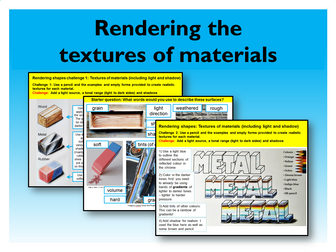
• Developing their drawing and visualising skills, increasing their ability to draw freehand more quickly and confidently.
• 5 different major activities, including a Super challenge task.
• The technique used for rendering a range of materials realistically, including; wood, concrete, metal, glass, rubber and plastic
• In-depth knowledge of rendering wood, metal and glass, with step by step guidance on how to get a great outcome
• How to create the illusion that an object is made from a particular material and describe how light falls on it.
• Literacy: Students will also learn a wide range of subject specific key words
Worksheets:
The worksheets are differentiated into two categories:
• ‘LA’ worksheets having additional support in terms of the outcomes as well as sentence stems, word banks, etc.
• The second category of worksheet has differentiation in the form of more open ended tasks as well as ‘Super Challenges’.
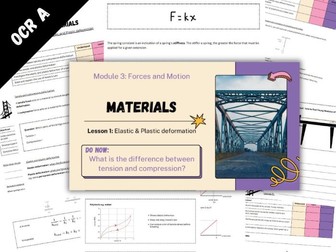
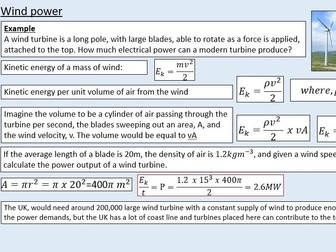
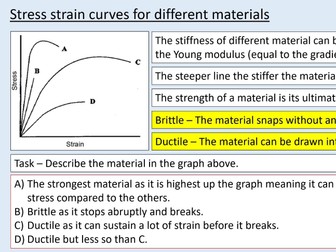
OCR AS level Physics presentations for module 3: Materials.
All presentations come with worked examples, solutions and homeworks.
This covers topics from Hooke’s Law to Young Modulus.
Introduction to smart materials when you just don’t have enough time or resources to give everyone a smart material to experiment with.
Good revision lesson too.
Includes:
Video link introduction
Key Vocubulary
Smart Material animations
Mini Review
Scaffolding Tasks
Example GCSE Questions
Exit Card.
The following PowerPoint is a revision session for A-Level Physics students studying AQA A-Level Physics. This includes both general review questions and also past paper examination style questions.
All questions have answered integrated into the PowerPoint.
Perfect for revision ahead of examinations.
Everyday materials print and go activities plus a 27 slide teaching power point suitable for year 1 UK. This product includes easy, print and and go activities plus a teaching power point - meaning no prep required from you! Children will love these fun activities whilst learning at the same time. The colourful power point will teach children about materials and how they are used in every day life. Real life photos, word cards, pictures for sorting and colouring for early finishers also included.
Included in this product:
Set of print and go activities that contains:
materials hunt
float or sink activity
recycle or compost cut and stick
magnetic or non magnetic cut and stick
properties of materials activity
design a toy activity
make a boat that floats activity
materials in school sorting
label the materials cut and stick
colour the materials
hunt the material
objects and materials
27 slide teaching power point
word cards
sorting cards (black & white and colour)
real life pictures for display
colouring sheet for early finishers
AQA GCSE Geography paper 3 pre-release support for 2025.
Morecambe Bay & Duddon Estuary tidal barrage proposal - Task sheet to help students to examine the pre-release booklet.
This document contains 14 pages of resources that can be set as homework to run along the pre-release booklet or taught in class. The booklet is aimed to help students to fully engage and understand the information provided in the pre-release booklet. This resource can easily be used by specialist and non specialist staff. I have created this resource early so that students have time to complete this over the Easter or the half term break.
Includes:
Exemplar answers to questions that could possibly be similar to the 9 mark question this summer.
Sorting activity to consider the good and bad points of renewable energy.
Map to annotate to help outline the features of the project.
Gap fill activities using answers from the resource booklet.
Bipolar survey to help students to review the issues surrounding the proposal.
Additional suggested questions to practice.
If you like this resource, please check out my AQA A level resources.
This bundle contains 8 lessons and an end of unit assessment
Each lesson follows the AQA Physics: A Level Year 1 and AS textbook https://amzn.to/3BGFsD5
The lessons are complete and designed to be taught over a period of 90 minutes. They are fully animated and contains fully worked out answers to every question.
The format
A recall starter activity to help store key definitions and ideas to long term memory.
Clear slides presented in a logical order, which can be used to talk through and explain the key concepts of the lesson.
Questions and example slides, which can be used to model perfect exam ready answers.
Summary questions to practice and consolidate the new knowledge gained from the lesson.
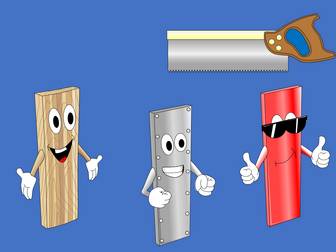
Perfect for KS3 Chemistry! This bundle has been created for the new Oxford SMART Activate 2 KS3 Science course. It comes complete with the following fully differentiated and resourced lessons:
3.1 Metals and acids
3.2 Metals and oxygen
3.3 The reactivity series
3.4 Metal displacement reactions
3.5 Extracting metals
3.6 Ceramics
3.7 Polymers
3.8 Composites
Perfect for KS3 Chemistry and lessons can easily be adapted for GCSE Science if needed. This bundle includes engaging and detailed PowerPoint Presentations with differentiated activities, worksheets, class practical activities and quizzes for students to complete.
Enjoy the resource and feel free to leave a review. Thank you.
This bundle contains 7 lessons and an end of unit assessment
Each lesson follows the AQA Physics: A Level Year 1 and AS textbook https://amzn.to/3BGFsD5
The lessons are complete and designed to be taught over a period of 90 minutes. They are fully animated and contains fully worked out answers to every question.
The format
A recall starter activity to help store key definitions and ideas to long term memory.
Clear slides presented in a logical order, which can be used to talk through and explain the key concepts of the lesson.
Questions and example slides, which can be used to model perfect exam ready answers.
Summary questions to practice and consolidate the new knowledge gained from the lesson.
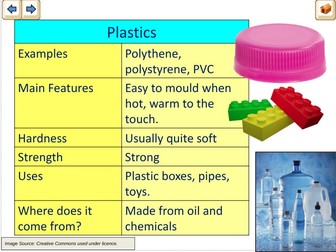
Chapter 3: Forces and Energy
KS3 (Stage 7): Cambridge Lower Secondary Science
This resource contains practice questions, experiments, and worksheets.
The unit covers the following:
5.1 Metals and non-metals
5.2 Comparing metals and non-metals
5.3 Metal mixtures
5.4 Using the properties of materials to separate mixtures
5.5 Acids and alkalis
5.6 Indicators and the pH scale
Create an informative and visually engaging display with these ‘responding to a text’ materials. Ideal for Key Stages 3 and 4
There are lost of acronyms out there when responding to a text. PEEZL is an ideal middle ground between the more simple PEE model and some of the ridiculously complicated ones that seem to be around these days!
Each part of PEEZL is broken down with a pupil-friendly definition alongside two worked examples.
Image depicts what the finished display could look like (although I’m guessing you’ll be better at lining up the letters than me!)
All the slides are fully editable and adaptable, so can be changed to suit your needs. When you’re ready to print them off, simply opt for the ‘print full page slides’ option on your settings and the resources will print as displayed.
Feedback welcomed and appreciated!
This lesson is an excellent, accessible introduction into wood theory or KS3, 4 or 5. It is essential that design technology and/or product design students know this as part of their theory, ready for assessments.
The lesson covers hardwoods, softwoods and manufactured boards, wood examples and their respective properties and manufacturing (felled, formed and finished) through various activities. Included is also a video on plywood production, worksheets and home learning tasks.
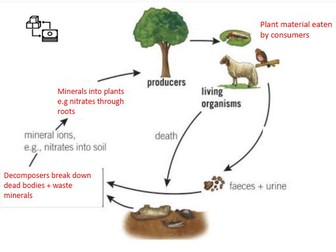
Cycling materials is a comprehensive lesson designed to help GCSE students develop their understanding of the importance of decay in recycling materials through engaging activities and differentiated instruction.
This lesson is the 2nd in a series of lessons and covers the content from the AQA 4.7.2.2 How materials are cycled lesson (B7 Ecology unit unit), and AQA GCSE Biology OUP Scheme B17.2 Materials cycling lesson (B17 Organising an ecosystem chapter).
The lesson includes all necessary resources, making it easy to implement in your classroom and the lesson’s text is adaptable, allowing you to adjust the duration and depth of the activities based on your students’ progress and time constraints.
Presentation contains (26 slides):
● Lesson Prep and Technician Notes: Guidance notes for teachers to prepare the lesson and technician instructions.
● Bell Work / Do Now Activity: Engaging task to activate student prior knowledge and set the stage for the lesson.
● Clear Lesson Aim, Objectives & Success Criteria: Explicitly defined learning targets to guide students and measure their understanding.
● Discussion Slides: Thought-provoking prompts and questions to introduce the topic.
● Information Slides with Levelled Content: Varied levels of information catering to diverse learning styles and abilities.
● Differentiated Activities (Group Work): Collaborative tasks in small groups to encourage active participation and enhance learning.
● Differentiated Questions with Answers: Comprehensive questions with accompanying solutions for self-assessment and note-taking.
● Student Worksheets/Handouts: Printable materials for students to complete and gather notes.
● Homework Activities: Varied homework tasks to cater to individual needs and promote independent learning.
Aimed at a mixed ability class covering content Grades 1-9, with three levels of demand to accommodate different learning styles and levels.
● Level 1: Low demand
● Level 2: Standard demand
● Level 3: High demand
This lesson is also available as a digital worksheet, which is ideal for absent students to catch-up missed work, distance learning, home schooling, or independent study.
Cycling materials Distance learning
If you require more assistance, please contact me at-
info@cmgsciencelessons.com
Printable revision materials for delivery and recap lessons for Macbeth by William Shakespeare with a focus on the AQA (Specification B) Gothic Literatute module.