Unlock the power of words with the Poetry Study Guide: Writing Poetry with Purpose, Technique, and Meaning! Designed for secondary school students (ages 13–17), it aligns well with curricula from O Level, A Level, GCSE, and Edexcel English Language/Literature courses. The guide introduces key literary concepts—theme, imagery, tone, rhyme, and free verse—while exploring universal ideas like humanity, peace, knowledge, and selfless service. Step-by-step instructions, practice exercises, and reflection prompts equip students to write meaningful, high-quality poetry, making it an ideal resource for exam preparation, classroom learning, or independent study. This guide not only builds confidence in writing but also strengthens analytical skills essential for success across international English examinations.
This resource explains what tourism mean, the importance and types of tourism and why people engage in tourism. It explains why there is a change in trend in global tourism and the positive and negative impact of tourism. The resource is prepared for Geography student , for IGCSE. The resource contains photographs and pictures of 10 world tourist attractions, explains coastal tourism and extreme places / locations for tourism etc.
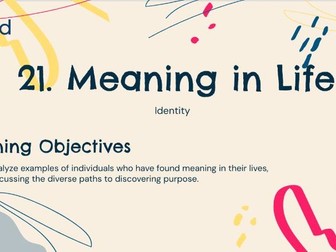
This reflective KS4 (Year 11) PSHE lesson encourages students to explore the many ways people discover meaning and purpose in life.
Through inspiring examples of individuals from diverse backgrounds, students analyze how values, passions, struggles, and life experiences can shape one’s sense of direction.
A powerful session that fosters self-reflection, aspiration, and a deeper understanding of what makes life fulfilling, beyond grades or careers.
Delivered as a fully editable PowerPoint presentation, no worksheets required.
Learning objective: Analyze examples of individuals who have found meaning in their lives, discussing the diverse paths to discovering purpose.
This full lesson covers A1: Meaning, Purpose and Terminology of the Law for Unit 23: The English Legal System for the Level 3 BTEC programme, including;
Rights and duties, law and morality, law and rules.
• Purpose of law, e.g. protection, upholding rights, maintaining order, delivering justice,
evaluation of effectiveness of the legal system.
• Differences between criminal law and civil law, purpose, remedies, punishment,
parties to an action, standard of proof in criminal and civil cases.
• Specific terminology used in civil and criminal cases, case names, current cases,
having an impact on business
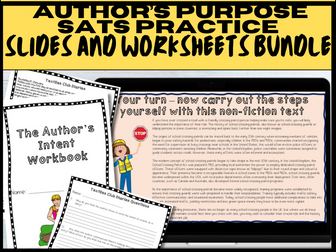
This is a SATs reading author’s purpose bundle of a PowerPoint, taking Y6 children through the process of answering author’s purpose questions, and then a pack of worksheets (texts and author’s intention questions).
The PowerPoint resource takes pupils through the process of answering authorial intent SATs questions. There is then a modelled answer, showing the author’s intention question answered using the steps.
After this, there are four texts (two stories, one poem and one non-fiction text) so that pupils can have a go at author’s purpose questions independently. There are three questions for each of these texts and all answers are provided.
At the end of the PowerPoint, there is a ‘can you remember the steps?’ slide, for children to talk with a partner and see if they can remember what they have learnt. This slide would be great for enlarging and putting up on a working wall as a reminder of the process.
What’s included?
28 slides
5 different texts - fiction/non-fiction/poetry
Steps to success
Author’s intent questions (13 in total)
Answers
Summary slide at the end
The worksheet pack includes 5 different texts - a mix of fiction, non-fiction and poetry. There are then 20 author’s purpose questions focusing very specifically on the author’s purpose.
To help you to introduce the worksheets, there is also a steps to success guide included, which takes pupils through the important elements of answering an author’s intent question. This can be enlarged to go on a working wall or given to the children as a revision aid.
The worksheets have a front cover, too. This means it can easily be given as homework or as a supply activity if you need to be away from your class close to SATs.
What’s included?
Front cover
Steps to success guide to author’s purpose questions
5 engaging texts:
-A Garden of Change (poem)
-Should We Have Intelligent Doorbells?(a balanced argument)
-The Thoughful Present (a story)
-The Moment (a poem)
-Textile Club Diaries (a series of diary entries)
4 author’s intent questions for each text (20 total)
Answers
Please note that the resource is not editable due to needing to protect the fonts and clip art.
This thoughtful PSHE lesson helps Year 7 students explore the concept of finding meaning in everyday activities, recognising how even small actions can contribute to a greater sense of purpose and wellbeing.
Through interactive discussions and personal reflection, students begin to connect daily routines and choices with their values and goals. The full PowerPoint presentation includes all activities, no worksheets needed.
Learning objective: Explore the concept of finding meaning in everyday activities, recognizing how small actions contribute to a sense of purpose.
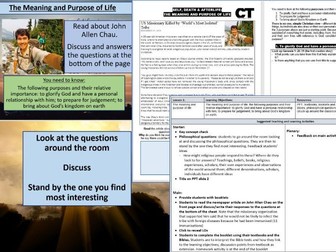
A double lesson on ‘the meaning and purpose of life’, looking at the following purposes and their relative importance - to glorify God and have a personal relationship with him, to prepare for judgement, to bring about God’s Kingdom on Earth.
Students start by looking at and discussing various philosophical questions that have been placed around the room; students then look at an article about a missionary that was killed making contact with a Sentinelese tribe in 2018; then have to complete booklets by using and interpreting texts from Bibles - Bibles not included ;) although the texts referred to are also in the AQA textbook. Answer booklet and lesson plan provided.
This teaching resource offers an in-depth ‘Literary Devices in Fiction and Their Purpose’ worksheet in PDF format, ensuring a non-editable, high-quality learning experience for students.
Overview:Designed to bolster critical thinking and analytical skills, this comprehensive worksheet provides engaging exercises to enhance word meaning, inference drawing, summarizing, analysis, evaluation, content assessment, structure comprehension, retrieval skills, prediction, explanation, exploration, comparison, and synthesis capabilities.
Key Features:
Word Meaning: Explore and understand various word meanings to enrich vocabulary.
Inferences: Master the skill of drawing logical conclusions from given information.
Summaries: Condense complex texts into concise and meaningful summaries.
Analysis and Evaluation: Improve analytical and critical evaluation abilities.
Content, Structure, and Quality: Assess the content, structure, and quality of texts.
Retrieval: Enhance the ability to locate and extract specific information from texts.
Predicting: Foresee outcomes based on available information.
Explaining and Exploring: Expand knowledge by explaining and exploring diverse topics.
Comparison and Synthesis: Combine information from multiple sources for deeper insights.
Ideal Usage:
Cover Lesson: Perfect for use during teacher absence.
Homework Task: Reinforce learning outside the classroom.
Revision: Excellent for revising and consolidating key skills and knowledge.
Don’t miss this invaluable resource that will undoubtedly accelerate academic progress and enhance critical thinking skills.
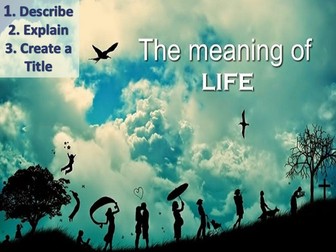
A lesson to help students explore the meaning of life inclusive of, but not exclusive to, religious belief.
Learning questions include:
What is the meaning of life for you?
Do we all need a purpose in our lives?
Do you have to follow a religion to have meaning and purpose in life?
Excellent for SMSC, Religious Studies, PHSE and citizenship objectives and General Studies or Philosophy modules.
Slides have some instructions in the notes, and there is enough to pick and choose from to suit the needs of your class. 11 slides including youtube clips.
Writing for Different Purposes
Our ‘Writing for Different Purposes’ teaching resource explains how the purpose of a text affects its composition. The resource has been made with KS3 learners in mind, but it can be easily adapted for use with KS4 students.
This fully editable PowerPoint teaching resource covers the following:
What do we mean by the purpose of a text?
How to identify the purpose of a text.
Exploring different purposes.
Adapting written work to fit an explicit purpose.
.
Not quite what you’re looking for? Click below to see similar resources:
Writing for Different Purposes
Writing for Different Audiences
Writing for Different Audiences and Purposes
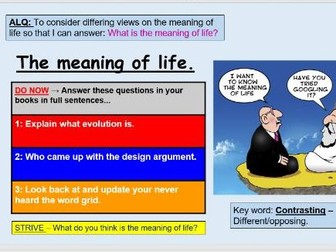
Lesson seeking to introduce students to thinking about one of lifes biggest questions. It poses a number of possible meanings to life and of course includes reference to hitch hikers guide to the galaxy.
Includes a mini case study on pulitzer prize winner Kenvin Carter who, despite his career sucsess, saw little meaning to life and ending up taking his own life.
What engages kids even more than listening to a good story? ☀️PARTICIPATING IN IT!☀️ That’s what they’ll be doing with AESOP'S FABLE POWER PACK, which offers a COMPLETE, NO-PREP UNIT.
***************************************************************************
This HUGE BUNDLE offers a mix of hands-on, printable, and digital media resources. By the time you have finished this pack, your students won’t just be able to READ and COMPREHEND fables, but will also be WRITING their own unique fables with structure and purpose. That’s why this is one of the best reviewed products we have to offer – it keeps kids excited and engaged for over a week as you work through the following areas:
✔ What Is a Fable and Its Purpose?
✔ Who Is Aesop, The Father of Fables?
✔ 12 Famous Interactive Fables by Aesop (Professionally Narrated)
✔ Scripted Fable Theater - Turn These Fables into a Drama Class
✔ Deconstructing Fables for Meaning
✔ Planning and Assessment Rubrics for Writing Fables
✔ Fable Writing Workshop
✔ Character Traits Worksheets and Activities for All of Aesop's Creatures
✔ Digital and Paper Based Resources for Publishing Fables
✔ Fable Glossary and Curriculum Links.
The entire collection is provided to you in EDITABLE PowerPoint and Word formats and also available as a printable PDF eBook. Each lesson is a complete plan that eliminates your preparation time, but if you need to modify the content to suit a particular class, you can easily do so. We even hired a professional voice actor so that you can listen to these fables with your class in style!
******************************************************************************
Like the sound of this? For more creative ideas and new product updates, be sure to sign up for our email newsletter, and visit us on Facebook to take part in our exclusive giveaways.
***************************************************************************
Other Popular Products From Innovative Teaching Ideas - Search for these items on TES
Year Long Visual Writing Prompts
Fable Power Pack
Teaching Digital Technologies and STEM
*****************************************************************************
YOUR REVIEWS ARE ESSENTIAL IN KEEPING OUR PRODUCTS LOW PRICED AND REGULARLY UPDATED!!! IT MAKES A HUGE DIFFERENCE TO US!!! PLEASE LEAVE A REVIEW
This resource is an introduction to statistics.
It contains ten multiple choice questions on the meaning and origin of statistics, the purpose of statistics and data collection.
It is a good resource to use as an exit card or even as an introduction to the next topic.
I hope you find it useful.
THANK YOU
This is a lesson plan that I carried out recently. It was successful and delivered to Functional English Entry Level 3, Level 1 & Level 2 students. These resources and the lesson plan can be adapted to suit different levels. I have included the lesson plan and all of the required resources.
The learning objectives I set are as follows:
Entry Level 3:
LO1: Understand the main points of texts.
LO2: Obtain specific information through detailed reading.
Level 1:
LO1: Identify the main points and ideas and how they are presented in a variety of texts.
LO2: Read and understand texts in detail.
Level 2:
LO1: Select and use different types of texts to obtain and utilise relevant information.
LO2: Identify the purposes of texts and comment on how meaning is conveyed.
Tasks for looking for meaning unit. i used this for my early entry group who had to be able to work through the topics indp/endantly. I also use this as work to send to pupils if they have missed lessons or want to do something extra at home for revision
 Quick View

 Quick View
 Quick View
 Quick View
 Quick View
 Quick View
 Quick View
 Quick View
 Quick View
 Quick View
 Quick View
 Quick View
 Quick View
 Quick View
 Quick View