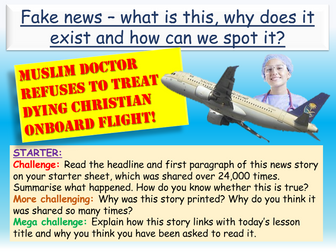
A detailed, engaging and well-differentiated lesson to encourage critical thinking (lasting 1-2 hours), focused on the growth of Fake News and ‘alternative facts’. These resources teach students how we must always use critical thinking skills when studying media material.
Included: 1 - 2 hour PowerPoint, worksheets, clips, alternative facts reading comprehension, well differentiated, KS3/ KS4. These resources have been designed to be engaging, detailed and easy to follow. All our resources are editable (so easy to adapt for your classes) and are designed to last one hour each.
Or you can check out some of our most popular PSHE, Citizenship and RE resources below:
Mental Health PSHE Bundle
1 Whole Year of PSHE Resources
British Values Citizenship Bundle
Careers, Employment and Enterprise Bundle
Islam Bundle
Sex and Relationships Education
GCSE CITIZENSHIP 9-1
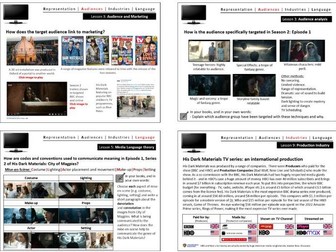
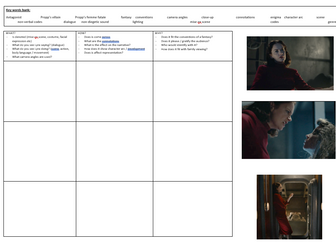
Resources for the Close Study Product for the AQA GCSE Media Studies course (first teaching September 2021). Designed for AQA, and anyone examining the TV series unit on His Dark Materials: City of Magpies. The 53 slide, 10 lesson resource includes all resources and ten lesson’s work (with possible expansion) and pupil questions/activities. Download also includes a knowledge checklist for the CSP.
Lesson 1: What is ‘His Dark Materials: City of Magpies’ and what are the key themes of the episode.
Lesson 2: Target audience analysis.
Lesson 3: Audience and Marketing/Promotion links. Character links to target audience.
Lesson 4: Audience response to His Dark Materials – including audience numbers, critical response and preferred/oppositional readings of His Dark Materials.
Lesson 5: A semiotic analysis of His Dark Materials – including CLAMPS.
Lesson 6 and 7: Media Language theory including genre, Propp, Todorov, Barthes and Levi-Strauss.
Lesson 8: Representation in His Dark Materials.
Lesson 9: The remit and funding of BBC. The production companies behind His Dark Materials. The BBC/HBO link. The multi-platform, multi-channel media landscape.
Lesson 10: Comparing His Dark Materials and Dr. Who.
As reviewers have stated for previous Media Studies CSPs shared on TES:
“Just buy it!”
“Your resources have been life savers!”
“Well worth the money and really saved my life”
“I just wanted to say that as a non-specialist these resources are worth every single penny! Thank you so much for making and sharing them.”
“Blown away by this! Can’t thank you enough!”
“They have saved me a huge amount of time and the detail that goes into your work is second to none. You put others to shame who charge twice as much for very little. Can’t thank you enough.”
“Your new spec resources are saving me hours & hours of work! Thanks, they are really good.”
“These resources are so useful - I cannot tell you how much time they have save me - very clear to follow and easy to adapt for revision material — well worth the money”
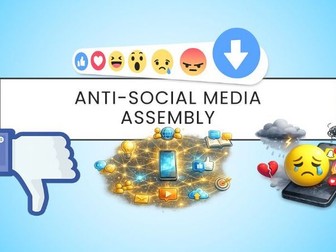
Anti-Social Media? A Powerful Secondary School Assembly on Social Media, Mental Health & Online Safety
Looking for a thought-provoking, research-informed assembly that gets students genuinely reflecting on their relationship with social media?
This engaging and highly relevant assembly explores the impact of social media on young people, combining current research, discussion opportunities, video clips and practical strategies to help students take greater control of their online habits.
Perfect for KS3, KS4 and KS5 students, the assembly moves beyond simple “social media is bad” messages and instead encourages balanced, critical thinking about how technology influences attention, wellbeing, sleep, relationships and mental health.
Students will explore:
• Why social media is so difficult to put down
• How platforms are designed to capture and hold attention
• The psychology behind notifications, likes, streaks and infinite scrolling
• The impact of social comparison and FOMO
• Social media and mental health research findings
• Body image, filters and unrealistic online portrayals
• Sleep disruption and constant connectivity
• Cyberbullying and its long-term consequences
• AI, deepfakes and misinformation
• The UK’s Online Safety Act and growing age verification measures
• Practical strategies for creating healthier online habits
Includes:
✔ Full assembly PowerPoint
✔ Discussion questions throughout
✔ Student reflection opportunities
✔ Multiple video clip links included
✔ Research-informed content from organisations including Ofcom, the Royal Society for Public Health, Anti-Bullying Alliance and other reputable sources
✔ Positive and balanced approach rather than fear-based messaging
✔ Suitable for whole-school delivery
Why teachers like this assembly
Unlike many assemblies on social media, this resource avoids simply telling students to spend less time online. Instead, it helps them understand how social media platforms are designed, why they can feel so addictive, and how young people can make informed decisions about their own use.
The assembly encourages meaningful discussion around attention, wellbeing, online safety, digital literacy and personal responsibility while acknowledging the positive role social media can play when used appropriately.
Ideal for:
• Whole-school assemblies
• Tutor time programmes
• PSHE
• RSHE
• Mental Health Awareness events
• Safer Internet Day
• Digital Citizenship education
• Online Safety initiatives
Please also visit my TES Assembly Store where over 100 assemblies are available on a huge range of topics.
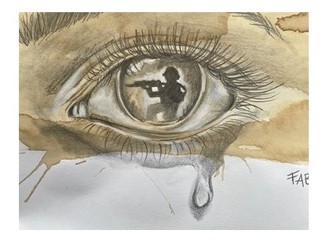
This lesson will assist year 9-11 with GCSE experimentation using the theme of ‘War and conflict’.
AO2: Refine work by exploring ideas, selecting and experimenting with appropriate media, materials, techniques and processes.
Creating a surface of coffee as a background to draw onto.
This will take approx 3 lessons to complete to a high standard.
Inspiration images of eyes included along side outlines for differentiation to trace if needed.
This quiz comprises of a PowerPoint Presentation. The presentation includes a quiz on the His Dark Materials CSP in relation to all areas of the theoretical framework of media: Contexts, Media Language, Representation, Industry and Audiences.
This resource comprises of the lessons you need for the AQA Media Studies GCSE Course.
It includes:
Marcus Rashford (All areas of the theoretical framework)
Kim Kardashian (All areas of the theoretical framework)
Lara Croft Go 2015 (All areas of the theoretical framework)
The Times Newspaper (All areas of the theoretical framework)
Daily Mirror (Media Language, Industry, Audiences)
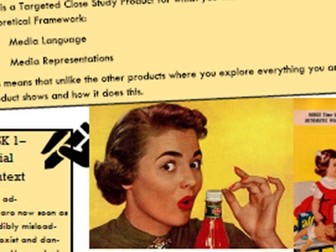
OMO Advertisement (Media Language, Representations)
NHS Blood Donation Advert featuring Lady Leshurr (Media Language, Representations)
Galaxy Advert Audrey Hepburn (Media Language, Representations)
Doctor Who, Unearthly Child (Industry and Audiences)
His Dark Materials, The City of Magpies (Industry and Audiences)
Tatler Magazine (Media Language, Representations)
Heat Magazine (Media Language, Representations)
BBC Radio 1 Tony Blackburn (Industry, Audiences, Contexts)
Kiss Breakfast Show (Industry, Audiences, Contexts)
Black Widow (Industry, Contexts)
I, Daniel Blake (Industry, Contexts)
BLACKPINK How You Like That (Industry, Audiences, Contexts)
Arctic Monkeys I Bet You Look Good On The Dancefloor (Industry, Audiences, Contexts)
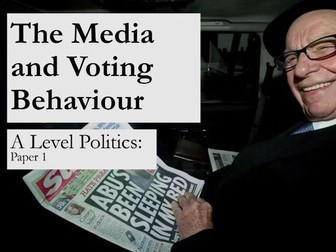
An up-to-date (March 2025) and accurate comprehensive lesson resources on the media and voting behaviour. There is enough material in here for a whole week of lessons and the PPT covers all types of media, including social media and questions around bias, persuasion and opinion polls. I am also including some worksheets looking at the key media impacts on the 1992, 1997,2010, 2015, 2017, 2019 and 2024 general elections.
A complete teaching pack designed to support delivery of key Media, Film and Creative Media concepts through a structured introduction to Creative Media. Originally created for the Edexcel BTEC Tech Award in Creative Media Production Component 1 (2024 specification), this resource covers the essential analytical and practical skills that underpin studying media texts. While the content was fully accurate for the 2024 specification, teachers may need to adapt elements to reflect any changes to the qualification since that date.
This resource includes a full mock Component 1 walkthrough for students and an accompanying PowerPoint with explanations, examples and scaffolded tasks. The lesson materials are SEN/AEN friendly, clearly structured, and suitable for cover lessons, allowing non-specialists to deliver confidently.
The content is also ideal for GCSE Media Studies, Film Studies, Creative iMedia, BTEC Creative Media, or any curriculum introducing students to media language, analysis and production skills.
Key concepts and skills covered:
• Representation – how people, events and issues are portrayed
• Audience – target audiences, demographics and engagement
• Genre – conventions, hybridity and audience expectations
• Narrative – story structure, character roles and media storytelling
• Cinematography & Mise-en-scène – visual codes, camera work, lighting, props, costume
• Practical Skills Tasks – production skills in practice, basic filming and planning
• Media Analysis – analysing moving image or print examples
• Knowledge Retrieval Tasks – recap questions to secure learning
• Mock Component 1 Task – scaffolded practice for assessment-style work
This resource is:
• SEN/AEN friendly with clear layouts and accessible explanations
• Suitable for KS3 or KS4 Media, Creative Media or Film courses
• Cover ready, with all instructions included
• Adaptable to a wide range of classroom contexts
This pack provides a strong foundation in media analysis and production skills while offering teachers flexibility to tailor the content to their own course and the most up-to-date specifications.
We had to fight for our Pathway 1 students to be able to take our subject - here are the posters we used on Options evening - they might come in useful if the subject is derided in your school!
Aimed at the GCSE AQA Media spec, the booklets contain resources and tasks to help students cover most of the major areas of the spec and the materials provided. Although some texts will change over each year those pages are easily omitted or make for excellent introductory material.
A pack of resources including.
-Revision Guide for Year 11 Media studies with range of tasks for all texts
-Guide which covers most of the initial topics with information and tasks as a Unit of Work
-A Homemade exam paper
-A brief overview of the units and content for students
Please feel free to check out some of my free resources to get a taste of what I make before you buy.
This resource comprises of differentiated tasks and activities, and PowerPoint presentations in relation to the industry and audience areas of the theoretical framework of media.
(His Dark Materials)
Industry
Audiences
Quiz on all areas of the theoretical framework of media (information that can be used to create lessons for media language and representations)
Homework
Theory application
Creative tasks
Exam questions with sentence starters, mark schemes, assessments objectives
Article and video links
In-depth study
Clear specification links
This resource comprises of two worksheets and a PowerPoint presentation. This PowerPoint presentation comprises of the following:
Specification Requirements
Assessment Objectives
Product Contexts
Worksheet with most of the companies involved in the series
Independent study on rights to popular fiction and adaption
Answers for self assessment
Starter activity on research on public service broadcaster and BBC
Answers
Public service broadcaster in a modern world - article read and tasks
Mind map in the modern world
Worksheet on how the series meets the BBC’s requirements
Answers
Reflection questions
Video links on production and note taking
Group work on different areas of collaboration
Prompt questions
Worksheet
Answer sheet
Recap quiz
HBO contexts
Recap questions on collaboration
Answers
Article with questions (pair activity)
Answers
Fill in the blanks activity for more able and low able
Independent study activity on funding and commissioning
Answers for self-assessment
Video on the future of TV with questions
Answers
Group work on benefits and challenges of convergence in television
Prompt questions
Answers
Worksheet
Answers
Exam question with paragraph structure, sentence starters, exemplar and mark scheme
Questions on regulation
Answers
Information on watershed
BBC regulation
Ofcom with research activity and answers
Group work on regulation with prompts, worksheet, and answers
Recap quiz
This resource comprises of a PowerPoint presentation. The presentation includes the following:
**(This is an in-depth study with a range of activities, differentiation, exam questions, clear links to the assessment objectives and specification, a wealth of information, theory application etc.)
**
Specification Requirements
Assessment Objectives
Trailer and targeting audiences analysis
Answers
NRS social grades
Psychographics
Creative tasks
Primary audience information
Article reading on diversity and audiences
Answers
Audience appeal mindmap and worksheet
Answers
Opinions of the TV adaption with video link and questions
Review and reactions tasks
Reflection questions with answers
Mindmap on reactions of audiences who have not read the book with prompts and answers
Creative task
Recap quiz
Opening scene viewing with questions and challenge and answers
Group work on how target audiences influence scheduling, marketing, and distribution of media products
Answer sheet for teacher
Homework task
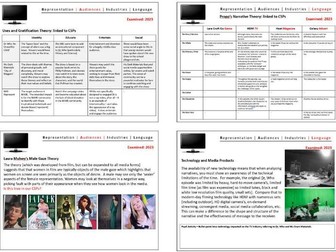
Uses and gratifications theory
Exam question with paragraph structure, sentence starters, mark scheme, exemplars
Stuart Hall reception theory with task and answers
RAGs assessment
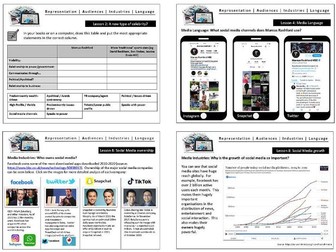
Resources for the Close Study Product for the AQA GCSE Media Studies course (first teaching September 2021). Designed for AQA, and anyone examining the Online, Social and Participatory unit on Marcus Rashford. The 55 slide 10 lesson resource includes all resources and ten lesson’s work (with possible expansion) and pupil questions/activities. Download also includes a knowledge checklist for the CSP.
Lesson 1: Who is Marcus Rasford?
Lesson 2: Why is Marcus Rashford a CSP? How has Marcus Rashford redefined celebrity through his online presence?
Lesson 3: Who is the audience for Marcus Rashford and why do they engage with his online presence?
Lesson 4: Analysing the codes and conventions of his social media channels.
Lesson 5: Analysing the official Marcus Rashford website.
Lesson 6: Audience positioning and narrative structures.
Lesson 7: Who selects the various representations of Marcus. The rise of social media managers and PR companies.
Lesson 8: The growth of social media companies and who owns them? Who regulates social media companies?
Lesson 9: How do social media companies make money? What businesses link with Marcus Rashford and why?
Lesson 10: Marcus Rashford, the political powerbase and public policy.
As reviewers have stated for previous Media Studies CSPs:
“Just buy it!”
“Your resources have been life savers!”
“Well worth the money and really saved my life”
“I just wanted to say that as a non-specialist these resources are worth every single penny! Thank you so much for making and sharing them.”
“Blown away by this! Excellent AS Eduqas revision tool. Can’t thank you enough!”
“They have saved me a huge amount of time and the detail that goes into your work is second to none. You put others to shame who charge twice as much for very little. Can’t thank you enough.”
“Your new spec resources are saving me hours & hours of work! Thanks, they are really good.”
“These resources are so useful - I cannot tell you how much time they have save me - very clear to follow and easy to adapt for revision material — well worth the money”
A 48-slide revision package written to support the AQA GCSE (9-1) Media Studies course 2023 specification. This can be projected with the class, completed by the pupils in using computers or photocopied onto A4/A5 and used as a homework project.
The package deals with the key media theories outlined by AQA and links to the CSPs. It also covers key media language and terms linked to various CSPs with pupil activity involved. The final slides deal with key terms that may be assessed for 2 mark responses and then more detailed exemplar questions for 6, 8 and 12 mark questions.
These resources support the popular CSP resources that are on TES. Reviews have stated:
“Just buy it!”
“Your resources have been life savers!”
“Well worth the money and really saved my life”
“I just wanted to say that as a non-specialist these resources are worth every single penny! Thank you so much for making and sharing them.”
“Blown away by this! Excellent AS Eduqas revision tool. Can’t thank you enough!”
“They have saved me a huge amount of time and the detail that goes into your work is second to none. You put others to shame who charge twice as much for very little. Can’t thank you enough.”
“Your new spec resources are saving me hours & hours of work! Thanks, they are really good.”
“These resources are so useful - I cannot tell you how much time they have save me - very clear to follow and easy to adapt for revision material — well worth the money”
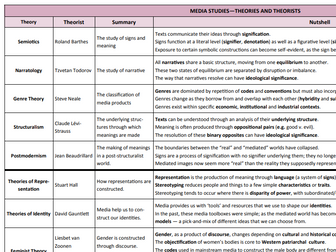
A revision resource for A Level Media Studies focused on the WJEC Eduqas specification and the theorists listed in the exam board Teaching Guides.
I encourage my students to highlight the sections on the sheet as we cover the material. It also serves as a basis for checking knowledge later on. It is designed to fit on a single side of A4 paper, though it scales decently to A3 for displaying.
The two-page resource summarises each theoretical viewpoint briefly and organises the theorists according to the appropriate theoretical framework.
This resource pairs reasonably well with the A Level Media Studies - Exams Structure and Theories knowledge organiser available on the store.
Both the .pdf and the .pub are included so that you can customise it to your teaching groups.
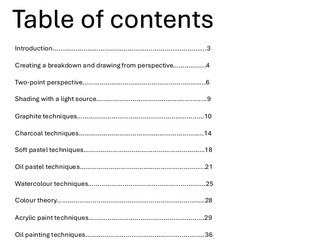
This resource is a comprehensive visual-procedural guide designed to bridge the gap between creative execution and pedagogical theory. It provides a structured road map for mastering materials and methods, translating complex artistic processes into clear, step-by-step instructions.
By aligning practical “how-to” demonstrations with current educational frameworks, the resource ensures that every technique is grounded in purposeful learning outcomes. It is designed to foster both technical fluency and conceptual depth, making it an essential toolkit for educators and practitioners who value a rigorous, research-informed approach to art and design.
Empower your classroom with a research-informed approach to making.
This comprehensive resource is the definitive guide for educators looking to bridge the gap between technical instruction and pedagogical excellence. Designed specifically for teachers and curriculum leads, it transforms complex material processes into clear, visually-rich instructional units that fit seamlessly into any modern art and design curriculum.
What is Inside:
Visual Step-by-Step Guides: High-quality imagery paired with concise instructions to support diverse learners and foster independent practice.
Framework-Aligned Pedagogy: Every method is underpinned by current educational standards, focusing on substantive knowledge, disciplinary skills, and procedural fluency.
Scaffolded Learning: Strategies to move students from basic material exploration to sophisticated, intentional making.
Classroom-Ready Tools: Ready-to-use processes for a wide range of media
Why Choose This Resource?
More than just a “how-to” manual, this guide provides the theoretical scaffolding necessary for deep learning. It saves hours of planning by providing a structured, professional-grade toolkit that ensures your students don’t just “do” art, they understand the how and why behind every mark.
Elevate your teaching. Inspire their making.


 Quick View