A useful power-point summarizing the main key concepts in Media Studies. Perfect for GCSE level groups or as a refreshment course for A-level students.
Perfect for classroom display or student revision!
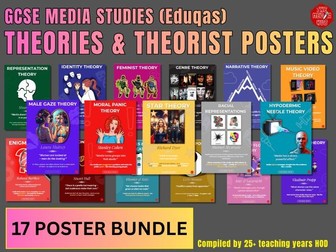
Bring Media Studies to life with this vibrant and accessible set of Media Theory Posters designed specifically for the Eduqas GCSE Media Studies course. These eye-catching posters simplify key media theorists and theories into student-friendly summaries, memorable quotes, and bold visuals – ideal for helping learners understand and recall core concepts.
What’s Included:
17 full-colour posters (A4 or A3 printable)
Each poster features:
• Name of the theory and theorist
• Simple one-sentence explanation
• Direct quote from the theorist
• Bold image for dual coding
Covers theories on representation, narrative, identity, media language, gender, race, and audience
Theorists Included:
Stuart Hall, Roland Barthes, David Gauntlett, Levi-Strauss, Propp, Dyer, Andrew Goodwin, Alvarado, , Dyer, Goodwin, Propp, Todorov, Blumler & Katz, Katz and Lasarsfield, Stanley Cohan, Steve Neale, Levi-Strauss, Mulvey, Van-Zoonan, and more!
Designed by a Media Studies teacher with over 25 years teaching experience, for use with mixed-ability groups – perfect for displays, revision walls, theory lessons, or student folders.
Printable PDF – ready to download and print at home or school.
Aligned with the Eduqas GCSE Media Studies glossary and exam content, but also suitable for other specifications (AQA, OCR) or KS5 introduction.
Love this resource? Please leave a review! Massive thank you!
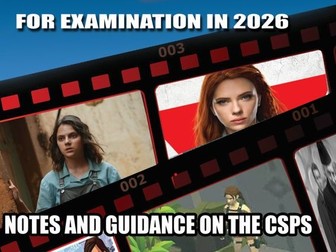
Covering all the CSPs for the 2026 AQA GCSE Media Studies exam, this revision guide is chunked and written in student friendly language. Including clear links to the theoretical framework, media theories, past questions, glossary of terms and more.
Please note: I have also created a whole unit on the key concepts which you will find useful- priced at just £3.99 please follow this link: https://www.tes.com/teaching-resource/key-media-concepts-and-theory-full-unit-gcse-media-studies-as-media-studies-11710838
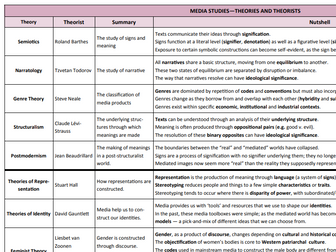
THIS RESOURCE is a one page Mat which explains each of the key concepts. Works best when enlarged to A3 and laminated in colour (great to reuse again and again). Each of the key media concepts explained in a student- friendly way.
Suited to higher ability GCSE students and all AS/ A2 students of Media.
M- Media Language
I- Ideology
G- Genre
R- Representation
A- Audience
I- Institutions
N- Narrative
A revision resource for A Level Media Studies focused on the WJEC Eduqas specification and the theorists listed in the exam board Teaching Guides.
I encourage my students to highlight the sections on the sheet as we cover the material. It also serves as a basis for checking knowledge later on. It is designed to fit on a single side of A4 paper, though it scales decently to A3 for displaying.
The two-page resource summarises each theoretical viewpoint briefly and organises the theorists according to the appropriate theoretical framework.
This resource pairs reasonably well with the A Level Media Studies - Exams Structure and Theories knowledge organiser available on the store.
Both the .pdf and the .pub are included so that you can customise it to your teaching groups.
Whole Unit of Work consisting of 73 Slides covering course content for BlackPink The Game by TakeOne/YG Entertainment based off the CSP booklet from AQA.
Tasks for students to work independently, exam questions included, links to BP Music Video CSP.
Covers all areas listed in booklet - whole CSP.
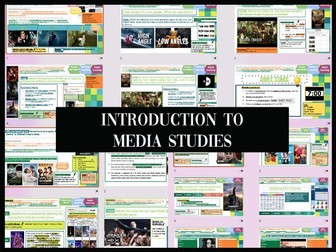
An outstanding scheme of work which is a perfect way to introduce media studies. The scheme of work focuses on the key media concepts: Audience, representation and Media language embedding important media theories. The scheme of work introduces these concepts in a engaging way with a focus film study embedded into the scheme of work. The film study explores the film: Divergent, perfect for representation and audience. The scheme of work assesses using the BTEC Tech Award in Creative media production 2022 curriculum however, the mark sheet is easily adapted and only focuses on audience, which I’m aware most exam boards focus on.
Each lesson is planned for 60-minute lessons However, can easily be adapted or extended further. The lessons support students with all of the tasks needed to complete the component. There are a variety of teacher led activities, active learning tasks with all differentiated to stretch and challenge the higher ability students and support the lower candidates. I use the lessons as half teacher led and second half Workshops and active learning. When introducing key concepts there is useful worksheets and learning mats which has been designed by myself whereby my head teacher expressed that “he had never seen such fantastic resources”.
The lessons in the scheme of work include:
Introduction to media studies
Audience
Audience structure when writing
Target audience
Camera angles
Practical workshops
Representation
Genre
Analysing key scenes
Propp’s character theory
Todorov’s narrative theory
Assessment
Photoshop
And more…
The PowerPoints are aesthetically pleasing and students have commented on this throughout my teaching of the component. I have a 100% pass rate
I really hope you enjoy teaching these lessons. Please leave any feedback
A two hour lesson which introduces and explores the feminist theory bell hooks. This is a set theory for Eduqas A Level media but relevant to all study of media representations. The lessons focuses on: Time Magazine, Beyonce’s Formation and The Jinx but these could be replaced with any relevant media products.
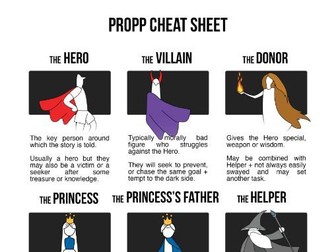
A poster boiling down the theory in simple and easy terms with a worksheet to go alongside to help students create their own convincing characters. Useful for KS3 and KS4 English as well as Media Studies.
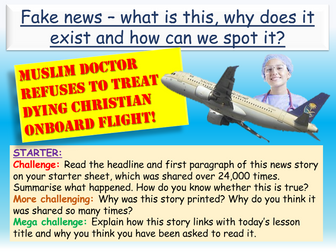
A detailed, engaging and well-differentiated lesson to encourage critical thinking (lasting 1-2 hours), focused on the growth of Fake News and ‘alternative facts’. These resources teach students how we must always use critical thinking skills when studying media material.
Included: 1 - 2 hour PowerPoint, worksheets, clips, alternative facts reading comprehension, well differentiated, KS3/ KS4. These resources have been designed to be engaging, detailed and easy to follow. All our resources are editable (so easy to adapt for your classes) and are designed to last one hour each.
You can find many more inexpensive and free PSHE, Citizenship and RE resources at my shop: EC_Resources
Leave me a review and pick any other resource for free :)
Or you can check out some of our most popular PSHE, Citizenship and RE resources below:
Mental Health PSHE Bundle
1 Whole Year of PSHE Resources
British Values Citizenship Bundle
Careers, Employment and Enterprise Bundle
Islam Bundle
Sex and Relationships Education
GCSE CITIZENSHIP 9-1
This resource is a complete 110-page revision guide for AQA GCSE Media Studies students (CSPs up to date for 2026 exams).
This booklet contains Four main sections:
- Exam layout and Close Study Product occurence (clear outline as to the contents of each exam paper)
- Terminology (key terms that students can define, recap and learn ready for the exam)
- Theory (Space for students to research and recap academic media theory, summarise each theory and apply each theory to a range of CSPs)
- Close Study Products (Key questions from each area of the theoretical framework about each and every one of the 19 CSPs studied, for students to complete as revision, recap, alongside lessons or as practice)
An outline of Media Theory concepts for GCSE and A-level. Suitable for all exam boards, with examples and videos embedded. This lesson will take approx, 2-3 hours to cover.
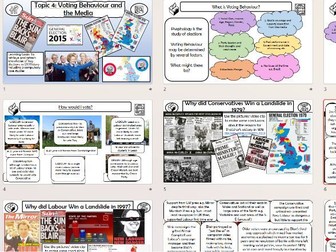
Introduction lesson to Voting Behaviour and the Media
This lesson introduces students to the concept of studying voting behaviour and examines factors which may affect voting behaviour.
The idea is that students are then given case studies to produce and present on an individual election.
Includes powerpoint on intro lesson which covers 1979 and 1997 key case studies as an overview of what happened in each election. Debate on the question “1979/1997 elections were lost by the government rather than won by the opposition” examination of Valence Voting and brief introduction of other theories.
Detailed statistic booklet on General Elections since 1979
Template sheet for students to make notes on each election during Presentations with example for 1945 Election.
PNG images for illustration only, files include fully editable powerpoint and word documents.
New to teaching or studying Media Studies? This detailed guide introduces you to the key terminology, theories and concepts - and explains how to successfully apply them in written analysis.
Suitable for GCSE and A-Level students, this thirty-chapter guide takes you on a tour through the four key concepts underpinning Media Studies:
Media Language
Representation
Audiences
Industries
Suitable for use with any current specification, this is an invaluable resource for students and teachers alike, which includes:
A glossary of key terms
Examples of terminology and theory in use
Information to stretch and challenge the most able
Questions at the end of each chapter to test knowledge and understanding
Step-by-step guides for written analysis
The Complete Media Bundle for A Level Sociology offers a full, engaging, and exam-focused set of resources covering every topic required by the specification. It enables students to master the sociological study of the media through in-depth PDF summaries, visually dynamic PowerPoint presentations, and a range of skills-based and assessment-focused materials. Core content areas include: Media Ownership and Control, The New Media, Globalisation and the Media, Media Representations (of class, gender, ethnicity, age, and disability), Media Content and Audiences, and Media Effects and Audience Theories.
Each topic is supported by comprehensive PowerPoint slides that break down theoretical perspectives (Marxist, Pluralist, Feminist, Postmodernist), key sociologists, and contemporary examples such as streaming services, citizen journalism, media moral panics, and the impact of digital algorithms on consumption. The bundle explores how media both reflects and shapes society, power structures, and identities, and how audiences actively interpret or resist media content.
To build exam confidence and critical writing skills, the pack includes connectives worksheets, skills-based activities (e.g. PEEL paragraph practice, media text analysis, theory-application tasks), and essay planning templates. Each major topic comes with a focused podcast episode, offering accessible summaries of key theories, debates, and sociological applications—ideal for independent revision or flipped learning. The question bank features a wide range of exam-style questions and model answers, including 10- and 20-mark essay questions such as “Evaluate the view that media owners control media content for ideological purposes” and “Assess the impact of new media on audience behaviour.” A series of interactive quizzes reinforces key terms, theorists, and concepts through fun and formative assessment.
Altogether, this full-course Media bundle equips students with the theoretical depth, real-world application, and analytical skill needed to excel in the media unit of A Level Sociology. It’s ideal for teachers delivering the course or students seeking a structured, content-rich, and engaging way to revise.
A set of short summary slides for key media studies theories:
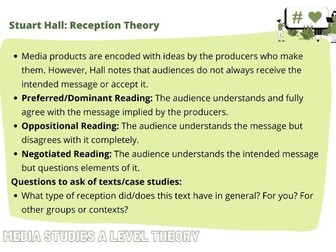
Audience Theories- Jenkins, Hall, Gerbner, Bandura, Shirky, Hesmondhalgh, Two-step flow, hypodermic needle, Uses & gratifications, Livingston & Lunt, Curran & Seaton,
Language Theories- Strauss, Barthes, Todorov, Propp, Neale
Representation Theories- Hall, hooks, Mulvey, Butler, Gauntlett, Gilroy, Van Zoonen
Postmodern Theories-Postmodern elements, Baudrillard, Lyotard, Jameson.
Ecology Theories- McLuhan, Postman, Ong
Can be printed double sided to use as flashcards for student revision.
Accessible to a range of students with questions to apply to set texts and case studies to encourage student application of theories too.
A 12-page document containing 29 Media Studies theories and explanations for A Level Media Studies students.
8 Media Language theories
9 Media Representation theories
8 Media Audience theories
4 Media Industry theories
I have tried to keep the explanations of each theory relatively straightforward and accessible for year 12 and 13 students.
Some diagrams given with theories to illustrate key point(s) of each theory.
Essentially, this is a glorified knowledge organiser, as there are no activities for students, but this document can be used as a companion when completing practice questions or applying theory to Close Study Products.
A collection of theory handouts that I use to supplement the points taught in lesson via PowerPoint. Each handout summarises the main points behind the theory in a way which is designed to be useful for revision at the end of the year.
Have a close read as a couple have been personalised with my name which you may wish to replace with yours!
Hope these prove useful in relation to your own teaching, any feedback is appreciated.
Moral Panics and media effects, will need personalisation for groups and modernising as the years pass (as media moves so quickly) but good enough to get a Y12 group discussing what the media does to manipulate the audience.


 Quick View
 Quick View
 Quick View
 Quick View
 Quick View
 Quick View
 Quick View
 Quick View
 Quick View
 Quick View
 Quick View
 Quick View
 Quick View
 Quick View
 Quick View