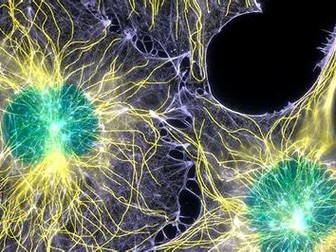
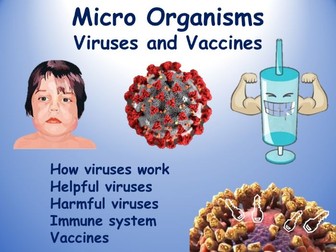
A powerpoint introducing micro-organisms to Year 6 as part of the Science curriculum Living Things.
Ppt should explain to children what micro-organisms are, where they can be found and what they can do.
The presentation also introduces the 'Mouldy Bread Experiment' to children so they can observe how micro-organisms grow under different conditions.
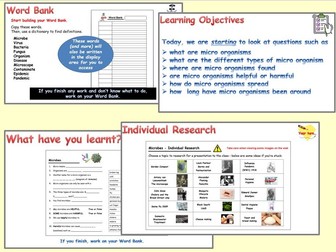
Download includes ppt, writing frame for experiment write up and experiment observation table.
This powerpoint and worksheets have been designed for the teaching of WJEC Food and Nutrition. It can also be used in the teaching of WJEC Hospitality and Catering & KS3 Food. It could be used for remote learning.
The work links to Chapter 6 the effects of cooking on food, which is found in the WJEC Food and Nutrition book. The information on the powerpoint means that you do not need the text book to teach the lessons.
It focuses on : the use of positive micro organisms in yoghurt, cheese, meat products, drinks, bread making and quorn.
The powerpoint includes: Think Pair Shares, facts, practicals, tastings, lots of youtube clips and tasks. It also works alongside the worksheets.
This could take more than 1 lesson.
There is one worksheet which is 4 pages long and the tasting worksheet is 1 page. Both sheets have been written to work alongside the powerpoint which is 14 pages long.
The resources can be edited.
I hope that this saves you some time.
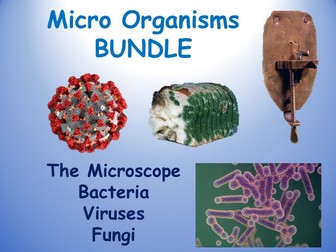
Introduce children to bacteria, viruses and fungi as micro-organisms. They are living organisms and are very small. Investigate how the numbers of bacteria grow by simple division and gain an understanding of their size compared to a metre.
Suitable for Y6 pupils.
This set of resources has a power point of examples of Children's Art around the theme of Micro-organisms. Children investigated pictures and films around this theme, discussed creative issues as well as scientific knowledge and made their own responses from a selected range of resources.
There are three planning documents for the topic.
The entire series of lessons on Micro-organisms provides enough material for over 10 one-hour lessons, but you can be selective.
The series covers:
Introduction to Micro-organisms
The Microscope and Microscope Art
Bacteria, The Immune System and Antibiotics
Viruses, Vaccines and Virus Art
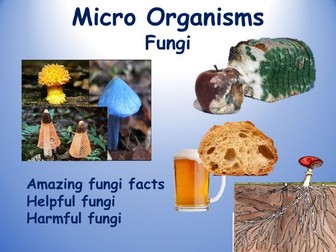
Fungi & Fungi Art
Additional misc. activities
The 5-star rated lessons have proven extremely popular with both teachers and students and comprise:
self-contained PowerPoint lessons packed with thought provoking material
lots of pinstakingly selected, embedded videos (if you need to detach the videos, see here)
Worksheets (with answers) in Word providing individual and class activities.
Let me know if you have any questions or suggestions, and a BIG BIG thanks for looking (as a full time practicing teacher, I KNOW how time consuming this process can be).
ALL my postings are FULLY “classroom-tested” - before I publish, my lessons are tested by both myself and colleagues, rigorously evaluated and discussed, and continually updated to maximize their effectiveness.
But there is always the possibility of error and room for improvement, so do please provide constructive feedback.
Teacher/Author: Barrie James
Search words: quarantine, vaccinate, pasteurisation, germ, antibiotic, inoculate, immune, yeast, immunize, pathogen, inhalation, microbe, virus, bacteria, fungus, organism, disease, microscope, electron, contaminate, epidemic, pandemic, electron, light, metric, lens, convex, concave, optical, symbiotic, exponential, infectious, infect, antiseptic, plaque, toxin, toxic, compost, mucus membrane, quarantine, vaccinate, pasteurization, germ, antibiotic, inoculate, immune, yeast, immunize, pathogen, inhale, habitat, spore, parasite, mushroom, toadstool, species, volva, gills, mycelium, disperse, mould, mildew
The entire series of lessons on Micro-organisms provides enough material for over 10 one-hour lessons, but you can be selective. (bundle available)
The series covers:
Introduction to Micro-organisms
The Microscope and Microscope Art
Bacteria, The Immune System and Antibiotics
Viruses, Vaccines and Virus Art
Fungi & Fungi Art
Additional misc. activities
The 5-star rated lessons have proven extremely popular with both teachers and students and comprise:
self-contained PowerPoint lessons packed with thought provoking material
lots of painstakingly selected, embedded videos (if you need to detach the videos, see here)
Worksheets (with answers) in Word providing individual and class activities.
Note that there is no Preview File to download.
Instead, Session 1 (Introduction) is FREE to give you a feel for the material - you won’t be disappointed.
Let me know if you have any questions or suggestions, and a BIG BIG thanks for looking (as a full time practicing teacher, I KNOW how time consuming this process can be).
ALL my postings are FULLY “classroom-tested” - before I publish, my lessons are tested by both myself and colleagues, rigorously evaluated and discussed, and continually updated to maximize their effectiveness.
But there is always the possibility of error and room for improvement, so do please provide constructive feedback.
Teacher/Author: Barrie James
Search words: quarantine, vaccinate, pasteurisation, germ, antibiotic, inoculate, immune, yeast, immunize, pathogen, inhalation, microbe, virus, bacteria, fungus, organism, disease, microscope, electron, contaminate, epidemic, pandemic, electron, light, metric, lens, convex, concave, optical, symbiotic, exponential, infectious, infect, antiseptic, plaque, toxin, toxic, compost, mucus membrane, quarantine, vaccinate, pasteurization, germ, antibiotic, inoculate, immune, yeast, immunize, pathogen, inhale, habitat, spore, parasite, mushroom, toadstool, species, volva, gills, mycelium, disperse, mould, mildew
A powerpoint introducing helpful micro-organisms to children and the benefits they can bring.
Finishes with a task setting slide with differentiated research based activities.
Students are introduced to disease and pathogens with key vocabulary (infection/infectious, microbes/micro-organisms, viruses, bacteria, fungi, pathogens) explained in a 3 page worksheet with interactive activities covering reading, writing and speaking.
Suitable for classwork, homework, distance learning, home schooling and English as a Foreign Language students.
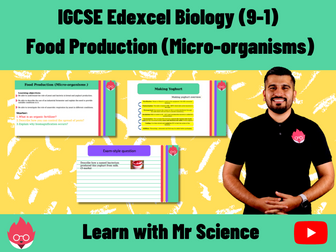
Designed for the new specification IGCSE Edexcel course but can be used for other examination boards.
Covers:
Micro-organisms
5.5 understand the role of yeast in the production of food including bread
5.6 practical: investigate the role of anaerobic respiration by yeast in different conditions
5.7 understand the role of bacteria (Lactobacillus) in the production of yoghurt
5.8 understand the use of an industrial fermenter and explain the need to provide suitable conditions in the fermenter, including aseptic precautions, nutrients, optimum temperature and pH, oxygenation and agitation, for the growth of micro- organisms
New AQA GCSE Biology Scheme (2016).
A lesson on culturing micro-organisms. This lesson covers the basics of binary fission and how to calculate the mean division time. The lesson also details how to carry out the aseptic technique.
Includes information slides and pupil activities and an exam question to assess progress.
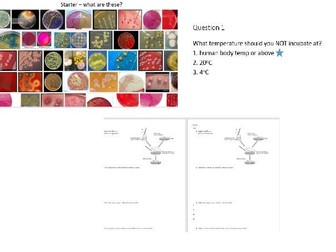
This starter is to ascertain the level of knowledge students hold at the start of the a lesson. Here you will be able to find out if they know key points of the information already so you don’t have to go over them in detail in the lesson.
Language games
matching cards
word mats
picture vocabulary cards
word search
science dictionary
crossword
supporting year 6 micro-organisms science language. Part of a large scheme - see the read me file for more details.
The entire series of lessons on Micro-organisms provides enough material for over 10 one-hour lessons, but you can be selective. (bundle available)
The series covers:
Introduction to Micro-organisms
The Microscope and Microscope Art
Bacteria, The Immune System and Antibiotics
Viruses, Vaccines and Virus Art
Fungi & Fungi Art
Additional misc. activities
The 5-star rated lessons have proven extremely popular with both teachers and students and comprise:
self-contained PowerPoint lessons packed with thought provoking material
lots of painstakingly selected, embedded videos (if you need to detach the videos, see here)
Worksheets (with answers) in Word providing individual and class activities.
Note that there is no Preview File to download.
Instead, Session 1 (Introduction) is FREE to give you a feel for the material - you won’t be disappointed.
Let me know if you have any questions or suggestions, and a BIG BIG thanks for looking (as a full time practicing teacher, I KNOW how time consuming this process can be).
ALL my postings are FULLY “classroom-tested” - before I publish, my lessons are tested by both myself and colleagues, rigorously evaluated and discussed, and continually updated to maximize their effectiveness.
But there is always the possibility of error and room for improvement, so do please provide constructive feedback.
Teacher/Author: Barrie James
Search words: quarantine, vaccinate, pasteurisation, germ, antibiotic, inoculate, immune, yeast, immunize, pathogen, inhalation, microbe, virus, bacteria, fungus, organism, disease, microscope, electron, contaminate, epidemic, pandemic, electron, light, metric, lens, convex, concave, optical, symbiotic, exponential, infectious, infect, antiseptic, plaque, toxin, toxic, compost, mucus membrane, quarantine, vaccinate, pasteurization, germ, antibiotic, inoculate, immune, yeast, immunize, pathogen, inhale, habitat, spore, parasite, mushroom, toadstool, species, volva, gills, mycelium, disperse, mould, mildew
An entire lesson on the culturing of micro-organisms including worksheet and quiz.
Objectives
Describe how microorganisms can be safely grown on agar plates.
Explain the safety precautions you must take when growing microorganisms.
Explain why cultures are incubated at a maximum temperature of 25ºC in schools.
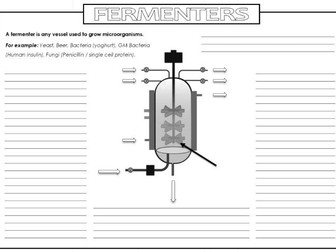
IGCSE Biology Uses of resources Micro-organisms, Fermenters. Worksheet for students to annotate
Useful worksheet for students to annotate using textbook or revision guide.
Micro-organisms come in a variety of shapes and sizes, from those that cause disease to adorable water bears. From the yeast that occurs in your bread, beer and other foods and beverages to fungi and mold and spores of all kinds. They survive, adapt and thrive beyond our wildest dreams and they do it in places smaller than we can image. Micro-organisms are just excellent to learn about.
These biology based research project templates (webquests) provides the perfect grab and go, print and provide resources that can help your students learn all about biology / life science topics. For digital, you can provide a Google doc copy for ease of submission or a Microsoft word version as well. In these biology related research project templates (webquests) with questions to check comprehension and inspire scientific thinking. They gives a rich and supportive framework that can be tweaked as needed for students to support differentiation.
These biology science research project templates include:
Space for a one paragraph summary (that links to the 2 page science article also available on this topic - but does not have to).
Students should produce a mathematical connection, an engineering / technology connection, 2 interesting facts / stats.
5 glossary terms they should fill in with their own words (which also links to the science article also available)
3 thought provoking questions (ie: critical thinking questions) they must answer.
Finally, each template has 3 alternative thought provoking questions for younger students and 3 other alternative harder questions to extend high flying or older students. Giving you a total of 9 possible thought provoking questions that could be used with students to enhance their research and critical thinking.
Further, I have added a 1 page - 20 point rubric to be used for either self-assessment or teacher assessment as you deem fit. I hope it helps support the learning even further!
The template is some of my best work and I am proud to share it with you.
A SCIENCE RESEARCH PROJECT TEMPLATE CAN BE USED SO MANY WAYS:
Useful for substitute (sub) teaching
To extend students
To increase scientific literacy and research skills in your class
Great as a lesson filler when class goes too fast and you need a long running task
To inspire students on a particular topic
As a scaffold to support students who need support on research skills and can use a framework
To enhance critical thinking when doing research and making a relevant and interesting output
Give a selection of these research project templates for students to choose from
To enhance students ability to express ideas and synthesis knowledge
To increase scientific literacy in your class
A weekly reading / research task
WHAT’S INCLUDED:
Biology / Life Science Research Project Template
6 - 7 page Google doc teacher version with supporting appendix items
6 - 3 page Google doc student version with room to fill in answers (text boxes)
6 - 7 page Word doc teacher version with supporting appendix items
6 - 3 page Word doc student version with room to fill in answers (text boxes)
6 - 7 page PDF teacher version with supporting appendix items
6 - 3 page PDF student version with space to fill in answers
1 page 20 point rubric for self or teacher assessment in all three - Google doc, Word doc and PDF form
Please note: That the Doc versions are images with editable text boxes overlayed on top and this is the most effective way to keep the article sleek and well-designed and also that students cannot change things significantly.
This set of science articles provides the perfect grab and go, print and provide resource that can supplement lessons. It is a set of articles with questions to check comprehension and inspire scientific thinking. I am very proud of this series of science articles and they are rich with information and wonder at the majesty of science. Each science article includes a fun fact(s) to add to the knowledge gained from this article. Formatted in an easy to read and digest manner, each paragraph is numbered to help with referencing and each question answer has a paragraph reference number to point to the specific information (where applicable).
WHY / WHEN TO USE:
Useful for substitute (sub) teaching
To extend students
To increase scientific literacy in your class
A weekly reading task
Great as a lesson filler when class goes too fast
To inspire students on a particular topic
Give a selection of these articles for students to choose from
WHAT’S INCLUDED:
6 sets of 3 page Word doc teacher version with answers
6 sets of 2 page Word doc student version with room to fill in answers (text boxes)
6 sets of 3 page PDF teacher version with answers
6 sets of 2 page PDF student version without answers (but space left to do so)
More will be coming to cover other subjects and other topics, so please do keep an eye out for more science articles from The Teaching Astrophysicist!
If you have any questions, please feel to DM me on instagram @theteachingastrophysicist
Let’s Connect! - All under the handle - The Teaching Astrophysicist
Be sure to follow my:
★ Blog
★ Instagram
★ Linkedin
★ Pinterest
The entire series of lessons on Micro-organisms provides enough material for over 10 one-hour lessons, but you can be selective. (bundle available)
The series covers:
Introduction to Micro-organisms
The Microscope and Microscope Art
Bacteria, The Immune System and Antibiotics
Viruses, Vaccines and Virus Art
Fungi & Fungi Art
Additional misc. activities
The 5-star rated lessons have proven extremely popular with both teachers and students and comprise:
self-contained PowerPoint lessons packed with thought provoking material
lots of painstakingly selected, embedded videos (if you need to detach the videos, see here)
Worksheets (with answers) in Word providing individual and class activities.
Note that there is no Preview File to download.
Instead, Session 1 (Introduction) is FREE to give you a feel for the material - you won’t be disappointed.
Let me know if you have any questions or suggestions, and a BIG BIG thanks for looking (as a full time practicing teacher, I KNOW how time consuming this process can be).
ALL my postings are FULLY “classroom-tested” - before I publish, my lessons are tested by both myself and colleagues, rigorously evaluated and discussed, and continually updated to maximize their effectiveness.
But there is always the possibility of error and room for improvement, so do please provide constructive feedback.
Teacher/Author: Barrie James
Search words: quarantine, vaccinate, pasteurisation, germ, antibiotic, inoculate, immune, yeast, immunize, pathogen, inhalation, microbe, virus, bacteria, fungus, organism, disease, microscope, electron, contaminate, epidemic, pandemic, electron, light, metric, lens, convex, concave, optical, symbiotic, exponential, infectious, infect, antiseptic, plaque, toxin, toxic, compost, mucus membrane, quarantine, vaccinate, pasteurization, germ, antibiotic, inoculate, immune, yeast, immunize, pathogen, inhale, habitat, spore, parasite, mushroom, toadstool, species, volva, gills, mycelium, disperse, mould, mildew
ALL Fully Updated 2020
The entire series of lessons on Micro-organisms provides enough material for over 10 one-hour lessons, but you can be selective. (bundle available here)
The series covers:
Introduction to Micro-organisms
The Microscope and Microscope Art
Bacteria, The Immune System and Antibiotics
Viruses, Vaccines and Virus Art
Fungi & Fungi Art
Additional misc. activities
The 5-star rated lessons have proven extremely popular with both teachers and students and comprise:
self-contained PowerPoint lessons packed with thought provoking material
lots of embedded videos (if you need to detach the videos, see here)
Worksheets (with answers) in Word providing individual and class activities.
Note that there is no Preview File to download.
Instead, Session 1 (Introduction) is at a DISCOUNTED PRICE to give you a feel for the material - you won’t be disappointed.
Let me know if you have any questions or suggestions, and a BIG BIG thanks for looking (as a full time practicing teacher, I KNOW how time consuming this process can be).
ALL my postings are FULLY “classroom-tested” - before I publish, my lessons are tested by both myself and colleagues, rigorously evaluated and discussed, and continually updated to maximize their effectiveness.
But there is always the possibility of error and room for improvement, so do please provide constructive feedback.
Teacher/Author: Barrie James
Search words: quarantine, vaccinate, pasteurisation, germ, antibiotic, inoculate, immune, yeast, immunize, pathogen, inhalation, microbe, virus, bacteria, fungus, organism, disease, microscope, electron, contaminate, epidemic, pandemic, electron, light, metric, lens, convex, concave, optical, symbiotic, exponential, infectious, infect, antiseptic, plaque, toxin, toxic, compost, mucus membrane, quarantine, vaccinate, pasteurization, germ, antibiotic, inoculate, immune, yeast, immunize, pathogen, inhale, habitat, spore, parasite, mushroom, toadstool, species, volva, gills, mycelium, disperse, mould, mildew