The Development Gap: Our Unequal WorldQuick View
markthegeographer

The Development Gap: Our Unequal World

(0)
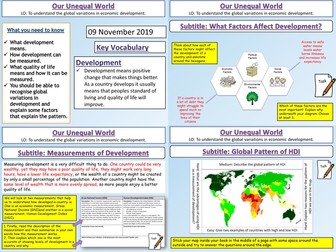
AQA GCSE Geography lesson. At least 1 hour long. This lesson explores what the concept of development is. the students then explore what factors affect development worldwide by annotating the four categories with ideas, Social, environmental, political and economic. We then look at GNI and HDI as measurements of development and consider both their strengths and weaknesses. We then look at global patterns of HDI, and quality of life. Included is: Map interpretation starter Factors of development activity Video clip on development measurements Activity on development measurements HDI questions activity. Hope this helps. https://www.tes.com/teaching-resources/shop/markthegeographer
5. Earthquakes (Our Physical World SOW)Quick View
devinegeography

5. Earthquakes (Our Physical World SOW)

(0)
Students will: investigate the Richter scale and how earthquakes are measured draw connections between plate margins and global distribution of earthquakes gather details on the impacts of the Nepal earthquake of 2015 Lesson 5 of Our Physical World SOW (AQA Heading towards GCSE)
Entry Level_AQA_Science_Component 4_Chem_Chemistry in our worldQuick View
hannah_byrne

Entry Level_AQA_Science_Component 4_Chem_Chemistry in our world

(0)
Contents: Resource packs and answers to allow the delivery of the AQA Entry Level Science Component 4 (Chemistry - Chemistry in our world) (the packs contain opportunities to further push pupils towards GCSE) topic included: * Reaction of Acids * Energy and rate of reaction * Earth’s Atmosphere * Fuels and Human Impacts on the Atmosphere * Water for Drinking Practice teacher designed assessment are included in the work packs. Teacher designed assessment work packs are also included (there are multiple teacher designed assessment to allow pupils more than one opportunity to successfully complete them.)
Our World - KS1/KS2Quick View
TeachItForward

Our World - KS1/KS2

9 Resources
Our World is a comprehensive Geography topic about Planet Earth, suitable for KS1 and lower KS2 (Y1-3). The planning overview, topic title page and vocabulary page can be downloaded for free here. Lessons include: L1 – Completing a world map jigsaw L2 – Identifying the continents and oceans of the world (FREE) L3 – Where do we live? L4 – Identifying human and natural features of the world L5 – Investigating satellite photos of famous world landmarks L6 – Introduction to compass directions L7 – Identifying world climate zones L8 – Identifying the countries and capitals of the UK (FREE) Each lesson includes a presentation and differentiated activities/worksheets. If you like this resource, we would appreciate a review! We will happily send you a free resource in return for a review or useful suggestions/feedback. Contact us at ed@teachitforward.co.uk.
Our Worlds PopulationQuick View
WillsonEducation

Our Worlds Population

(4)
This booklet looks at several areas of population including: key Words, Population Change, World’s Population Distribution, Why Are Some Families Larger Than Others?, Changes In Population, Sustainable Population, One-Child Policy, Ageing Population, France’s Solution, International Migration
Penguins - Our WorldQuick View
Inspireplaycreate

Penguins - Our World

(0)
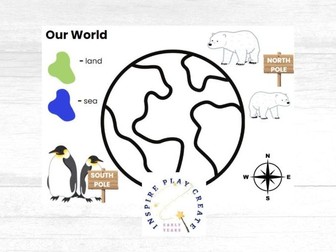
Penguin Awareness Day is Monday 20th January Use any art materials to add the colour for the land and sea on the earth outline. You could use sponges or cue tips with paint, water colours, pastels or collage. The pictures will prompt discussion about where penguins and polar bears live.
KS1 RE - Caring for the World: Why is our world special? (Lesson 1)Quick View
BareminimumBrilliance

KS1 RE - Caring for the World: Why is our world special? (Lesson 1)

(0)
A complete KS1 RE lesson exploring the question: Why is our world special? This lesson is fully aligned with the Northamptonshire Agreed Syllabus 2025–2030 and forms Lesson 1 of Unit 1.4: Caring for the World. Designed for real KS1 classrooms, this lesson uses short, structured learning steps and regular opportunities for pupil talk to support attention, participation and understanding. This opening lesson introduces the idea that the world is special and worth caring for. Pupils begin to explore what makes the world important and how people can show care through their actions. Includes: • A clear, ready-to-use slideshow • Structured discussion questions • Engaging worksheet task • Oracy prompts and sentence stems • Key vocabulary support Children learn: • The world is special and important • People can care for the world in different ways • Actions can show care for people, animals and the environment The lesson is carefully structured to support attention, reduce cognitive overload and build understanding through talk. Low-prep, inclusive and suitable for Year 1 and Year 2. Also available as a full unit.
Our WorldQuick View
cmfield

Our World

(0)
WJEC GCSE - Series of lessons/activities on Our World
Our WorldQuick View
peterfogarty

Our World

13 Resources
Here are lots of different presentations about the different aspects of our world. There is something for everyone in this wonderful collection of different places. It could be used again and again, throughout all the year!
Our WorldQuick View
katewilliams_poetry

Our World

(0)
Beautiful, evocative eco-poster. Words - ‘Our World - in our hands’ - on natural scene of wild flowers. Celebrates nature. Sends out gentle reminder to care for our natural world. Will inspire children with the beauty and wonder of nature, and help them understand its vulnerability and our duty of care. See my other ‘green’ and ‘eco’ resources too, many free. I have a debut book of poems: ‘SQUEAK! SQUAWK! ROAR! Amazing Animal Poems’, published by Otter-Barry Books. ‘A brilliant resource for schools’ - School Reading List.
WW2 - Was the Battle of Britain Our 'Finest Hour'?Quick View
History_Wizard

WW2 - Was the Battle of Britain Our 'Finest Hour'?

(2)
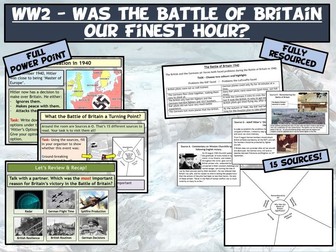
This lesson contains: A starter to consider the famous quote by Churchill. A run through of the situation in 1940 post-Dunkirk and the situation Britain was in. A Youtube video of WW2 in colour to bring it to life. Students complete a comprehension multiple choice set of questions as the video plays. An activity to consider the tactic advantages and disadvantages of both sides. A task to use a series of sources in groups to build an arguement for the significance of the battle using the ‘GREAT’ formula. A worksheet is designed for this purpose. A plenary to consider what factors won the Battle of Britain for the British. Attachments: 1 x Powerpoint Presentation 2 x Word Files 1 x Publisher File
Our worldQuick View
JodiP

Our world

(3)
I used these two lessons for my early entry class who had to work through the module very quickly. I would print off some off the slides in order to save time
Our WorldQuick View
NGfLCymru

Our World

(1)
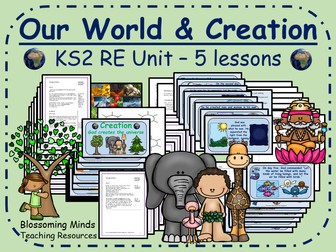
Materials dealing with issues of scientific and religious theories of creation and humans responsibility for the environment. The resources are suitable for whole class teaching to promote thinking skills and discussion. Some of the resources are designed to be used with a digital projector, ideally on an interactive whiteboard. Paper based resources are also included with references to recommended WJEC texts.
3. Our underwater world (Our Physical World SOW)Quick View
devinegeography

3. Our underwater world (Our Physical World SOW)

(0)
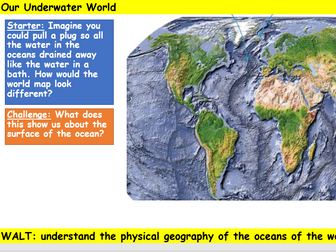
Students will: investiage the Mid-Atlantic ridge and tis location at the bottom of the Atlantic Ocean create a cross section diagram of the Mariana Trench consolidate information on the Mariana Trench and Mid-Atlantic Ridge to compare them. Lesson 3 of Our Physical World SOW (AQA Heading towards GCSE)
World Ocean Day / Save our Ocean Assembly PPTQuick View
nikkij86

World Ocean Day / Save our Ocean Assembly PPT

(0)
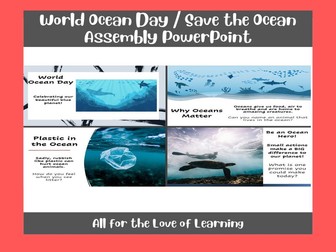
Looking for a quick and engaging way to celebrate National World Ocean Day in your school assembly? This ready-to-use 16-slide PowerPoint assembly is the perfect solution! Designed to be led by a teacher, it includes everything you need—no prep required. Children will learn what World Ocean Day is, why our oceans are so important, and the challenges they currently face, such as pollution, overfishing, and climate change. The presentation highlights amazing ocean facts, the incredible creatures that live there, and the role oceans play in keeping our planet healthy. There’s a focus on how children can make a difference—whether it’s by reducing plastic use, taking part in beach clean-ups, or spreading awareness. The assembly wraps up with discussion prompts around why the oceans matter and what small actions we can take to help protect them. Perfect for a time-saving, meaningful assembly that inspires and informs—with no preparation time needed!
Exploring Our WorldQuick View
ftbnemesis

Exploring Our World

(0)
Exploring Our World A structured and engaging geography learning resource covering physical, human, environmental and locational geography. This resource introduces key geographical concepts in a clear and accessible way, helping learners understand how people, places and environments are interconnected across the world. Key features: Clear explanations of physical, human, environmental and locational geography Visually engaging content with structured sections and examples Real-world geographical concepts including climate, population and landforms Key vocabulary definitions to support understanding of essential terms Integrated explanation of how different areas of geography are connected Includes an accompanying worksheet to reinforce and practise key concepts Includes an accompanying worksheet to reinforce and practise key concepts.