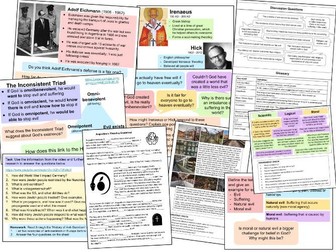
A fully resourced lesson focused on philosophical responses to the problem of evil. The lesson looks at Other Christian response ( John Hick) and Non-religious response (Epicurus, David Hume and John Mackie). The lesson follow Eduqas, Route B spec.
This is a complete unit of work, covering around 14 hours of teaching time. This resource includes a range of activities, lesson powerpoints, a student booklet which follows the powerpoints and assessments. It encourages philosophical discussion about evil, explores theodicies and a case study of the Holocaust to question whether God can exist even though there is evil in the world.
This is a complete unit, ready to teach!
It covers:
The problem of evil and the inconsistent triad
Natural and moral evil
Augustine’s theodicy
Soul-making theodicies
The rise of anti-semitism and Auschwitz
Holocaust denial
Jewish responses to the Holocaust and problem of evil
Psychological explanations for evil, from Milgram and Zimbardo
Assessments, including extended writing responses and multiple choice tests
I personally find this unit most appropriate to teach in Year 9 as a good step to prepare for the GCSE, though it may also work well with Year 8.
Please leave a review, and happy teaching!
Instantly create random philosophical debates for any KS3-5 classroom or tutor group. Created by a philosophy teacher with a masters in philosophy and designed to take students as deep as possible in as short a time as possible!
This is a 200 slide PPT, containing 198 philosophical debates, discussions, and dilemmas.
It also contains a ‘randomiser’ slide: when clicked a random moral problem is presented to the group.
For a FREE DEMO please search: ‘The Philosophical Debate Generator [Free Demo Version]’
Uses:
-P4C (Philosophy for kids)
-Form time activities
-R.S./Philosophy/Citizenship cover lessons
-Debating societies
-Making best use of spare time at the end of lessons
Discussions follow one of four formats, each asking students to move from one side of the room or the other to make their position clear: teachers should then use questioning to foster a debate between students, encouraging them to present reasons for their choice and defend their position.
The formats are:
-True or False
-Which Philosopher is more correct?
-Agree or Disagree?
-Which is more True?
This resource is great value at £4.99 and cannot be found elsewhere:
-It clearly contributes to your school’s SMSC provision
-Furthers students’ critical thinking skills
-It allows for countless hours of discussion and debate to be structured in a focussed and engaging manner.
-It would take days to reproduce yourself.
-It can save vast amounts of staff time in preparing cover lessons
-It is the perfect way to make the most of any time a teacher might have left at the end of a lesson.
-It deals with cross curricular issues
Please note: this resource deals with controversial issues, debates and questions that may be deemed unsuitable for younger children. It is designed for secondary school students, but can be easily adapted to younger years with appropriate amendments by their teacher.
A Level Philosophy, Epistemology, the unreliability of the senses, optical illusions, Hume and the problem of induction, Hume on causation vs constant conjunction.
This bundle of lessons look at Philosophical Thought Experiments. They have been used with Sixth Form students as part of an elective program to broaden their understanding of Philosophy (especially if they are not studying Philosophy for A Level). They aim to get students thinking in a philosophical way, asking and answering questions during class discussion. There are links to videos found on YouTube to support the learning and these can be found within the presentation. Some fascinating discussion and deep thinking should result!
This resource contains a complete lesson on ‘Philosophical scepticism’ as part of the Epistemology unit for AQA’s A-Level Philosophy course. The lesson focuses on theory and skills on debate/oracy as well as higher-order thinking. For further activities and guidance, please use the official AQA A-Level Philosophy textbook.
A Philosophy Mini-Curriculum for Primary
PDF - scripted lessons for Primary School Educators.
EYFS Lessons - Optional use of Socrates Doll
Socratic Method: Plan, script - question sorting and introducing ‘Big Questions’
What is ‘real’? Plan - thinking about where knowledge comes from and whether we can tell if something is real or not. Discusses personhood.
Years 1 and 2 Lessons
What’s the Big Idea? Plan - an introduction to philosophy and some of the big ideas it delves into.
How Did the Universe Come to Be? A discussion-based unit about creation and the idea of God.
Year 3 Lesson
What is the Difference Between Knowing and Believing? Plan - a look at observation, faith and miracles.
Year 4 Lesson
Morality: How do People Make Moral Decisions? Plan - a look at how people justify moral decisions with logical arguments.
Year 5 Lessons
Utilitarianism Parts I & II - Plans, Presentation, Scenario Cards - a look at Bentham and Mill’s system for moral decision making.
Ontology: Plan, Presentation - A look at the Ontological arguments for the existence of God and its problems.
Year 6 Lesson
Plato’s Cave: Plan - A look at the role of the philosopher in society and the idea of knowledge through revelation.
Primary Range Home/School
Lesson 1
The Purpose of Things: Plan - A discussion-based enquiry into the purpose of everyday things. It examines the ‘why’ of objects, both made and naturally occurring. An introduction to teleology.
Lesson 2
Of Superheroes and Miracles: Plan and Presentation - A discussion-based enquiry into the origins of the idea of the ‘superhero’. Encompassing believability, scepticism, Hume and his views on miracles.
Lesson 3
Morality with a Buddhist Focus: Plan - A discussion-based enquiry looking at morality and the externalised, spiritual drives behind it. Encompassing non-spiritual reasons of morality, inviting discussion about internal morality as well as a starting point to study belief in karma.
Lesson 4
Knowing VS Believing Part 1: Plan - A discussion-based enquiry looking at the difference between ‘Knowing’ and ‘believing’. Part 1 covers magic tricks and the senses as a source of ‘fact’. It asks whether scientists need a little belief in their line of work too. Introduces concepts such as dark matter.
Lesson 5
Knowing VS. Believing Part 2: Plan - A discussion using Flew’s The Invisible Gardener Parable. How do we know things? Is there a battle going on between science and belief? Do scientists believe? An introduction to the Falsification Principle.
For more and the accompanying Free presentations can be found on my website by googling philosophy in ks2. These are made using ‘creative commons’ pictures and so are not subject to copyright.
Use the news to get inside the curriculum. News story, class activities, glossary and discussion points. Get the debate going in citizenship, religious studies or English and media with this news story written for classroom use.
The Philosopher’s Hat Game
Objective: Explore different philosophical viewpoints.
How to Play:
Participants choose a hat and must argue a viewpoint from that philosopher’s perspective on a given issue.
Encourage creative interpretations and lively discussions.
Great as an A Level lesson, for philosophy clubs, or open days.
The problem of Other Minds (Solipism)
Typed notes about:
Mills argument from analogy
Wittgenstein Private Language
Satre and Heidegger's criticisms
Student tasks are upon the worksheet along with example exam questions
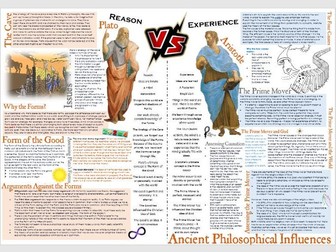
Ancient Philosophical Influences for OCR A Level Religious Studies Philosophy of Religion.
This is the full unit broken down into detailed individual lessons within two PowerPoint presentations, one being 3 lessons on Plato within 35 slides and one 4-5 lessons on Aristotle within 47 slides. Included are information worksheets on both philosophers and a series of tasks covering key themes including the Allegory of the Cave, Theory of the Forms, the Four Causes of Aristotle. Included is also an assessment essay guidance sheet used for a formal assessment of this unit’s learning. These resources cover the full unit in a circa 8 lesson scheme and include class, homework and assessment opportunities within.
This resource is aimed at AQA A Level Philosophy. It can also be used with IB, Scottish Highers and international KS5. It includes Philosophical Zombies (particularly through David Chalmers’ version), property dualism and its appeal to qualia and phenomenal properties of experience. The slides should deliver a lesson of approx 60 minutes but could also suit 75-90 minutes with questioning and student activities, which are in slides.
This is a unit of 5 lessons for the OCR unit on Philosophy of Religion: Ancient Philosophical Beliefs. Lessons cover a variety of tasks, activities and learner styles, geared towards the final exam. Also included is the A3 and A4 Learning Mats / Revision Mats for this topic.
Lessons are:
Introduction and Background
Plato’s Reality
Aristotle’s Causes
Aristotle’s Prime Mover
Comparing Plato and Aristotle
Learning Mat / Revision Mat also included.
Free Workbook also included
Please give feedback! I am always happy to respond to comments - whether positive or constructive - this will help to improve the quality of my resources in the future and, more importantly, the quality of pupils’ RE/RS education in general - which is what we’re all here for!
This is a 19-slide PowerPoint (pdf also included) covering the topics for the OCR unit on Philosophy of Religion.Each slide covers a topic or sub-topic and thinkers/philosophers who have a view on that particular topic/sub-topic, which students can learn for their exams. Can be used an an in-lesson resource or for independent study / revision.
Slides are:
Ancient Philosophy
Knowledge / Reality
Soul, Mind and Body
Arguments based on observation
Teleological Argument
Cosmological Argument
Arguments based on reason
Ontological Argument
Religious Experience
William James on Religious Experience
Problem of Evil
OMnipotence
Eternal God
Omniscience
Omnibenevolence
Apophatic Way
Cataphatic Way (Analogy)
Cataphatic Way (Symbol)
20th Century Perspectives
My own students use this resource whilst writing and planning essays. I also find it useful when marking them - it is a reference/guide to who says what and gives a quick insight into what could be added/argued to make improvements to essays.
Please give feedback! I am always happy to respond to comments - whether positive or constructive - this will help to improve the quality of my resources in the future and, more importantly, the quality of pupils’ RE/RS education in general - which is what we’re all here for!
BHA’s educational resources are for teachers who want to make RE, Citizenship and PSHE properly inclusive, and for students researching assignments. They are all PDF resources and you will need Adobe Reader to view and print them. Most of these resources for students of all ages outline how humanists approach a range of issues. They contain discussion questions, further reading suggestions and web links, as well as a humanist perspective. (Please note that they are not intended to be definitive or prescriptive statements about what all humanists think or BHA policy.)
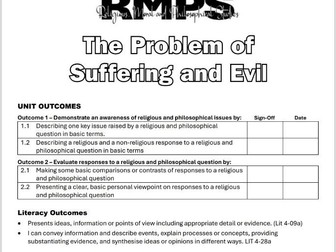
Bring the Problem of Suffering and Evil to life with a ready-to-use student booklet designed for SQA National 4 RMPS. It explicitly targets Unit Outcomes 1.1, 1.2, 2.1 and 2.2, with literacy links to Lit 4-09a and LIT 4-28a.
• Structured sections on: Types of suffering; Natural evil and natural disasters; Moral evil and crime; Supernatural evil and possession; Qualities of God; and the classic problem of suffering with theodicies.
• Engaging activities: riddles and starters, Venn diagrams, data handling of disaster and crime stats, a fact-file research task, news-report writing, a responsibility scale, and an evidence-board project.
• Case study: The Devil Made Me Do It – a detailed, question-led exploration of the 1981 Brookfield case, perfect for critical thinking and evaluating claims.
• Text and belief analysis: students work with contrasting voices including Fry, Leibniz, C S Lewis and Darwin to compare religious and secular responses.
• Retrieval and assessment: SQA Outcome challenges embedded throughout plus an Outcome Retrieval section for re-drafting and evidence of progress.
• Creativity options: Dante’s Inferno nine levels task, superhero ‘qualities of God’ comic strip, and six-word stories to support expression and recall.
Skills and differentiation
• Meta-skills are signposted across the unit, including Empathy, Sense-Making, Focus, Curiosity, Initiative and Critical Thinking. Tasks are scaffolded with sentence frames, choice grids and step-by-step prompts to support mixed-attainment classes.
Format and use
• PDF student booklet. Print and go, or project pages for guided completion. Ideal as a mini-unit or to dip in for standalone lessons. Suits National 4 RMPS and adapts well to lower KS4 or upper KS3 RE and Philosophy.
Keywords: RMPS, Problem of Evil, suffering, natural evil, moral evil, supernatural evil, theodicy, Christianity, Humanism, SQA National 4, data analysis, literacy, meta-skills.
This is a learning mat indented for independent study or revision for the topic of Philosophy of Religion: Ancient Philosophical Influences, as part of the OCR AS/A Level specification, although it can be applied across specifications. Document can be downloaded as an A3 Word document and as an A4 PDF, for compatibility.
Resource Includes:
Plato’s Reality
Plato’s Forms and Form of the Good
Assessing Plato
Aristotle’s Reality
Prime Mover
Assessing Aristotle
Comparing Plato and Aristotle
Created with the OCR RS AS/A Level in mind, though can be applied across specifications and qualifications.
Please give feedback! I am always happy to respond to comments - whether positive or constructive - this will help to improve the quality of my resources in the future and, more importantly, the quality of pupils’ RE/RS education in general - which is what we’re all here for!
Here is a table with all the philosophers on the OCR A2 Philosophy And Ethics Course from the philosophy side. Within the table are all of the philosophers opinions and arguments for the course topics along with criticisms from other philosophers. I will add one for all of the philosophers in the Ethics part of the course soon. A great resource to cement the knowledge into your head as it is written in understandable and relevant language.
A fully resourced lesson on the main problems associated with miracles, with particular reference to the Bible. Two key theistic responses are then analysed and considered in the plenary. I hope you find this helpful- any comments would be great!