Political Philosophy - IB Philosophy (Whole unit!)Quick View
SBReligiousStudies

Political Philosophy - IB Philosophy (Whole unit!)

(0)
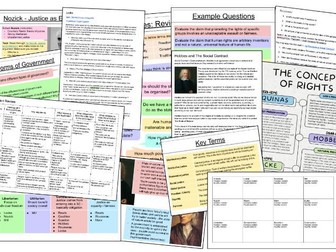
This is a resource for a years worth / two terms of teaching for Political Philosophy. The resource has been made for IB Philosophy, but may also be useful for other exam boards. The content covered includes: The state of nature, particularly studying Hobbes, Locke and Rousseau Political ideologies - liberalism, conservatism, socialism (incl. communism) Anarchism The role of justice and distributive justice, particularly studying Rawls and Nozick The concept and development of rights Positive and negative liberty (Isaiah Berlin) Non-human rights The content covers a wide range of scholars with particular focus on Hobbes, Locke, Rousseau, Burke, Paine, Marx, Rawls and Nozick. This resource includes: Multiple powerpoints, mainly split into introduction; state, society and nation; justice; and rights A student study guide to match the powerpoints A study guide inclusive of my answers which matches the powerpoint Multiple worksheets and resources for reading content Links to useful content to support teaching Example essays IB past paper questions Revision resources, e.g. game of key words, planning tools This is a comprehensive, detailed and accessible resource which is ready to teach. If you like it, please do leave a review and happy teaching!
PhilosophyQuick View
EC_Resources

Philosophy

12 Resources
12 hours of fully resourced Philosophy lessons and an assessment offering an introduction to Philosophy for KS3/4. All lessons include a 1 or 2 hour PowerPoint, clips, worksheets and are differentiated fully to three or four levels. All our RE, PSHE, Citizenship and RE resources have been designed to be engaging, detailed and easy to follow. All our resources are editable (so easy to adapt for your classes) and are designed to last one hour each. You can find many more inexpensive and free PSHE, Citizenship and RE resources at my shop: EC_Resources Leave me a review and pick any other resource for free :) Or you can check out some of our most popular PSHE, Citizenship and RE resources below: Mental Health PSHE Bundle 1 Whole Year of PSHE Resources British Values Citizenship Bundle Careers, Employment and Enterprise Bundle Islam Bundle Sex and Relationships Education
Edexcel A Level Politics Political Ideas Lessons 14-25 (Conservatism)Quick View
md89

Edexcel A Level Politics Political Ideas Lessons 14-25 (Conservatism)

(1)
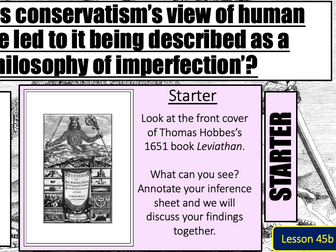
LIST OF LESSONS IN THIS RESOURCE 45a What is conservatism and what is the principle of ‘change to conserve’? 45b Why has conservatism’s view of human nature led to it being described as a ‘philosophy of imperfection’? 45c What is the conservative view of society? 45d How have conservatives viewed the purpose of the state and the economy? 46a What were the origins of traditional conservatism? 46b How did conservatism change from the 1800s onwards? 46cd How did New Right conservatism challenge traditional conservative thinking? (2-hour lesson) 47a What are the tensions within conservatism? 47b How have the key thinkers within conservatism disagreed? 47c Knowledge test 10 47d Assessment Further to the 125 lessons I have created for the UK Politics components of the Edexcel A Level, I have also created 50 lessons for the Political Ideas element of the course (Liberalism, Conservatism, Socialism, Feminism). These lessons, designed to be taught over ten to twelve weeks, include: LIST OF MATERIALS IN THE FULL 50 LESSONS ACROSS TOPIC BUNDLES Between 2 and 4 substantial homeworks set per week (answers also provided); 8 assessment opportunities (4 in class, 4 as homework – two per ideology); 4 substantial knowledge tests, each out of 100 marks. Further reading integrated (although you will need to purchase the relevant books yourself). The core textbook for students to use is Political Ideas for A-Level (the version that includes Feminism) by Neil McNaughton and Richard Kelly (Hodder Education). I recommend buying enough for all students. Frequently, activities will reference the Pearson textbook. If you wish to do these activities, this book is Edexcel GCSE Politics AS and A-Level Student Book and eBook - worth snapping up a copy of this also. I also make use in places of Political Ideologies: An Introduction (5th ed.) by Andrew Heywood, and for Feminism I also make use of The Penguin Book of Feminist Writing (edited by Hannah Dawson – easily found on Amazon) and All the Rebel Women by Kira Cochrane (available for £1.99 as an eBook on Google Books).
Citizenship UK Political Parties + VotingQuick View
EC_Resources

Citizenship UK Political Parties + Voting

(9)
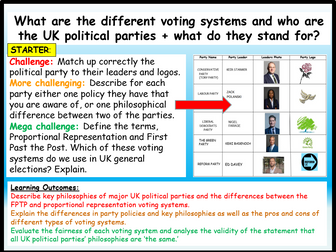
UPDATED FOR 2026 : A 1 hour lesson on FPTP, PR and the philosophies of the main UK political parties. As required by the AQA spec (but also suitable content for other specs), this lesson covers: 1.The major political parties contesting UK general elections; key philosophical differences between the political parties operating in UK general elections. 2.The nature of the ‘First Past the Post’ system based on parliamentary constituencies; the frequency of Westminster elections. Other voting systems used in UK elections, including proportional systems and the advantages and disadvantages of each. Created for Citizenship GCSE - Politics and Participation - perfect for revision too. Includes: 1 hour PP, worksheets, exam practice question, clips, well differentiated and easily adapted. Made for AQA Citizenship 9-1 but suitable material for any of the Citizenship GCSE courses or could be used for non-GCSE British Values lessons. This lesson has been planned for Citizenship AQA 9-1 : Politics and Participation, specifically spec point 3.4.3 Where does political power reside: with the citizen, parliament or government? These resources have been designed to be engaging, detailed and easy to follow. All our resources are editable (so easy to adapt for your classes). You can find many more inexpensive and free PSHE, Citizenship GCSE AQA and RE resources at my shop: EC_Resources Leave me a review and pick any other resource for free :)
Political Philosophy Task CardsQuick View
thephiloteacher

Political Philosophy Task Cards

(0)
10 Political Philosophy Task Cards to facilitate exploration of the key concepts of Government, Human Nature, Power and Control. Note: Students will either need a copy of the excerpt, or the excerpt slide shown on the board in order to complete the task cards.
Philosophy and Ethics - Rousseau on Political Philosophy - Context and InformationQuick View
CreativeRE

Philosophy and Ethics - Rousseau on Political Philosophy - Context and Information

(0)
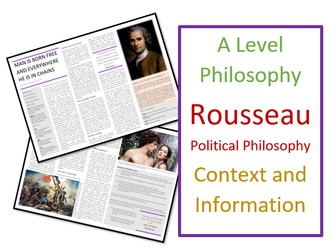
These clear and engaging revision sheets are indented for independent study or to aid revision for the key scholar Rousseau in the topic of Philosophy (Free will and political philosophy) and the Theological topics of Human Nature and Karl Marx/Liberation Theology. Each sheet is downloaded as an A3 Word document and an A4 PDF, for compatibility. I felt it was important to make these sheets as my students sometimes misunderstood the context of the philosophers or the chronology of the arguments (and responses). Therefore, these context sheets aim to tackle these misconceptions and re-examine the theory and/or philosopher within the context in which they should be viewed. A sample context sheet can be found here: https://www.tes.com/teaching-resource/a-level-anselm-and-ontological-argument-context-and-information-sheet-12316408 Additional topics and/or philosophers can be found in my Tes shop! Please give feedback! I am always happy to respond to comments - whether positive or constructive - this will help to improve the quality of my resources in the future and, more importantly, the quality of pupils’ RE/RS education in general - which is what we’re all here for!
Complete RE/Philosophy Classroom Display PackQuick View
toddbeamish

Complete RE/Philosophy Classroom Display Pack

(40)
STOP! This bundle is still available but our latest and greatest Massive Display bundle can be found here: https://www.tes.com/teaching-resource/resource-13287219 ^^^^^^^^^^^^^^^^^^^^^^^^^^ Firstly, I’d like to say a HUGE thank you to the more than 1000 of you who have downloaded this display pack! I hope your classrooms look gorgeous! This is a complete 200+ page pack of a number of classroom displays that I have developed over the last couple of years to invigorate my department. Two updated booster packs have already been added. Original Display Pack: - Philosophers and Religious Figures Timeline (Over 40 thinkers with pictures, dates and outlines of their thinking). - Famous quote callouts to add along the timeline (one for almost every philosopher). Get students talking! - Custom-made colourful lettering for timeline eras. - Over 20 ethical and philosophical questions in colourful speech bubbles to inspire thinkers in your classroom (A great one for open-evenings or tutor time discussions!) - Steps/Levels display with optional number arrows. Department levels policy documents included. - ‘How to’ guides for all displays. Booster Pack 1: - Philosophical Language Literacy Display with sentence starters for knowledge/explanation and assessment/evaluation. - Agree --> Disagree continuum signposts to make human bar charts in your classroom! - Blooms thinking guidance for teachers with question prompts. Great for shrinking and sticking on desks or displaying at the back of the room. Booster Pack 2: - A raft of additional thinkers to give greater flexibility to the Philosopher Timeline across exam boards. - Quotes for every new thinker of course! I’ve also added another high-quality display pack covering Logical Fallacies and Cognitive Biases. Find it here: https://www.tes.com/teaching-resource/logical-fallacies-and-cognitive-biases-display-pack-philosophy-psychology-11925635
John Rawls and Robert Nozick - Political Philosophy - LessonQuick View
MissRowesResources

John Rawls and Robert Nozick - Political Philosophy - Lesson

(0)
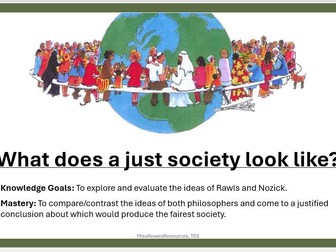
This lesson has been created for a KS3 class (Years 7, 8 or 9) for Religious Education / Philosophy and Ethics. They could also be used at GCSE level. These resources are perfect to be used for a one hour lesson. Purchase of this lesson includes: 1 x PowerPoint This lesson is part of a unit of work exploring wealth, poverty and the distribution of wealth. This lesson is entitled ‘what would a just society look like?’ and explores the ideas of the philosophers John Rawls and Robert Nozick.
Edexcel Politics ALevel Topic 5 The US Supreme CourtQuick View
mossa

Edexcel Politics ALevel Topic 5 The US Supreme Court

7 Resources
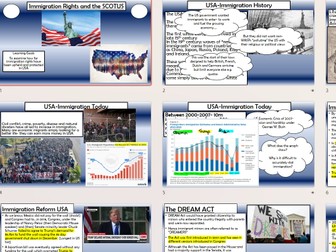
This is a bundle of all my lessons on the US Supreme Court and Civil Rights- most lessons take 2 hours plus homework- some e.g. civil rights is longer. Includes: Lesson 1: SCOTUS Introduction and Philosophy including a glossary/ key words sheet and a detailed topic check list with case studies for students to learn Lesson 2: The Nomination process including case studies for students to complete for Amy Coney Barrett and Ketanji Jackson Brown Lesson 3: How Politicised is the Court? Lesson 4 The SCOTUS and shaping Public Policy- Judicial activism vs restraint and different interps of Constitution Lesson 5 The SCOTUS and Civil Rights and Voting Rights- this is around 3-4 hours of teaching plus homeowkr Lesson 6 The Scotus and Immigration rights Lesson 7 Comparative Politics including planning sheets for 12 mark question Also includes blank and model essay plans for 30 mark questions for key debates on the SCOTUS (located in the Comparative files) Price individually £34.50
KS1-3: Political Philosophy (P4C) "Big Issues in Politics" [Philosophy Boxes] Debates & DiscussionsQuick View
godwin86

KS1-3: Political Philosophy (P4C) "Big Issues in Politics" [Philosophy Boxes] Debates & Discussions

(0)
The Philosophy Boxes Method is a new approach to P4C designed for students in KS1, 2 & 3: it is graphically stimulating, engaging, and fun. This download is also suitable for older students: but the format was designed with younger students in mind. The topic of this Philosophy Boxes download is: “The Big Debate of Politics”, which features a range of debates and discussions on the fundamental conflicts within political philosophy as well as the great practical political issues of our time. The aim of Philosophy Boxes is to bring philosophy and critical thinking into every subject at every level: we believe that any subject becomes philosophy when students are asked the right questions and when they think about a topic hard enough and on the deepest (most fundamental) level. The Philosophy Boxes Method presents students with a set of ‘mystery boxes’, when a student selects one of the boxes they are presented with 1 of 21 discussion/debate activities [that use 1 of 8 different formats]. The presentation has integrated AfL so that teachers can test knowledge at any point in the lesson. There are 10 different AfL slides to choose from. The design is colourful, animated, fun and engaging: all activities require movement and teachers can decide whether students are expressing their ideas purely verbally or by using post-it notes. The nature of the design is that it can be used for short sessions (5-10 minutes) or much longer sessions (up to 2 hours!) - it allows for classroom practitioners to be flexible and adaptable. It can, therefore, be used in lessons or as a tutor-time activity. The download includes a PowerPoint Show; if you would like an editable PPT presentation so that you can make your own ‘Philosophy Boxes’ presentation you will need to download the template here: https://www.tes.com/teaching-resource/-the-philosophy-boxes-method-template-for-creating-your-own-philosophy-boxes-lessons-p4c-p4k-11463227 A complete selection of Philosophy Boxes lessons can be found here: https://www.tes.com/resources/search/?&q=philosophy+boxes+godwin86 You can also save money by purchasing lessons as bundles.
Massive RS and Philosophy Classroom Display Pack (2025 edition)Quick View
toddbeamish

Massive RS and Philosophy Classroom Display Pack (2025 edition)

6 Resources
Our classroom displays have been sold on TES for years but now we’re releasing a fully updated compilation with mostly brand new displays to beautify your spaces and support your students. Included: Philosopher Timeline - over 100 thinkers pulled from RS and Philosophy specs with beautiful oil-painting portraits, each with a famous quote call-out. Skills Ladder - our AO1/AO2 skill ladders and accompanying skills chart. I’ve included a framework document to outline the assessment framework Careers Display - Outlining how RS/Philosophy are the natural fit for so many diverse careers. Logical Fallacies and Cognitive Biases - an eye-catching display to get students talking about their own irrationality. This display has been brought forward from the 2012 display pack. Opinion Line - a simple set of bullet point numbers to display along your classroom wall for running opinion line/human bar chart activities. Window quotes - beautifully colour-backed quotes display for classrooms/corridors. Print them on OHP transparent film and let the sun illuminate the truth.
Political Philosophy : Philosophy Lesson for Students Aged 8-16 [P4C, Philosophy for Children]Quick View
godwin86

Political Philosophy : Philosophy Lesson for Students Aged 8-16 [P4C, Philosophy for Children]

(0)
This fun philosophy lesson focuses on political philosophy: the branch of philosophy that explores matters relating to politics, liberty, justice, property, and rights. Political philosophy also explores law and how laws are enforced by authorities, the purpose of government, what rights and freedoms it should protect, what form it should take. This download uses our innovative new format for philosophy education, you can download a FREE SAMPLE by clicking here. It is one of over fifty new philosophy & ethics teaching resources that uses this format. The resource cannot be edited. This session is of interest to all teachers working with students aged 8-16 but has a special relevance to teachers of civics, politics, and those covering politics in their school’s PSHE/SMSC curricula. This session explores topics such as: Different forms of government The importance of laws The nature of freedom and ‘free societies’ Human Rights The nature of utopias and dystopias The big question asked in this session is “What would a perfect society (utopia) be like? To what extent is creating one possible?”. Using a variety of engaging activities students will discuss and debate a wide range of other philosophical questions such as: What do terms like ‘freedom’ and ‘liberty’ really mean? What qualities ought a good leader of a country to have? All in all, are we more or less free as a result of living in a modern civilised society? In our own society, which laws (if any) do you think are potentially unjust? Students will also analyse and evaluate an eclectic mix of philosophical claims such as: “Society cannot function without people sacrificing certain freedoms” “I would rather live in a tribe in the jungle than in a modern society” “I can think of ways to improve this society and make it a better system for people to live in” This session uses our unique format for philosophy teaching resources and features an integrated menu that allows teachers to select from a variety of starter, main, plenary, assessment and end-of-lesson reflection activities. This resource is suitable for students aged 8-16; due to the flexible nature of the sessions design it can be used for multiple hour-long sessions or as a short stimulating tutor-group activity.    The file is a non-editable PowerPoint Show: no planning or preparation is required, just run the file and the intuitive menu system will make delivering a powerful philosophy session very easy!
[P4C] The Political Debate Generator - [200 Political Debates with 'Randomiser'] PHILOSOPHY FOR KIDSQuick View
godwin86

[P4C] The Political Debate Generator - [200 Political Debates with 'Randomiser'] PHILOSOPHY FOR KIDS

(2)
Generate political debates instantly! This is a 200 slide PPT, containing 198 political debates, discussions, and dilemmas. It also contains a ‘randomiser’ slide: when clicked a random moral problem is presented to the group. Uses: -P4C (Philosophy for kids) -Form time activities -Citizenship/History/Politics/Sociology/R.S./Philosophy cover lessons -Debating societies -Making best use of spare time at the end of lessons Discussions follow one of three formats, each asking students to move from one side of the room or the other to make their position clear: teachers should then use questioning to foster a debate between students, encouraging them to present reasons for their choice and defend their position. The formats are: -Agree or Disagree? -Which parallel dimension would you go to? -Which of the two laws would you put in place? This resource is great value at £4.99 and cannot be found elsewhere: -It clearly contributes to your school’s SMSC provision -Furthers students’ critical thinking skills -It allows for countless hours of discussion and debate to be structured in a focussed and engaging manner -It would take days to reproduce yourself -It can save vast amounts of staff time in preparing cover lessons -It is the perfect way to make the most of any time a teacher might have left at the end of a lesson -It deals with cross curricular issues Please note: this resource deals with controversial issues, debates and questions that may be deemed unsuitable for younger children. It is designed for secondary school students, but can be easily adapted to younger years with appropriate amendments by their teacher.
Voting Systems and PoliticsQuick View
Cre8tive_Resources

Voting Systems and Politics

(0)
Can be used for a series of lessons exploring the different Voting Systems used in UK elections and to learn more about UK politics. Series of Worksheet forming a large Work Booklet of Classroom-Ready Activities. Suitable for KS4 and KS3 Humanities Students (Focus Citizenship). The learning objectives for this series of worksheets are: -To study the various different voting systems used in the UK -To understand /the advantages and disadvantages of each type of voting system -To evaluate whether First Past the Post is fit for purpose anymore Product Code:CIT/C8/WB/48 Product Contents: o Contemporary case studies around this topic Easily 4-8+ Hours Worth of material to chose from o A clear focus on key terms and literacy-based activities o Differentiated Exam Questions and Practice o Ready-to-use student worksheets designed to be written on o A wide range of activities, to suit all types of learners. o Minimal preparation required – o Discussion activities included in with every case study, challenging your most able students Positive wellbeing posters o Links to online digital and flipped learning activities Our Philosophy We aim to help you equip students with the knowledge and skills to take ownership of their own learning. Our Citizenship and PSHE 2020 Products come ‘Ready-to-Teach’ with everything you need to teach fun and creative lessons. Our products are teacher-designed, classroom tested & student approved. JUST PRINT AND GO! They can also be used to encourage a flipped learning environment. We offer a full teaching curriculum for the following subjects; PSHE Careers Sixth Form Personal Development GCSE Citizenship You can also get more FREE tips, resources and curriculum ideas by joining one of our teacher CPD Support groups Search ‘Cre8tive Resources’ for support with our library of resources or send us an email to TheCre8tiveResources@gmail.com Explore all our resources on TES
AQA Philosophy: 4 x PLC / DIRT Worksheets BundleQuick View
godwin86

AQA Philosophy: 4 x PLC / DIRT Worksheets Bundle

4 Resources
This bundle contains four double-sided learning checklist and DIRT worksheets: ideal for revision sessions and for students starting the course. They are for the 2017 (onwards) AQA Philosophy spec, The Personal Learning Checklists (PLCs): -Allows the student to see clearly what they need to know for the exam. -Allows the student to communicate to their teacher how they can be best helped. -Gets the student to analyse their progress in relation to their target grade. -Encourages students to reflect in a structured manner on their necessary revision focusses. -Gets students to establish both a revision and an exam technique focus. Buy them individually for £2.99 or save 50% buying them all together. Positive reviews greatly appreciated! . Check-out some of our most popular resources on TES! GCSE Religious Studies Buddhism (20 Lesson Unit) Buddhism (Thematic Studies Units) Christianity (Thematic Studies Units) Hinduism (20 Lesson Unit) Hinduism (Thematic Studies Units) Islam (Thematic Studies Units) . .    GCSE Sociology Resources Complete Units (Whole Course) . .  AS/A2 Revision Sessions OCR Religious Studies AQA Philosophy AQA Sociology .  Philosophy for Children (P4C) The Ultimate P4C Resource Pack The Debating Society Toolkit Philosophy Boxes . . . Other Tools A3 DIRT Worksheet (15+ 5-star ratings!) KS3 RE Units
Philosophy and Ethics/ RE displayQuick View
ploguey

Philosophy and Ethics/ RE display

(4)
Based around the question 'What is Philosophy and Ethics?', this display looks at RE/ Philosophy & Ethics from different viewpoints: politics, maths, history, writing, science etc to show why RE/ Philosophy & Ethics is important today!
The Political PhilosophiserQuick View
mikegershon

The Political Philosophiser

(3)
168 political philosophy questions which can be chosen at random from a front screen of coloured dots. The questions cover all areas of the subject and include key quotes from a range of thinkers. Great for use as a starter, plenary or discussion activity.
The Political PhilosophiserQuick View
MikeGershonAustralia

The Political Philosophiser

(1)
168 political philosophy questions which can be chosen at random from a front screen of colored dots. The questions cover all areas of the subject and include key quotes from a range of thinkers. Great for use as a starter, plenary or discussion activity.
Comparative politics  - Changing the politics of tomorrow by questioning todayQuick View
Futurum_Careers

Comparative politics - Changing the politics of tomorrow by questioning today

(0)
Thank you for downloading this free resource. Let us know how we are doing and leave us a review. Suitable for 14-19-year olds (secondary and high schools, and college), this article and accompanying activity sheet can be used in the classroom, STEM clubs and at home. This resource links to KS4 and KS5 Politics and PSHE. It can also be used as a careers resource and links to Gatsby Benchmarks: Gatsby Benchmark 2: Learning from career and labour market information Gatsby Benchmark 4: Linking curriculum learning to careers • This teaching resource explains the work of Dr Jonas Pontusson who leads the Unequal Democracies programme based at the University of Geneva in Switzerland. The project explores rising income inequality and the ways it affects political processes in liberal democracies. • This resource also contains an interview with Dr Pontusson. If you or your students have a question for him, you can submit it online – go to the article using the Futurum link below and scroll to the bottom of the page. Dr Pontusson will reply! • The activity sheet provides ‘talking points’ (based on Bloom’s Taxonomy) to prompt students to reflect on Dr Pontusson’s research and asks them to consider which political causes they care about. This resource was first published on Futurum Careers, a free online resource and magazine aimed at encouraging 14-19-year-olds worldwide to pursue careers in science, tech, engineering, maths, medicine (STEM) and social sciences, humanities and the arts for people and the economy (SHAPE). If you like these free resources – or have suggestions for improvements –, please let us know and leave us some feedback. Thank you!