This booklet will help students identify Prepositions and Conjunctions in texts, allowing them to understand and use them to become better communicators.
Resources to present and practice French prepositions and conjunctions. Includes a PPT with clear examples of prepositions with verbs/ nouns,
co-ordinating and subordinating conjunctions. All answers are on the PPT slides. Also includes a student worksheet with preposition and conjunction review exercises.
Promoting reasoning in SPaG. Ideal worksheet for children to deepen their understanding of words being used as prepositions or clauses. Children have to identify and then explain how they know. Extension task of creating their own for a friend.
Tried and tested in the classroom with very successful results.
Feedback always welcome!
The worksheets in this workbook focus on identifying and using prepositions, conjunctions and interjections. Students will enjoy completing the activities while consolidating their learning. (19 pages)
This activity can work in a number of ways to help your students revise prepositions and conjunctions.
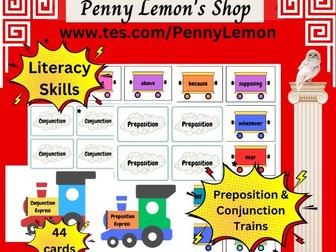
44 cards (or trucks) depicting prepositions and conjunctions.
Two trains displaying preposition or conjunction signs. Train designs are also blank if you don’t wish to specify.
Train ‘smoke’ cards. You can print as many of these as required.
Version 1: Train not specified. Students can connect all the trucks and place the correct ‘smoke’ sign above each truck. You’ll need to print as many smoke signs as necessary.
Version 2: Students must sort through all the truck cards and build the ‘Preposition Express’ or the ‘Conjunction Express’. This can be a fun, timed group activity with as many sets of the game as required.
A variety of exercises to give children practice at using prepositions.
See Prepositions and Pronouns for a package on both Prepositions and Pronouns.
Let me know if you have any questions or suggestions, and a BIG BIG thanks for looking (as a full time practicing teacher, I KNOW how time consuming this process can be).
ALL my postings are FULLY "classroom-tested" - before I publish, my lessons are tested by both myself and colleagues, rigorously evaluated and discussed, and continually updated to maximize their effectiveness. But there is always the possibility of error and room for improvement, so do please provide constructive feedback.
Search words: literacy, grammar, prepositions, pronouns, worksheets
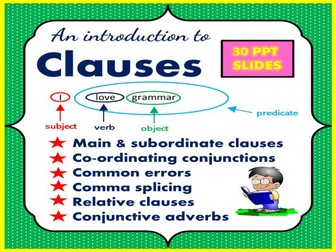
In this powerpoint, it highlights the difference between SUBORDINATING CONJUNCTIONS and PREPOSITIONS looking at past SPAG test examples and other examples to solve using the methods explained.
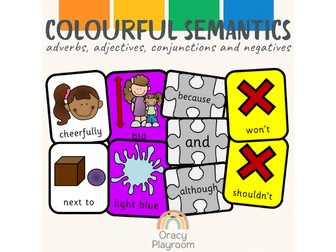
Colourful Semantics adverbs, adjectives, conjunctions and negatives pack!
What’s included in this pack?
15 conjunction cards (coordinating and subordinating)
18 modal verb cards, including negatives
54 adjective cards
9 preposition cards
36 adverb and fronted adverbial cards
Adjectives: The purple ‘describe’ cards are the adjectives in a sentence. An adjective is a describing word. The ‘describe’ card can be placed at different points to describe different words in the sentence. Various strips are included.
Adverbs:
Adverbs are words that change verbs, adjectives and other adverbs. They can modify (or change) a verb by making it more precise. This pack includes adverbs, fronted adverbials and prepositions.
Conjunctions:
Conjunctions are used to join two clauses or expand an idea. This pack contains both coordinating and subordinating conjunctions.
Negatives:
This pack includes modal verbs to show how possible something is, or how likely it is to happen/have happened. The cards help children learn how to indicate degrees of possibility and how to use them correctly in language.
The cards can also be used to help children learn to form questions by inversion. For example:
Statement = She can go to the park.
Question = Can she go to the park?
These cards are designed to be used in conjunction with the Colourful Semantics starter pack (stages 1-4), which can be purchased here: https://www.tes.com/teaching-resource/colourful-semantics-starter-pack-12121851
I update the packs regularly as I use them in my own classroom. You will be notified of any updates as they become available.

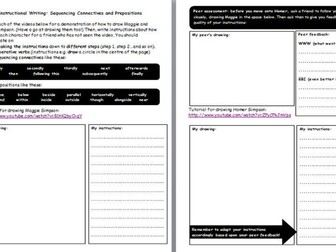
A fun lesson in which pupils follow online tutorials to learn how to draw characters from The Simpsons. This worksheet guides them through using prepositions and sequencing conjunctions in their instructional writing. Includes a peer assessment activity!
This was originally intended to go with expo 1 and is a simple introduction to French prepositions using pictures of a cat as a memory aid. I have found year 7 classes responded well to this and liked the cat theme! On the slide with a grid of 6 numbered pictures I have played pass the parcel. I put lots of scraps of paper with the numbers 1-6 in a box and pass it round the room to French accordian music. When the music stops the pupil holding the box pulls out a nuber and has to say the relevant French sentence. Works a treat every time!
Please leave feedback :)
I noticed that students are often confused with the grammatical terminology in French and make mistakes such as useing adjectives instead of adverbs. Hence this interactive PPT presentation on Prepositions, conjunctions and adverbs in French will clarify the function of each category and will help them with sentence building . Some gap-filling exercises provide students with practice.
This is suitable for intermediate and advanced learners of French.
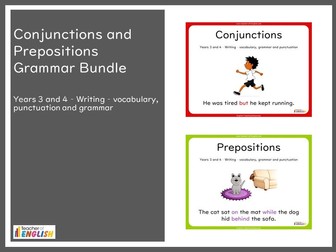
Conjunctions and Prepositions Bundle - Years 3 and 4 Grammar
This English grammar teaching bundle contains 2 of our conjunctions and prepositions teaching resources for lower KS2.
Conjunctions – Years 3 and 4 Grammar
Prepositions – Years 3 and 4 Grammar
Each of these English grammar teaching resources has been designed to help deliver lessons covering the curriculum objectives as outlined in the Years 3 and 4 English programme of study (Writing - vocabulary, grammar and punctuation ).
For a full description and preview of each resource please click on the images above.
This bundle gives you a saving of 20% when compared to buying each resource individually.
This resources includes a SMART about how to express cause; three differentiated challenges (two challenges on a sheet); a help sheets and an AfL task.
This promeathean flipchart supports the planning of the same name. It gives examples and links for year 6 grammar work for prepositions, subordinating conjunctions, hypens and direct speech