

 Quick ViewQuick View
 Quick View
 Quick View
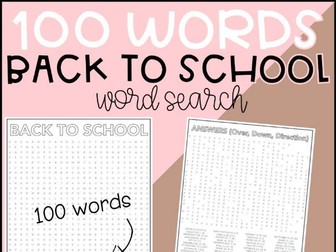
Back To School Word Search
Back To School themed word search
This activity is perfect as an extra activity to celebrate this exciting time!
Part of my 100 words series. These are generally challenging for students - encourage them to use their growth mindsets and work in pairs or teams if necessary!
 Quick View
Job Searching
Lesson Objectives:
To identify the common places to look for jobs.
To identify the less common places to look for jobs.
To be able to provide their own evidence for jobsearch trackers.
Aimed at job searchers/seekers over the age of 16.
Comes with student and teacher handout. Would benefit from a powerpoint presentation to aid in delivery.
 Quick View
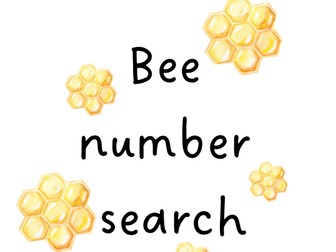
Bee Themed Number Search
Contains:
Honey hive with numerals 1-20
honeycomb number representation in ten frame 1-20
undefined
 Quick View
Summer Word Search
Summer Wordsearch / word search
Perfect as an End of Year EOY worksheet / activity
This Summer word search is perfect for a vocabulary practise in literacy centres or as an extra activity to celebrate the season!
Part of my 100 words series! These are generally challenging for students - encourage them to use their growth mindsets and work in pairs or teams if necessary!
Annotations for Search for My Tongue
Annotations for the poem Search for My Tongue by Sujata Bhatt- questions and answers. Could be used in lesson, as a homework, to check understanding or to revise the poem.
There are also six slides included where the poem can be copied (labelled which stanzas) and the questions and answers will be annotated around it, however the poem itself cannot be included due to copyright.
 Quick View
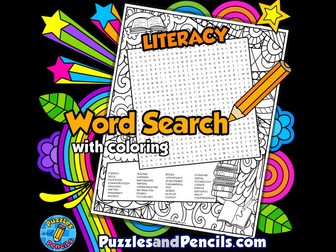
Literacy Word Search Puzzle Activity with Colouring | Wordsearch
Literacy word search puzzle / colouring page activity worksheet. Combines a challenging word find activity with mindfulness colouring to provide an engaging and relaxing learning activity. Contains 32 words in a puzzle for older kids, teens and adults.
Perfect resource for International Literacy Day on 8 September each year.
Reinforce vocabulary, spelling and learning with a fun printable wordsearch puzzle. Also great for games nights and class parties. The perfect solution when you need an engaging and fun activity to support class activities.
Includes:
1 page combining a Literacy word search puzzle with a mindfulness colouring page border.
Puzzle solution page.
Word list contains 32 words/phrases, including: literacy, reading, books, literature, learning, writing, language, written, stories, vocabulary, comprehension, and more.
Add some learning and fun to your projects with a printable word puzzle. Great for reinforcing vocabulary and also works great for sub plan activities, bell ringers and early finishers.
This resource is useful for:
Vocabulary and terminology
Reinforcing knowledge and memory
Memory aid
Spelling
Literacy activity
Classification and comprehension
Mindfulness and relaxation
Brain break activity
© PuzzlesandPencils
Printable puzzle activities for substitute teachers, fun puzzles for early finishers, fast finisher activity, morning work, literacy activities, printable games word searches, super word find vocabulary bell ringers, mindfulness colouring page for kids and adults.
Search for my Tongue: Sujata Bhatt
This 36-slide lesson explores Sujata Bhatt’s poem ‘Search for my Tongue’.
The lesson provides detailed analysis of the poem and includes: biographical information about Bhatt, analysis of the poem’s use of language and poetic techniques, analysis of the poem’s structure, form & rhyme, as well as a range of questions, discussion points, and tasks for students to complete. Students are encouraged to think about the significance of language and its relationship to cultural assimilation and identity.
The final task at the end of the lesson is an extended writing activity.
This lesson is ideal for KS3 pupils, but could be used for GCSE too.
PowerPoint saved as PDF.
 Quick View
 Quick View
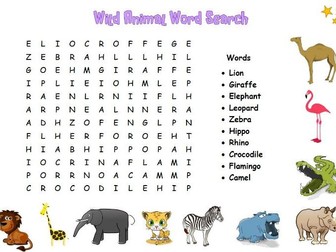
Wild Animal Word Search
Word search for KS1 and KS2. Ideal as a quick activity for all abilities. Complements themed studies.
 Quick View
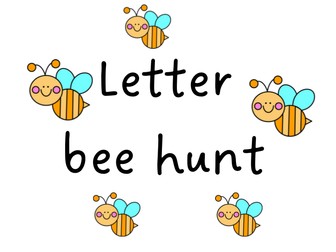
Bee themed letter search
contains bee template with lower case outlines
bee hives with capital letter representation
children to select a capital letter and colour the corresponding lower case to match
Electromagnetic Spectrum Word Search
This word search on the electromagnetic spectrum includes the following vocabulary terms. The solution to the puzzle is included.
♦ Electromagnetic Spectrum
♦ Electromagnetic Wave
♦ Gamma Rays
♦ Infrared Light
♦ Microwave
♦ Radio Wave
♦ Ultraviolet Light
♦ Visible Light
♦ X-Ray
 Quick View
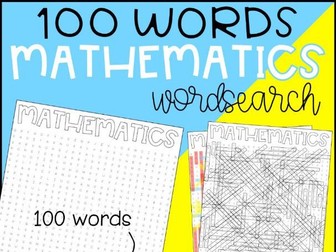
Mathematics (Maths) Word Search
Maths word search activity (Mathematics / Math wordsearch) - Perfect activity for vocabulary practise in literacy centres or as an extra activity to promote the subject!
Words were chosen carefully so spelling is suitable for US/CAN/UK :)
Part of my 100 words series! These are generally challenging for students - encourage them to use their growth mindsets and work in pairs or teams if necessary!
 Quick View
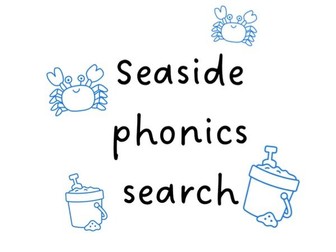
Seaside phonics search
contains record sheet and 15 cvcc/ccvc images for children to find and write on record sheet
Ancient Greece Word Search
Ancient Greece: This Ancient Greece word search also doubles as a coloring book!. The advantage to this is that students can actually see the concept behind the term they are attempting to find. The Solution to the puzzle is included.
This Ancient Greece Word Search/ Coloring Book contains the following terms:
♦ Achilles
♦ Amphora
♦ Athena
♦ Caduceus
♦ Chariot
♦ Discus
♦ Drachma
♦ Kantharos
♦ Lyre
♦ Obol
♦ Olive Branch
♦ Parthenon
♦ Tragedy Mask
♦ Warship
♦ Zeus
Thank you to Glitter Meets Glue Designs who provided the images
Plate Tectonics Word Search
This word search on tectonic plates also doubles as a coloring book!. The solution to the puzzle is included.
Vocabulary Terms Included:
♦ Convection
♦ Convergent
♦ Divergent
♦ Earth Layers
♦ Earthquake
♦ Fault
♦ Hot Spot
♦ Ocean Ridge
♦ Pangaea
♦ Seismologist
♦ Tectonic Plates
♦ Transform
HISTORY WORD-SEARCH
This file contains three word-searches, and have been created using words which students would have become familiar with during their lessons about the changes in Britain from the Stone Age to the Iron Age. There is a printable sheet for the pupils and a solution sheet highlighting the sixteen words in each puzzle for the teacher. To make the words easier to locate on the solution sheet I have highlighted the first letter of each word in yellow, or orange when the letter begins two words running in different directions.
 Quick View
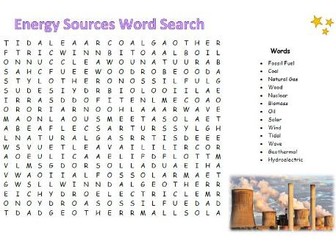
Energy Sources Word Search
Word search of terms relating to renewable and non-renewable energy sources. Ideal for KS3 or GCSE students studying Geography or Science as part of a revision lesson, a lesson starter or, for low ability, a main activity.