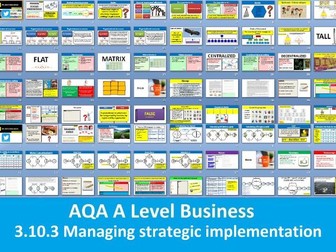
A range of materials aimed at supporting teachers of the AQA A Level in Business modified to reflect the 2023 changes. This presentation is designed to cover the topic of managing strategic implementation by businesses and has been adapted to meet the specific requirements of the AQA specification. The presentation considers how to implement strategy effectively and the value of leadership in its implementation. It then looks at the value of communication and its impact on implementing strategy. The pack concludes with an assessment of network analysis. This includes an understanding and interpretation of network diagrams, amending network diagrams and identifying the critical path and calculation of total float. The pack contains the Quick Fire Five knowledge questions, a variety of practice calculation activities, a short objective test and an essay question all complete with suggested answers. This pack also includes a FREE copy of the student revision notes for this section of the course.
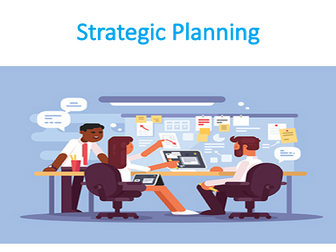
Strategic Planning is a lecture which is covered during Management Module. This resource is suitable for bachelor and master level students who are studying in business department.
In this lecture, we look at an important part of the planning that managers do: developing organizational strategies. Every organization has strategies for doing what it’s in business to do. And managers must manage those strategies effectively.
Effective managers recognize the role that strategic management plays in their organization’s performance. Throughout this lecture, students discover that good strategies can lead to high organizational performance.
Focus on the following learning objectives as you read and study this lecture.
Learning Objectives of this lecture are:
Define strategic management and explain why it’s important.
Explain what managers do during the six steps of the strategic management process.
• Know how to identify your own personal strengths and weaknesses and deal with them.
• Develop your skill at strategic planning.
Describe the three types of corporate strategies.
Describe competitive advantage and the strategies organizations use to get it.
Discuss current strategic management issues.
In this file you will find:
1 Strategic Planning Lecture Power Point Presentation
1 Lecture Note Guide
1 Test Bank with 131 different questions with full answer description and explanation
8 Interesting Discussion Questions and answers to them
4 Interesting Exercise related to the topic with all answers to them
2 Interesting Case Studies with all answers to case study questions
1 additional reading resource file related to lecture topic in order to enhance Lecturer/Teacher/Student knowledge
1 Folder with relevant useful pictures
Once you will purchase this resource please leave a comment!
All resources are compressed in Zip File.
This bundle of four PowerPoint and revision note topics, provides students with an indepth understanding of core areas relating to the AQA A Level Business specification and modified to reflect the 2023 changes. The pack contains notes abouts managing change, managing organisational culture, managing strategic implementation and concludes with the problems of strategy and why strategies fail.
Specific topic areas include:
The causes of and pressures for change
Disruptive change
Incremental change
Lewin’s Force Field Analysis
The value of change
The value of a flexible organisational model
Restructuring
Delayering
Organic v mechanistic structures
Knowledge and information management
Barriers to change
Kotter and Schlesinger’s models
The importance of organisational culture
Handy’s cultural models
Hofstede’s national culture models
Influences on organisational culture
Problems of changing culture
How to implement strategic change
Leadership and strategic change
Communication and strategic change
Network analysis
Critical path analysis
Strategic drift
Planned and emergent strategies
Divorce of ownership and control
The value of strategic planning
Contingency planning
Given the inclusion of student revision notes, this pack represents excellent value for money and saves teachers hours of time in preparing notes.
Business Vision and Mission (Strategic Management)
This lecture describes the nature and role of vision and mission statements in strategic planning, and provides specific guidelines on how to develop these statements. Both characteristics and components that should be included in these statements are provided, as are numerous examples. In this Strategic Management course, students should become proficient devising and improving vision and mission statement documents, and this lecture provides the foundation for that knowledge. Everything a company or organization does should be vision and mission driven, so the language in these statements is vitally important – the statements are not just “feel good” platitudes.
Learning Objectives of lecture:
Explain the need for core values statements in strategic management.
Describe the nature and role of vision statements in strategic management.
Identify the characteristics of a vision statement.
Describe the nature and role of mission statements in strategic management.
Identify and discuss the characteristics of an effective mission statement.
Identify the components of mission statements.
Discuss the benefits for a firm of having clear vision and mission statements.
Evaluate and write mission statements for different organizations.
By purchasing this resource, you will get:
Business Vision and Mission Lecture Power Point Presentation
Test bank for Business Vision and Mission Lecture / Seminar with all answers
1 file with useful notes for instructor
File with teaching tips
Once you will purchase this resource please write some feedback!
You may also like:
The Nature of Strategic Management (Strategic Management)
Strategies in Action Lecture (Strategic Management)
This lecture provides basic guidelines for when various strategies have historically been most effective to use. This lecture also describes Porter’s generic strategies, first-mover advantages, joint ventures, partnering, and new-to-this-edition the concept of Build, Borrow, or Buy in the context of strategic planning. It concludes by describing strategic planning in nonprofit and governmental organizations.
Learning Objectives of lecture:
Identify and discuss 5 characteristics and 10 benefits of clear objectives.
Define and give an example of 11 types of strategies.
Identify and discuss the three types of “Integration Strategies.”
Give specific guidelines when market penetration, market development, and product development are especially effective strategies.
Explain when diversification is an effective business strategy.
List guidelines for when retrenchment, divestiture, and liquidation are especially effective strategies.
Explain value chain analysis and benchmarking in strategic management.
Identify and discuss Porter’s two generic strategies: cost leadership and differentiation.
Compare and contrast when companies should “build, borrow, or buy” as key means for achieving strategies.
Discuss first-mover advantages and disadvantages.
Explain how strategic planning differs in for-profit, not-for-profit, and small firms.
By purchasing this resource, you will get:
Strategies in Action Lecture Power Point Presentation
Test bank for Strategies in Action with all answers
1 file with useful notes for instructor
File with teaching tips
Once you will purchase this resource please write some feedback!
You may also like:
Business Vision and Mission (Strategic Management)
The Nature of Strategic Management (Strategic Management)
The Internal Assessment Lecture (Strategic Management)
The External Assessment Lecture (Strategic Management)
A-level Business Studies lesson (Cambridge) on introduction to strategic management used with my Year 13s. Includes:
PowerPoint (with learner activities)
Starter on corporate strategy
Strategy versus tactics
Link between corporate strategy & business structure
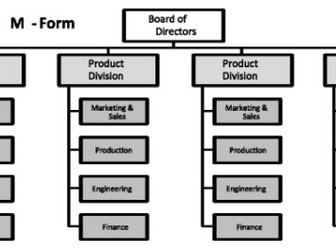
Chandler’s multi-divisional structure (M-form)
Practice questions (with answers)
More Business, Economics & Politics resources here: https://www.tes.com/teaching-resources/shop/smith_michael
ICAEW
Institute of Chartered Accountants in England and Wales
Strategic Business Management - Revision notes
Ideal for students
Ideal for teachers and private tutors
Exam advice
Exam question and illustrative answer with revision notes
Strategic analysis tools
SWOT
PESTEL
Porter’s Five Forces
Product Life Cycle
BCG Matrix
Ansoff’s Matrix
Strategic, Operational, Financial
Costing systems
Break even analysis
International expansion
Investment appraisal
Discounted cash flows
Internal rate of return
Cost of capital
WACC
Business valuation
Hedging strategies
Foreign currency risk
Interest rate risk
Strategic, operational & financial issues and risks
Financing
Financial restructuring
Acquisition risks
Unquoted companies
Non current assets held for sale
Present value
Synergies
Due diligence
Impairment
Brands
Positioning strategies
Horizontal integration
This comprehensive resource is designed for teachers who are facilitating courses in business management, leadership, or organisational behaviour, especially at the post-secondary or adult education level. It offers a detailed, interactive workshop framework that guides participants through the entire process of developing a strategic plan. This resource is ideal for classroom or online delivery, particularly through platforms like Microsoft Teams, making it suitable for both virtual and blended learning environments.
What’s Included:
Ready-to-use templates for conducting SWOT and PESTLE analyses, formulating strategies, planning implementation, and setting up evaluation metrics. These templates ensure a structured approach to strategic planning.
Carefully designed worksheets that guide participants through each stage of the strategic planning process:
Analysis Worksheet: Questions to facilitate a thorough SWOT and PESTLE analysis.
Formulation Worksheet: Prompts to help identify strategic goals and decision-making criteria.
Implementation Worksheet: A checklist for mapping out action items, resource allocation, and timelines.
Evaluation Worksheet: Guidelines for establishing performance metrics and feedback mechanisms.
Learning Objectives:
Understand the components and importance of strategic planning in organisational contexts.
Develop critical thinking and analytical skills by engaging with real-world business scenarios.
Enhance communication and teamwork abilities through collaborative group exercises.
Apply theoretical knowledge to practical, real-world business planning tasks.
Ideal for:
Business Studies Teachers
Leadership and Management Trainers
Corporate Training Facilitators
Adult Education Providers
Usage:
This resource can be used as a core part of a business studies curriculum, leadership training program, or a standalone professional development workshop. It’s particularly effective for courses focusing on strategic management, organisational development, or any subject where understanding the intricacies of business strategy is beneficial.
Why Purchase This Resource?
Ready to Implement: Everything you need to conduct a successful workshop is included, saving you preparation time and ensuring you have a structured, engaging curriculum.
Highly Interactive: Designed to keep adult learners engaged through practical, hands-on activities that enhance learning retention and application.
Flexibly Designed: Can be adapted to shorter sessions or extended projects, suitable for various learning settings and timeframes.
This set of resources includes 2x PPTs and 4x word documents consisting of exam practice and activities - this can be delivered over at least 4 lessons.
In the first double lesson, we start off by looking at an overview of developing and implementing strategy, including ways to implement strategy effective. We then look at the importance of leadership and communication in implementing strategy. Learners are then introduced to key concepts in organisational structures such as span of control and chain of command in engaging ways i.e chinese whispers to demonstrate the negatives of a long chain of command. We look at the pros and cons of tall, flat and matrix structures, then we move on onto centralised and decentralised structures. A short case study based on cartoon characters who have switched to decentralised - a few questions to contextualize the knowledge. Students acknowledge that orgnaisations can be strcutured in different ways such as by function, product or region.
In the second lesson, students have the opportunity to learn about the supermarket industry, in particular Morrisons struggle with the budget supermarkets which led to restructuring - a 16 mark question with structure guidance and a detailed model answer to help students with peer assessments, as well as making improvements to WWW and EBI. To spice it up a bit, a group matching task, where students have to create an organisational structure - answer sheet provided so teacher can look around whilst students work on it.
In the second double lesson, learners are introduced to critical path analysis, quite a tricky concept to understand at first for a lot of students - but not with this powerpoint. We start with an engaging starter to contextualise the topic, then we break down the elements of the critical path such as node, EST LFT, activities and durations so that we can see how it is built. Guidance is displayed step by step how to work out EST and LFT.
Students have opportunities to practice completing and calculating critical path analysis, including working out the EST and LFTs, float times and the critical path.
We then look at the advantages and disadvantages of CPA, followed by a concise case study on the usefulness of using CPA. Structure guidance and a concise model answer is given to help students improve their exam technique. A group task to construct a more challenging CPA and a kahoot quiz + box plenary to end with.
All you need - open the powerpoint, run through it, and deliver quality lessons whilst saving precious time. Colourful, concise and engaging slides! - all files in zip folder.
Thank you
This set of resources includes 6x PPTs which can be delivered over 12 lessons. Hundreds of interactive and engaging slides.
3.10.1 Managing change - 4 lessons
3.10.2 Managing organisational culture - double lesson
3.10.3 Managing strategic implementation - 4 lessons
3.10.4 Problems with strategy and why strategies fail - double lesson
Filled with a variety of activities, real life examples, debates, true or false quizzes, case studies, exam questions, model answers, marking grids so students can self/peer assess to identify WWW and EBI with their responses before making improvements. Kahoot quizzes and box plenaries to consolidate learning in an engaging way.
All you need - open the powerpoint, run through it, and deliver quality lessons whilst saving precious time. Colourful, concise and engaging slides! - all files in zip folder.
Thank you
These presentations aim to cover all of the syllabus points pertinent to CIE A Level Business Unit 6 - Strategy, they reference page numbers and activities found in the core textbook suggested by CIE.
These presentations are not a substitute for experienced teaching, a thorough understanding of the syllabus and individual needs of the classroom, but I hope that these can save you time and give you some ideas to work from.
These presentations aim to cover all of the syllabus points pertinent to CIE A Level Business Unit 6, they reference page numbers and activities found in the core textbook suggested by CIE.
These presentations are not a substitute for experienced teaching, a thorough understanding of the syllabus and individual needs of the classroom, but I hope that these can save you time and give you some ideas to work from.
Business Stratgy Part 1
Dive into the dynamic world of business strategy with this all-encompassing 100-slide resource, meticulously crafted to prepare you for the Cambridge A Level Business Paper 4, Question 2. From dissecting internal strengths and weaknesses using SWOT analysis to navigating external environments with PESTLE, and disussing what exactly is meant by business strategy and why it is important.
Engage with real-world business examples, interactive class activities, and hyperlinked exam questions designed to reinforce learning and application. By the end, you’ll not only be exam-ready but also equipped with a robust understanding of strategic management, all delivered with a touch of humour to keep the journey enjoyable.
Stay tuned for Part 2!
Enjoy!
The Business Economics Playground.
Refreshed and updated PowerPoint resources aimed at assisting teachers with the delivery of the WJEC/Eduqas A-level Business specification. These slides are designed to support the delivery of the Component One topic of management and leadership. They examine the differences between a leader and a manager, before considering the roles and function of management. The concept of Management by Objectives is assessed and evaluated with a look at the benefits and drawbacks of this technique. Next the management theory of McGregor (Theory X and Theory Y) is evaluated before an examination of the leadership theories of Fielder and then Wright and Taylor. The slides also investigate the different leadership styles including autocratic, democratic, bureaucratic, paternalistic and laissez-faire and the importance and impact of leadership upon a business and its stakeholders. The slides contain the Quick Fire Five questions and also a practice essay (both with solutions).
A teaching pack incorporating a recorded lecture, Powerpoint presentation and exercise sheet.
This is part of a webinar series produced by the Aberystwyth Business School to support the A-level business curriculum.
This is just one of the free outreach services Aberystwyth University offers to schools and teachers
For more information please visit:
https://fbaps-outreach-hub.dcs.aber.ac.uk/index.html
The nature of higher education institutions is changing, primarily as a result of reduced government financial support for the sector. Fiscal restraint towards education funding has been observed in Australia, New Zealand, the United States, Canada, the UK and much of Europe. There has been steady growth in demand for higher education but reduced capacity by governments to fund it. Increasingly, students are required to contribute to the cost of their own education.