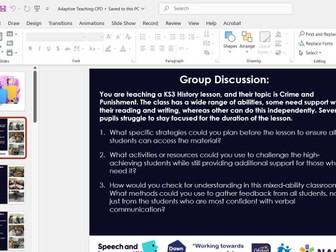
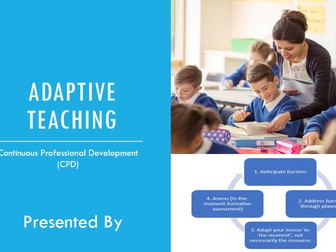
This Adaptive Teaching CPD PowerPoint presentation and resource pack are designed to help you tailor learning effectively for every student in your classroom. Packed with evidence-informed teaching strategies, the package also includes a self-assessment audit to support reflection on your current practice and help identify areas for growth.
A range of visuals for CPD/PLD teaching and learning theories, strategies and ideas such as Rosenshine, retrieval practice, feedback, Bloom, modeling and others.
This Adaptive Teaching PowerPoint is designed for staff training or CPD sessions and focuses on developing a clear understanding of the difference between differentiation and adaptive teaching. Perfect for use in teacher professional development meetings, INSET sessions, or department training, the resource supports teachers in embedding adaptive teaching strategies within everyday classroom practice.
The PowerPoint is structured to deliver approximately one hour of training, combining clear explanations, reflective discussion points, and practical tasks for staff to complete individually or collaboratively. It explores what adaptive teaching looks like in practice, how it differs from traditional differentiation approaches, and how teachers can adjust teaching to meet the needs of all learners without creating unnecessary workload.
The training includes:
• Clear explanations of adaptive teaching vs differentiation
• Opportunities for staff discussion and reflection
• Interactive tasks and prompts for collaborative thinking
• Practical examples teachers can apply in the classroom
• Flexible slides that can be adapted to suit different schools or contexts
The resource is fully editable, allowing leaders or facilitators to tailor the training to their school priorities, add examples from their own setting, or extend activities depending on the time available.
Learning Theories in Sport – Full 5 Lesson Bundle
A Level PE – Skill Acquisition (OCR)
Complete Unit: PowerPoints + Matching Student Notes
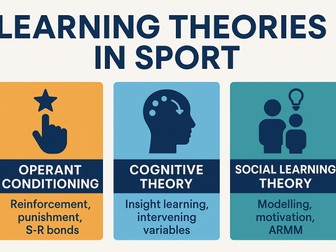
This comprehensive 5-lesson bundle covers all the essential learning theories needed for the A Level PE Skill Acquisition specification. Each lesson is designed with a clean, minimalist layout and comes with student notes that match every slide exactly, making the unit perfect for class teaching, revision, homework, flipped learning or cover lessons.
The unit includes Operant Conditioning, Cognitive Theory, Social Learning Theory, a comparative lesson, and a complete exam-preparation session. Every lesson contains paired and group work, sporting applications and exam-style questions to build AO1, AO2 and AO3 skills.
What’s Included
✔ Lesson 1 – Operant Conditioning
Reinforcement, punishment, S–R bonds, behaviour shaping and Thorndike’s Laws.
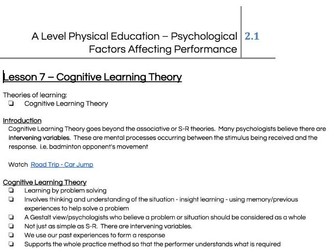
✔ Lesson 2 – Cognitive Theory
Gestalt, insight learning, intervening variables & Kohler’s chimpanzee experiment.
✔ Lesson 3 – Social Learning Theory
Bandura, ARMM, effective role models & the Bobo Doll experiment.
✔ Lesson 4 – Comparing Learning Theories
Strengths & limitations of OC, Cognitive Theory and SLT + scenario application.
✔ Lesson 5 – Exam Preparation Lesson
Scenario stations, mixed-mark exam questions (2/4/6/10 marks), AO1/AO2/AO3 skills & model answer construction.
Also Included
5 full PowerPoints (editable, clean and ready to teach)
5 matching sets of Student Notes (editable Word, identical to slides)
Applied sporting examples throughout
Paired and group tasks in every lesson
Multiple exam questions with structured prompts
Retrieval practice, peer assessment & plenaries
SEN-friendly formatting
Copyright-safe content
Why Teachers Love This Bundle
✔ Saves hours of planning
✔ Perfect for specialists and non-specialists
✔ Consistent design and structure across all lessons
✔ Strong focus on exam technique
✔ Ideal for revision or first teaching
✔ Classroom-ready and print-friendly
See MrSportandPE for the full unit and more…
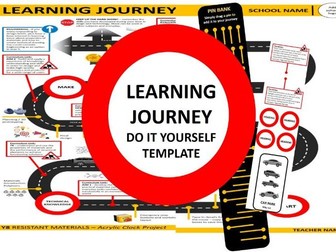
A template with tips on how to create your own eye-catching journey
Size is preset to fit A3 paper
With location pin bank, red roadwork boxes (for even more detail, such as curriculum links) and there are even some vehicles parked ready in the car park - just get creative!
Includes help notes that can be over typed
This is a powerpoint document
With the Ofsted focus on curriculum and the retention and recall of information - this resource provides some creative ideas on how to embed this into lessons. Templates are attached for ease and distribution to staff and ideas are supported with transferable instructions to share across subject areas.
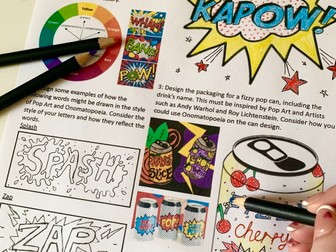
This worksheet was created to be used for cover lessons, allowing students to practice and recall their knowledge of Pop Art and apply in in a creative way.
Students will apply knowledge of Pop Art, Onomatopoeia and Colour Theory. Useful for quick cover lessons, or just for general lesson time.
L/Q: Can I show an understanding of Pop Art, Colour theory and Contextual Knowledge?
(Learning Question is along the top of the worksheet, to allow you to crop it down if not needed/necessary).
This worksheet would be most suitable for Key Stage 3.
Miss K Jenkins :)
All resources have been designed, created and/or constructed by myself, all used in my own teaching currently and in the past.
This resource pack is comprised of:
1.) Observation & Learning Walk Performance Grid
2.) Marking and Feedback Performance Grid
For use alongside lesson observations, learning walks, and book monitoring, these succinct performance grids enable observers to gauge, categorise, and feedback on teaching and learning sessions using OFSTED guidance for effective teaching. The documents provide descriptors of ‘outstanding’, ‘good’, ‘requires improvement’ and ‘inadequate’ practice within appropriately considered teaching and learning focus areas, for example: Questioning, Positive Feedback, Use of Additional Adults, etc. Schools who still grade individual teachers have noted that these are helpful aids in arriving at an overall judgement.
These teaching and learning CPD sessions offer engaging and original approaches to introducing or revisiting a range of effective pedagogical strategies. Grounded in educational research, these sessions are interactive, well-structured, and have been successfully tried and tested.
The aim of each teaching and learning CPD session is to develop the knowledge, skills, and strategies needed in order to utilise in practice in each key area, and as an aid in achieving these aims, the trainer is supported with:
-Colourful, engaging, and comprehensive PowerPoint presentations;
-Videos for analysis of key techniques;
-A wide range of interactive resources for CPD activities;
-Instructions and plans to assist delivery.
All images and videos are licensed for commercial use, and are cited on the final slide of each PowerPoint.
Brand new resource for teaching from September 2025
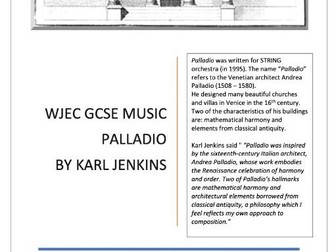
Palladio by Karl Jenkins
A step-by-step workbook, split up into the different sections of the music (screen shots give a good idea of content).
Supports:
individual learning
homework
group work
exam-style questions
teacher-led lessons
All answers are provided in a separate booklet
Please email misscreativecurriculum@gmail.com for any further information
This teaching presentation introduces the core theory for BTEC DIT Learning Aim A, using slides and video clips to explain how data impacts decision-making. It covers essential concepts like data collection, quality, and security, providing the necessary foundation for students to transition into the practical coursework tasks.
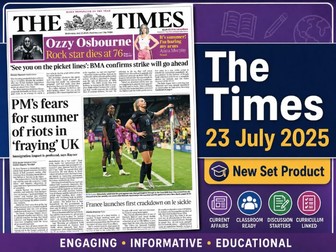
A detailed and student-friendly Eduqas A Level Media Studies Newspapers teaching resource focused on the new set product: The Times, 23 July 2025 front page, which will be assessed from 2028 onwards.
This resource includes two complete booklets:
A student booklet for classroom use, independent study, homework and revision
A teacher booklet with teacher notes and suggested answers included below each task
This complete teaching and revision resource is designed to help students understand, analyse and revise The Times as part of the A Level Media Studies Newspapers section. It breaks down the key areas of the Eduqas theoretical framework in a clear, accessible and engaging way, making it ideal for classroom teaching, intervention, cover work, independent learning and exam preparation.
The booklet covers all the essential areas students need to know, including media language, representation, media industries, audiences, ideology, political bias, ownership, regulation, print newspaper conventions and online newspaper contexts. It also supports students in applying key terminology accurately and developing confident exam-style analytical responses.
Included in the resource:
Clear introduction to the Eduqas Newspapers unit
Background and context for The Times
Focus on the new 23 July 2025 front page set product
Student-friendly notes on media language and layout conventions
Representation analysis of people, issues, events and social groups
Industry notes covering ownership, regulation and production
Audience and readership analysis
Clear explanations of ideology, political bias and social context
Exam-style questions and paragraph practice
Retrieval practice, comprehension tasks and knowledge checks
Pair, group and independent learning activities
Planning grids, sentence starters and revision checklists
Glossary of key newspaper terminology
Suggested answers throughout
This resource is ideal for teachers preparing students for the updated Eduqas A Level Media Studies newspaper set product. It gives students the knowledge, confidence and exam practice needed to analyse The Times effectively, while saving teachers valuable planning time.
Imagine a learning environment where learners are no longer passive recipients of information, but active architects of their own knowledge. A place where curiosity is sparked, creativity is fostered, and critical thinking is nurtured. This is the vision of constructivist learning theory, an approach to education/training that turns traditional teaching methods on their head. By recognising that learners construct their own understanding of the world through experiences and social interactions, constructivist learning theory empowers educators to create environments that are dynamic, collaborative, and learner centred. In this article I discuss the principles of constructivist learning theory, exploring how it can be applied to transform the way we teach and learn, and ultimately, unlock the full potential of our learners.
This is a SOW that was written by me for the COSIM/LESP project. It attempts to help students overcome their misconceptions on the phenomena linked to particle theory. It recomends using the LESP computer programme, but any particle simulation programme will do, so long as students can place the particles where they want to....alternately drawing storyboards also works.
This is a teacher-training resource comprising 47 slides that I compiled for refreshing teachers on the essentials of teaching and learning. It covers all of the basics, and is designed to be delivered as a one-day workshop. This could be adapted to cover a series of INSET sessions or PD twilights, too.
Topics covered include:
Lesson planning
Active Engagement
Cognitive Load Theory
Learning games
Use of feedback tools like Word Clouds
Spatial Learning
Curriculum Mapping
Please note: You will need to read through these slides and check them before delivery, as they will need to be tailored to your organisation.
The slides also link to some interactive quizzes I’ve created especially for this workshop at Blooket, Quizlet, Quizziz and so on. These should all be publicly available and working correctly.
I’ve also included some Nearpod slides as a bonus - I recommend that you upload these to Nearpod and create your own lesson in their for that section of the workshop (this won’t take long, and you can use the free version of Nearpod).
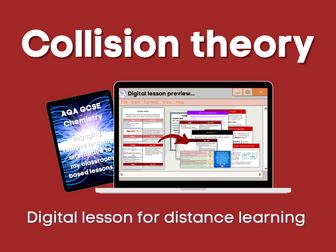
During this engaging distance learning lesson on Collision theory GCSE students work through the digital worksheet activities to develop their understanding of how collision theory and activation energy explain the rate of chemical reactions.
This lesson is the 4th in a series of lessons and covers the content from the AQA GCSE 4.6.1.3 Collision theory topic and OUP Kerboodle Scheme C8.2 Collision theory and surface area lesson.
This adaptable resource is perfect for:
● Distance learning: Keep students on track with independent learning activities.
● Missed work recovery: Help students catch up after absences at their own pace.
● Home-schooling: Provide a comprehensive learning experience for homeschooled students.
Aimed at a mixed ability GCSE class.
This editable resource includes (5 pages):
● Teacher guidance and answers: Clear instructions and solutions for teachers.
● Engage: Self-assessed vocabulary task, using Google Sheets, to reinforce key vocabulary.
● Explore: Links to articles, video clips, virtual labs, and simulations allow students to explore the topic in-depth.
● Explain: An embedded Google Slides™ presentation that clearly outlines lesson objectives, provides detailed information slides, and includes self-assessed questions for students to check their comprehension.
● Apply: Engaging activities and tasks encourage students to apply their knowledge gained during the lesson.
● Extend: Resources and activities that challenge students to further explore the topic and extend their learning.
Important:
● Internet Access: Students require a PC with internet access to use this resource.
● Google Doc™ Format: This resource is best used in Google Doc™ format. While it can be converted to Word/Excel, some tasks may not function properly in these formats.
This lesson is also available as a:
● Teacher-led lesson: Deliver an engaging lesson with this fully resourced PowerPoint presentation. Includes everything you need to teach, from instructions to activities and worksheets.
Collision theory
● Cover lesson worksheet: Perfect for unplanned absences, this version provides everything a cover teacher needs to deliver a smooth and engaging lesson.
Collision theory Cover lesson
If you require more assistance, please contact me at-
info@cmgsciencelessons.com
This is a worksheet resource to support learners in developing their knowledge of key words in a puzzle worksheet.
• Can be used to support apprentices in their off the job learning or learners to research as part of their self-study.
• Fully editable for customisation to any learner group
• Professionally designed by a Curriculum Quality Manager
• Aligned with current 2025 frameworks and legislation
• Suitable for blended, remote or classroom delivery
• Ready for Ofsted or EQA evidence folders
Can support wider curriculum opportunities in apprenticeships or suitable as recall activities for learners
Please check out our shop for many more resources and if you are looking for a resource on a specific topic, send us a message and we will be happy to help!
You will receive:
1 × Editable word document worksheet
1 x Editable word document answer sheet
Thank you for your purchase
This special issue is being published at a significant point in time in relation to simultaneous changes in higher education, in technology and in the field of learning technology itself. As the 2011 ALT C conference themes clearly state, learning technology needs to learn to thrive in a colder and more challenging climate. In this difficult political and economic environment technological trends continue to develop in terms of mobility, cloud computing, ubiquity and the emergence of what has been called big data.


 Quick View