AQA GCSE Geography lessons on the Nigeria: A Newly-emerging Economy section. The lessons feature differentiated tasks, examination style questions and video clips, where appropriate. There is one lesson that needs the AQA textbook, but could easily be adapted to use without it. The lesson titles include:
Nigeria: A Newly-emerging Economy (NEE) Introduction
Exploring Nigeria
Nigeria in the Wider World
Balancing a Changing Industrial Structure
The Impacts of TNC’s
The Impacts of International Aid
Managing Environmental Issues
Quality of Life in Nigeria
Hope the lessons help
https://www.tes.com/teaching-resources/shop/markthegeographer
“My purpose is to engage students in dialogue so they can see others’ points of view – in a world that needs this more than ever. I do this by sharing lessons on this site which connect students with the past and inspire critical thinking.
Please read below to find details about this one.” Dan
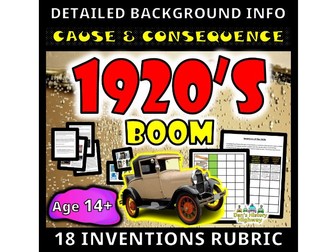
This lesson is crucial to an understanding of the USA in the 1920s. Students begin by exploring how First World War propaganda impacted on marketing techniques with a detailed PPT before progressing to a very detailed set of notes. From this students complete a worksheet designed to explore the significance of various 1920s inventions. The lesson concludes with a Dingbats-style plenary to test comprehension. My class always make exceptional progress in this lesson and I hope yours find it just as useful.
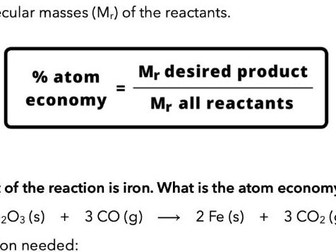
This resource contains information sheets, question sheets and answer sheets for percentage yield and atom economy. I use this resource as part of the AQA GCSE Chemistry Quantitative Chemistry topic in paper 1. It can also be used for A Level chemistry. Students can complete the questions as the main task in a lesson and keep the information sheet as a resource. A level students should find this a comfortable starter.
This is a diamond 9 card sort to categorise and prioritise the reasons that the US economy had weaknesses in the 1920s.
As an extension, you can challenge students to explain the more / less important reasons, and who was most affected by different problems – this is scaffolded for weaker students.
This can lead to a class discussion.
Categories could include, but not be limited to, farmers unemployed, black Americans and others.
Powerpoint presentation made on Canva. The powerpoint features outstanding resources to get students to analyse and understand the economic impact of WW2 on the US economy.
The presentation addresses the following points:
To undersand how WW2 pulled America out of the Great Depression.
To explain how America benefited economically from the Second World War.
To evaluate whether the New Deal or WW2 was more important to tackle the Great Depression.
This powerpoint can be used for AQA, WJEC/Eduqas, Edexcel exam boards.
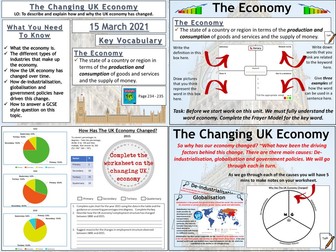
AQA GCSE Geography lesson for the new specification Unit 2B: In this lesson we introduce the economy and how it has changed over time and why.
The lesson starts with a quick retrieval practice quiz. We then introduce the idea of the economy with the pupils completing a Frayer model, we then look at where the UK is in international standings currently and where it might be in the future. We then look at the structure of the economy, we remind ourselves of the different sectors with a sorting task and then look at how the UK’s economy has changed over time. The pupils complete a worksheet and complete a pie chart. We then look at the main drivers in this change and the pupils use information sheets/slides to complete a worksheet. We then finish with a GCSE-style practice question with some guidance.
Hope this saves you some valuable planning time.
https://www.tes.com/teaching-resources/shop/markthegeographer
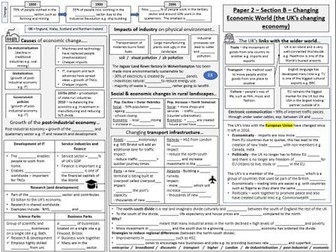
A revision sheet to summarise the changing UK economy part of the GCSE Geography (AQA) 8035 course.
Great as a revision resource or as catch-up for students who may have missed a number of lessons.
Can be used with the blue GCSE AQA Geography textbook or as a standalone resource.
Best enlarged to A3 when printed.
This power point contains about 5 hours worth of learning. It is the third group of 5x1 hour lessons for the A Level American Dream Depth Study.
It focuses on Truman’s Post War Foreign Policy and the US economy in the immediate aftermath of the Second World War. It contains a power point and 5 resources for linked activities.
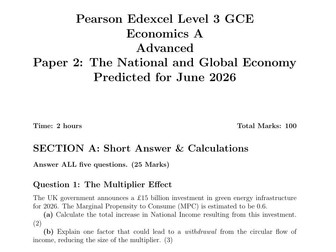
Edexcel A-Level Economics A – Paper 2 Predicted Paper 2026
National & Global Economy | Full Exam + Detailed Mark Scheme
Prepare students for success with this exam-realistic predicted Paper 2 for Edexcel Economics A (2026), designed using recent exam trends, full specification coverage, and likely 2026 themes.
This resource delivers a complete exam experience, helping students refine exam technique, apply theory to real-world contexts, and perform under timed conditions.
What’s included:
Full Paper 2 (100 marks) – structured exactly like the real Edexcel exam
Section A: Short-answer and calculation questions
Section B: Data response with realistic UK and global economic extracts
Section C: 25-mark essays with high-level evaluative prompts
Detailed mark scheme featuring:
AO1 / AO2 / AO3 breakdown
Level-based marking (Edexcel style)
Clear guidance on how to achieve top-band answers
Key Topics Covered:
The multiplier effect & circular flow
Inflation, real wages & monetary policy
Balance of payments & exchange rates (J-Curve)
Aggregate Demand & Aggregate Supply (AD/AS)
Economic growth & output gaps
Globalisation, trade blocs & protectionism
Labour markets & productivity
Supply-side policies and long-term growth
Predicted 2026 Focus:
Fiscal Drag and its impact on disposable income
AI and productivity (LRAS shifts)
Global protectionism & friend-shoring
Trade blocs (e.g. CPTPP) and post-Brexit trade dynamics
Why this resource?
Closely mirrors real Edexcel Paper 2 structure and difficulty
Designed to develop analysis and evaluation skills (AO3 focus)
Includes realistic data-response extracts and essay questions
Ideal for building A–A* level answers
Exam Details:
Time: 2 hours
Marks: 100
Perfect for:
Mock exams and timed assessments
Final revision before exams
Independent student practice
Teachers needing ready-to-use exam material
Designed for Results:
This paper targets top-grade performance, helping students:
Structure high-level evaluation
Apply theory to real-world contexts
Master exam technique under pressure
These resources look at the key reasons why the US economy boomed in the 1920s. I've included a PowerPoint, two worksheets and some revision / dingbat cards on the key features of the USA in the 1920s. Woven into the fabric of the PowerPoint and worksheets are two past paper questions which can be easily adapted to suit your assessment criteria. These resources are ideal for foundation and core students and include a range of DART stratedgies including a mix of true and false statements, missing word as well as traditional digging deeper questions.
Both the PowerPoint and the worksheets focus on the key role played by the car industry in stimulating demand and pioneering mass production techniques. These resources are ideal for foundation and core students.
The learning objectives are as follows:
Theme: Why did the US Economy Boom in the 1920s?
Know: Who was Henry Ford and why was he so successful?
Understand: How did assembly lines, unskilled workers and standardisation help to cut production costs?
Evaluate: How did car production contribute to the US Boom and the cycle of prosperity?
WILF – What Am I Looking For?
Identify / Describe: Who was Henry Ford and why was his ‘Tin Lizzy’ so popular?
Explain: How did mass production techniques cut production cost?
Analyse: Come to a judgement on how far the car industry contributed to the US Boom?
If you like this resource then why not check out my other resources on this topic in my TES shop. You can also follow 'The History Academy' on Twitter, Google Plus, YouTube and Facebook for the latest updates or even to get in touch and chat about how you have used this resource or to ask questions. We aim to produce cheap and affordable resources for either the price of a good cup of coffee or a happy meal so that you can spend more time doing the things that you want.
Anyway, have fun and stay in touch via social media for the latest updates.
Kind Regards
Roy
These resources look at the key reasons why the US economy boomed in the 1920s. I've included a PowerPoint, two worksheets and some revision / dingbat cards on the key features of the USA in the 1920s. Woven into the fabric of the PowerPoint and worksheets are two past paper questions which can be easily adapted to suit your assessment criteria.
Both the PowerPoint and the worksheets focus on the key role played by the car industry in stimulating demand and pioneering mass production techniques. These resources are ideal for foundation and core students and include a range of DART stratedgies including a mix of true and false statements, missing word as well as traditional digging deeper questions.
The learning objectives are as follows:
Theme: Why did the US Economy Boom in the 1920s?
Know: Who was Henry Ford and why was he so successful?
Understand: How did assembly lines, unskilled workers and standardisation help to cut production costs?
Evaluate: How did car production contribute to the US Boom and the cycle of prosperity?
WILF – What Am I Looking For?
Identify / Describe: Who was Henry Ford and why was his ‘Tin Lizzy’ so popular?
Explain: How did mass production techniques cut production cost?
Analyse: Come to a judgement on how far the car industry contributed to the US Boom?
If you like this resource then why not check out my other resources on this topic in my TES shop. You can also follow 'The History Academy' on Twitter, Google Plus, YouTube and Facebook for the latest updates or even to get in touch and chat about how you have used this resource or to ask questions. We aim to produce cheap and affordable resources for either the price of a good cup of coffee or a happy meal so that you can spend more time doing the things that you want.
Anyway, have fun and stay in touch via social media for the latest updates.
Kind Regards
Roy
Simple but effective revision summary option -ideally print A3
Includes …
Reasons for the boom
Role of WW1
Republican Policies
Why didn’t all industries benefit
Problems in the farming industry
This lesson is a part of the Superpower Unit made for my Y9.
The lesson covers the social and economic importance of the Mississippi River.
All resources are included in the PPT.
Enjoy teaching
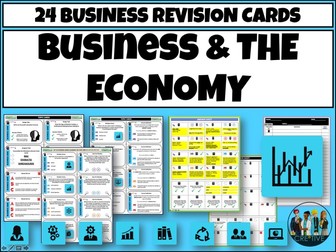
24 Business and the Economy themed task cards are perfect for your Business and or Economics lesson plans and topic. They are suitable for KS4 or KS5 students. They feature different activities including knowledge retrieval practice, multiple choice and spot the sporting mistakes amongst other Business related activities.
Contents of Business Revision Retrieval Topic Task Card bundle
✄ 1 x Set of 24 Different topic Task Cards with a range of activities and styles in editable and PDF versions (Q and A’s Included)
✄ 1 x Teacher Answer Sheet - All answers covered
✄ 2 x Student Fill in Activity Sheets that can be used with the cards (Optional)
Each Topic Task card is matched to the theme of the set and includes numbering and answers designed by our Business Specialist . The cards can be printed in colour or black and white.
How to use Business Knowledge Retrieval Revision Topic Task Cards?
These cards are perfect as an extension task, starter or plenary and as a means of testing knowledge upon completion of a unit. For a short task (extension/starter/plenary), you can simply give them one or two cards and differentiate which cards are given according to the students level or their areas needing improvement. For an end of unit, you could hand the cards out to different groups and have them switch the cards after a certain period of time (e.g. one group gets multiple choice, one group gets spot the mistakes, one group gets photocards, etc.).
Benefits of using this new style of PE T&L activity
Set of retrieval activities
Motivating for students
Bitesize tasks
Fun way to revise a topic
Allow for differentiation
Copy, cut and laminate – use over and over again
Versatile and can be used in many different ways
leave a nice review on TES and email us at thecre8tiveresources@gmail.com for a Business treat for your students.
Product code C8/TS/206
✰✰✰✰✰✰✰✰✰✰✰✰✰✰✰✰✰✰✰✰✰✰✰✰✰✰✰✰✰✰✰✰✰✰✰✰✰✰✰
Here are some of our other popular business and economics resources:
A Level Business Revision Bundle
GCSE Business Revision Bundle
Business Studies Christmas Quiz
Careers and Business Studies Quiz
The Big Brexit Quiz
Exploring FairTrade and Business
The Role and Purpose of Marketing & Market Research
This engaging and fully resourced activity helps students explore the key reasons behind the economic boom in the United States during the 1920s. It works perfectly as part of a wider enquiry into the causes of the boom or as a stand-alone lesson or revision activity, and it’s suitable for a wide range of abilities.
Students begin by cutting out or colour-coding twenty statement cards and sorting them under eight key headings: impact of the First World War, credit, confidence, natural resources, technological change, Republican policies, marketing, and mass production. The resource includes a challenge extension: a thinking skills “review triangle” task that encourages students to prioritise and evaluate which factors were most important in driving economic growth. This makes it an excellent foundation for essay planning or extended writing.
For lower-ability groups, teachers can use only the first page with fourteen statement cards for a more accessible version of the task.
Learning aims and objectives:
Theme: Why was there an economic boom in the 1920s?
Know: The main reasons for US economic growth.
Understand: How each factor contributed to the boom.
Evaluate: Which factors were the most significant.
WILF (What I’m Looking For):
Can You Describe: The key causes of the boom;
Can You Explain: How each contributed to rapid growth
Can You Analyse: Which were most important overall.
If you’re looking to extend learning for high-attaining students or sixth formers, check out my Diamond Nine activity on this topic in my TES shop.
If you like this resource then why not check out my other resources on this topic in my TES shop. You can also follow ‘The History Academy’ on Twitter, Google Plus, YouTube and Facebook for the latest updates or even to get in touch and chat about how you have used this resource or to ask questions. We aim to produce cheap and affordable resources for either the price of a good cup of coffee or a happy meal so that you can spend more time doing the things that you want.
Anyway, have fun and stay in touch via social media for the latest updates.
Kind Regards
Roy - History Academy
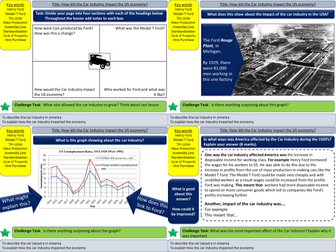
A lesson in a SOW intended for a three year GCSE looking at the AQA: America 1920 -1973. Students look at the impact of the car industry on America. The lesson is largely teacher led with information and question to pose to the class, as well as discussion about images and graphs.
There is a GCSE question included with sentence starters for the less able and challenge tasks to stretch the top end. There is also a model answer for students to evaluate as a class or on their own.
The previous lesson introduced the students to the circular economy. In this activity, students will be asked to design their own product or service fit for a circular economy. The product or service will allow the materials and energy to rejoin a circular flow.
This activity includes two learning activities focused on designing a product or a service. It also includes presentations showing case studies to be used as a visual aid.
Subjects: Economics, Sociology, Business, Citizenship, Design Technology
Age range: 12-19 years
Total time: 120 minutes
Learning outcomes:
• To learn about companies that have adopted the circular economy framework
• To design a product or service based on the circular economy
About the Circular Economy
"The circular economy is a new way to design, make, and use things within the limits of our planet. In the natural world, materials and nutrients cycle continuously, allowing the Earth’s biosphere to regenerate and for all lifeforms - humans included - to flourish. This insight lies at the heart of the circular economy. Instead of using things for a short time before throwing them away, in a circular economy everything is designed to fit within a cycle so it can be used again and again.
The concept is based on three principles, driven by design, and underpinned by a transition to renewable energy:
1 - Eliminate waste and pollution
2 - Keep products and materials in use
3 - Regenerate natural systems
Using these principles, we can create a system that restores biodiversity, addresses climate change, and makes the most of our planet’s limited resources. Such a system could work for the economy, society, and environment - making it a truly sustainable model for our future prosperity. "
About The Ellen MacArthur Foundation
The Ellen MacArthur Foundation, an international charity, develops and promotes the idea of a circular economy in order to tackle some of the biggest challenges of our time, such as plastic pollution, climate change, and biodiversity loss. We work with, and aim to inspire, business, academia, policymakers, and institutions to mobilise systems solutions at scale, globally.


 Quick View