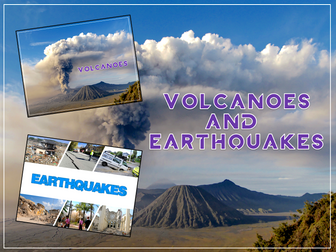
Volcanoes and Earthquakes Worksheets
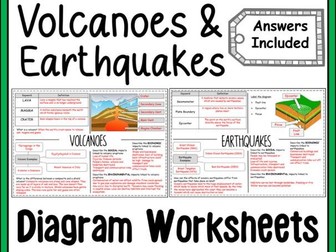
Summary worksheets with full comprehensive answers.
Editable, A4 PowerPoint files.
Included in the Volcano worksheet:
Keyword definitions
Label a volcano diagram
Shield and cone volcano comparison
Volcano examples
Social, economic and environmental impacts
Included in the Earthquake worksheet:
Keyword definitions
Label an earthquake diagram
Oceanic vs land earthquakes
Earthquake examples
Social, economic and environmental impacts
Volcanoes & Earthquakes is an exciting extended Geography unit designed for students in KS2.
The planning overview, topic title page and vocabulary page can be downloaded for free here. Lessons include:
L1 – Understanding the structure of the Earth
L2 – Investigating the structure of a volcano (FREE)
L3 – Locating the world’s famous volcanoes
L4 – Investigating the five deadly features of a volcanic eruption
L5 – Understanding tectonic plates
L6 – Exploring the effects of volcanic eruptions on Montserrat
L7 – Why do people live near volcanoes?
L8 – Understanding the causes of earthquakes
L9 – Investigating the five deadly features of an earthquake
L10 – Researching earthquakes using Wikipedia
L11 – Locating the world’s biggest earthquakes using latitude & longitude
L12 – Writing a fact file about a famous earthquake
Each lesson includes a presentation and differentiated activities/worksheets.
A FREE newspaper report template is also included in this unit.
If you like this resource, we would appreciate a review! We will happily send you a free resource in return for a review or useful suggestions/feedback. Contact us at ed@teachitforward.co.uk.
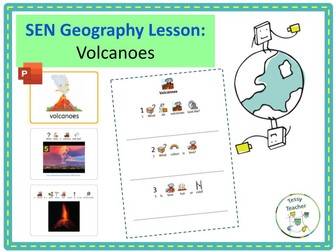
Editable powerpoint with images, gifs, a diagram and videos about natural disasters/volcanoes. Includes link to volcano breath yoga for brain break. Includes comprehension worksheet.
Visual content and Widgit visuals for young people with special education needs (SEN/SEND).
A question and answer worksheet (with follow on sheet) to support A Perfect Planet - Volcanoes (BBC Documentary). The programme looks at how without volcanoes, there would be no life on Earth. Although destructive, magma from the planet’s molten core builds land, and mineral-rich ash from eruptions fertilises the surface.
The worksheet has 20 questions that cover the full 50 minute documentary. To support staff a teacher answer sheet is included. There is a differentiated worksheet for students to reflect on their learning after they watch the documentary.
Worksheet includes the following topics:
Volcanoes
Advantages and disadvantages of volcanic environments
Ecosystem
Benefits and risks of habitats
Variety of land ecosystems
Animal adaptation
Climate change
For worksheets to support other science and nature documentaries please see my shop.
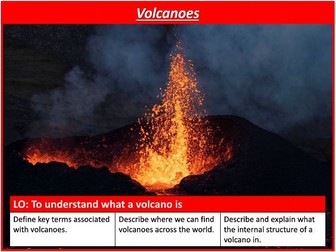
Full KS3 lesson on volcanoes. Lesson looks at key terms, types of volcano and structure of a volcano.
Lesson includes starter, learning objectives and plenary and will last around one hour of teaching time. All supporting worksheets included - no further resources required.
IGCSE Cambridge
L8: Why Do People Live Near Volcanoes?
Theme 2: Earthquakes and volcanoes
Lesson 1 FREE: https://www.tes.com/teaching-resource/-12759297
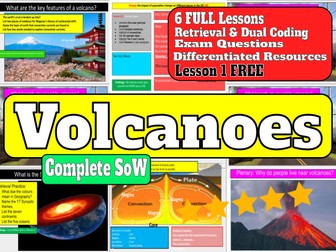
This SoW is designed in detail and is both differentiated and engaging and allows you to move pupils through content efficiently. As a result, lessons can take around two periods to deliver and are sequenced to flow through this period comprehensively.
Made to the highest standard and constructed using current research, both dual coding and retrieval practices are at the heart of this unit. A colour scheme also runs throughout to ease both your delivery and students’ comprehension.
Theme 2: 2.1 Earthquakes and volcanoes
L1: Why do tectonic events occur?
L2: What are the Key Features of Earthquakes?
L3: What are the Key Features of a Volcano?
L4: What Impacts Can Earthquakes have?
L5: What Hazards are Caused by Volcanoes?
L6: What impacts can Volcanoes and how to prepare for them?
L7: How are Earthquake Proof Buildings Designed?
L8: Why Do People Live Near Volcanoes?
Any questions please do feel free to get in contact:
GeographyShopOriginal@gmail.com
Best FREE Resources (The Geography Shop)
https://www.tes.com/teaching-resource/-12899088 (Climate Change SoW)
https://www.tes.com/teaching-resource/-12899440 (Development SoW)
https://www.tes.com/teaching-resource/-12638984 (Waste SoW)
https://www.tes.com/teaching-resource/-12451443 (Britain Globalisation SoW)
https://www.tes.com/teaching-resource/-12741793 (Local Area Investigation SoW)
https://www.tes.com/teaching-resources/bundler/12949461 (Cambridge International)
https://www.tes.com/teaching-resource/-12922653 (Israel & Palestine)
https://www.tes.com/teaching-resource/resource-12485457 (What is Geography?)
I hope you find this SoW useful. If you have, I have created a series of resources.
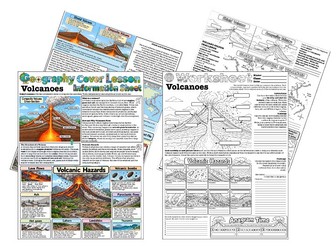
Volcanoes – KS3 Geography Cover Lesson
This engaging KS3 Geography cover lesson introduces students to volcanoes, their structure, distribution and hazards. Students explore different types of volcanoes, identify volcanic hazards, investigate the global distribution of volcanoes and examine major eruptions, including the 2010 Eyjafjallajökull eruption in Iceland. The lesson includes a range of independent activities, map skills, colouring tasks, questions and challenges, making it ideal for a cover lesson with minimal teacher input.
Includes:
Volcano structure and labelling activity
Shield and composite volcano comparison
Volcanic hazards investigation
Global distribution and map activity
Eyjafjallajökull 2010 case study
Extension/challenge activities
Colouring and independent tasks
Perfect for KS3 Geography, cover lessons, homework or independent learning.
The lesson is designed to be easy to follow for a non-specialist teacher, last about an hour, with clear instructions and a mixture of written, visual and colouring activities to keep students engaged throughout the lesson.
There is one information sheet to print out for the students and a double-side worksheet that can even be coloured in.
Hopefully it saves you some valuable time by avoiding planning cover work!
https://www.tes.com/teaching-resources/shop/markthegeographer
Please note: The PDF version is the recommended print-ready version of this resource and has been designed to maintain the intended formatting when printed. An editable PowerPoint version is also included, allowing you to adapt the resource to suit your own students or school.
The resources are designed for A4 printing, or A3 if a larger format is preferred.
Geography: Why are Volcanoes so Hazardous? (Edexcel B, Tectonics)
This Unit follows the Edexcel B syllabus but has been design to be part of a three year GCSE course. As a result this could be delivered at both KS3 and KS4.
This unit is created in line with my personal passion for tectonic hazards in the developing world. This Unit is my favorite to deliver and has been streamlined over the last two years.
This SoW work has been differentiated, with with both support and challenge throughout. Retrieval Practice and Duel Coding Theory are incorporated and as well as regular links to other parts of the syllabus, this is in line to my recent academic readings. Geographical and numeracy skill have been planned for.
Happy to answer questions and any feedback welcome…
jacobspong@gmail.com
SoW:
L1: How do volcanoes form?
L2: Why do people live near volcanoes?
L3: What threats are presented by volcanoes?
L4: How can humans respond to their threat?
L5: How do developed countries respond to volcanoes?
L6: Case Study Yellowstone Super Volcano.
Resources: Learning Checkers
thegeographyshoporiginal@gmail.com
Leave a review for any single resource FREE!
Best FREE Resources (The Geography Shop)
https://www.tes.com/teaching-resource/-12899088 (Climate Change SoW)
https://www.tes.com/teaching-resource/-12899440 (Development SoW)
https://www.tes.com/teaching-resource/-12638984 (Waste SoW)
https://www.tes.com/teaching-resource/-12451443 (Britain Globalisation SoW)
https://www.tes.com/teaching-resource/-12741793 (Local Area Investigation SoW)
https://www.tes.com/teaching-resources/bundler/12949461 (Cambridge International)
https://www.tes.com/teaching-resource/-12922653 (Israel & Palestine)
https://www.tes.com/teaching-resource/resource-12485457 (What is Geography?)
I hope you find this SoW useful. If you have, I have created a series of resources, one for each unit of the Edexcel B Geography course, as well as many KS3 units, all to the same standard. You can check them out here…
https://www.tes.com/teaching-resources/shop/TheGeographyShopOriginal
This lesson is designed for KS2 students. It can be taught as a stand alone lesson but is also available as part of two wider units, both of which are available on TES:
-Volcanoes
-Volcanoes & Earthquakes
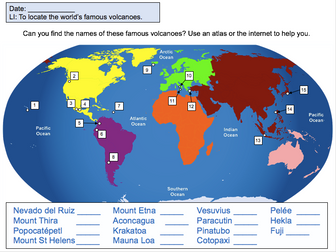
First the presentation introduces some of the world’s most famous volcanoes and classes them as active, dormant or extinct.
The activity then challenges students to locate volcanoes using an atlas or the internet (e.g. Google maps). Alternatively, a map of famous world volcanoes is also provided.
Easier – Students locate volcanoes using the map of famous volcanoes (writing numbers).
Medium – Students locate volcanoes using the map of famous volcanoes (writing volcano names).
Harder – Students locate volcanoes using an atlas.
(N.B. It is recommended you check the atlas has the relevant maps prior doing the activity.)
If you like this resource, we would appreciate a review! We will happily send you a free resource in return for a review or useful suggestions/feedback. Contact us at ed@teachitforward.co.uk.
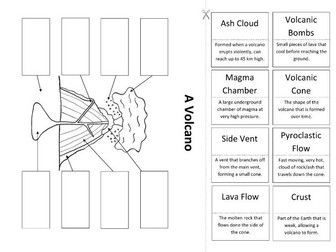
A differentiated resource for producing a labelled diagram of a volcano. There are two main versions of this activity, but both of them require the information cards. These can be printed out and placed around the room.
The first version is an all in one A4 sheet that has the diagram and labels that can be cut out and stuck on. This is better suited to lower ability students, they can find out where the parts are by looking at the information around the room.
The second version requires the diagram with no labels. Students have to collect the information from around the room and write it on their diagram. I run this as a memory game, giving students two rules: they can only write on their diagram at their desk, and they cannot move the information sheets.
Success criteria:
To identify the key features of a volcano.
To make a comparison between shield and stratovolcanoes.
To explain why these volcanoes are different.
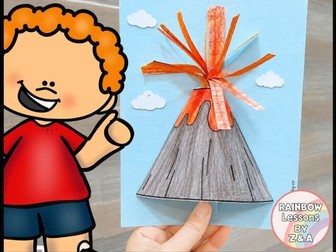
Make learning about volcanoes exciting and hands-on with this engaging Volcano Craft and Worksheets pack! Perfect for Earth Science, Geography, STEM, and NGSS-aligned classrooms, this resource combines creative crafting with meaningful literacy and science activities that help students understand volcanoes while having fun.
Ideal for Grades 3–5, this low-prep printable resource is great for science centers, classroom lessons, independent work, early finishers, homework, sub plans, or homeschool learning.
What’s Included:
Volcano Craft Templates
Full-color and Black-and-white templates
Parts of a Volcano Labelling Worksheet
Answer key included
Volcano Reading Comprehension
Answer key included
Volcano Word Search
Answer key included
Volcano Eruption Stages Sequencing
Cut-and-paste sequencing activity
Answer key included
Perfect for:
Earth Science units
Volcano lessons
Natural disasters unit
STEM activities
Science centers
Interactive notebooks
Early finishers
Homework
Homeschool
Sub plans
This engaging resource encourages students to explore how volcanoes work through reading, labeling, sequencing, and crafting. The combination of interactive activities helps reinforce key science concepts while keeping learners motivated and engaged.
Please watch preview video for instructions.
Hope you and your students enjoy this resource.
We really appreciate your sparing a few moments to review this resource.
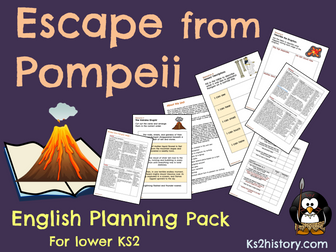
Download our popular Escape From Pompeii English Planning Pack for KS2.
This is a ten-lesson unit of work based around the book ‘Escape from Pompeii’ by Christina Balit, designed for Year 3 and Year 4.
The ten lessons in this unit aim to give children the opportunity to read and listen to the Escape from Pompeii story a number of times. In the first week, children will engage with the text through discussion, drama and even creating a parachute volcanic eruption in order to increase their familiarity with the story. They will have the opportunity to articulate ideas about the text using an increasingly varied vocabulary. There is a grammar focus on using powerful verbs and a chance to develop thesaurus skills.
In the second week, pupils will plan their own story based on the structure of Escape from Pompeii and they will then have the opportunity to draft, edit and present their final narrative.
The literacy objectives covered in this unit are:
To use sensory descriptions
To use a thesaurus to improve my writing
To perform a poem as a group
To use powerful verbs
To prepare a short drama piece based on a text
To write a descriptive recount
To make a story plan
To write my own narrative
To edit my writing
To make decisions about how to present my writing
The PDF file contains ten full lesson plans and all pupil worksheets/resources.
#lovehistory
You may also like the following planning for Year 3/ Year 4:
Roman Britain Planning Pack
Romans Literacy Pack (Instructions Unit)
Romans Planning Bundle of all three planning packs
This is a factsheet/poster packed full of information about Volcanoes. It can be stuck into topic books at the beginning of the topic, displayed (in A3) in your classroom, used for research purposes or even for comprehension activities. PLEASE NOTE: The misalignment in the 2nd preview (the Word version) is not a reflection of how it looks, but a TES issue with generating previews.
National Curriculum objectives covered:
Describe and understand key aspects of:
Physical geography, including: climate zones, biomes and vegetation belts, rivers, mountains, volcanoes and earthquakes, and the water cycle
Rainforests Fact Sheet/Poster
Romans In Britain Fact Sheet/Poster
This clear, detailed and visually-appealing resource offers a complete reference point for students learning or revising knowledge relating to volcanoes. It contains comprehensive sections on:
-Overview of Volcanoes;
-Answers to the Key Questions;
-Types of Volcanoes;
-Well-Known Volcanoes;
-Key Vocabulary;
-Key Facts.
The resource is designed to be printed onto either A4 or A3, and is provided as both a PDF and a Word version (so that you can edit if you want to). All images used are licensed for commercial use. The resource is most suitable for students in KS2 or KS3.
Exploring Four Volcanoes - documentary worksheet
A worksheet to support Earthstorm, Volcanoes episode 2 (Netflix Documentary).
This worksheet helps students explore four case studies of volcanoes across the world. From Iceland to Italy, experts take an in-depth look and provide an inside look at four imposing volcanoes and how they impact the settlements around them.
The worksheet has 21 questions and case study boxes to capture students attention for the full 43 minutes of the volcano documentary.
This worksheet comes with a detailed answer sheet for teachers, including answers and timings for each section.
Volcanoes:
Fagradalsfjall, Iceland
Campi Flegrei, Naples, Italy
Cumbre Vieja, Canary Islands
Masaya, Nicaragua
Questions on the worksheet includes the following topics:
Distribution of human settlements
Research and mapping around volcanoes
Impacts of eruptions
Aftermath of volcanic eruptions
For worksheets to support other science and nature documentaries please see my shop.
This worksheet covers the basics behind a volcano, namely covering its main components and key definitions.
Volcano, Components, Magma Chamber, Lava, Magma
This workbook and case sudies is designed to meet the majority of the requirements of the AQA Geography Entry Level - I think just the case study is missing. The tasks are short and designed for pupils with limited attention span and lower than age expected reading skills. Some of the work has been adapted from other worksheets available on TES to fit the spec and learning outcomes of Entry Level.


 Quick View