

Bundle
 Quick View
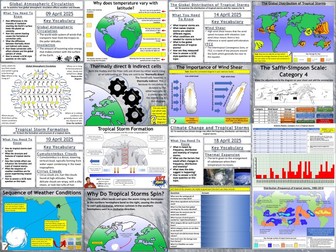
AQA GCSE Geography: Weather Hazards
Complete Weather Hazards sequence of lessons for Unit 1, Section A of the AQA GCSE. Cyclone Idai is the case study tropical storm and Somerset Levels is the example of extreme weather in the UK.
The lessons included are detailed below.
Global Atmospheric Circulation
The Global Distribution of Tropical Storms
The Formation of Tropical Storms
Climate Change and Tropical Storms
Cyclone Idai: A Tropical storm
Reducing the Effects of Tropical Storms
Extreme Weather In The UK
The Somerset Levels Floods: 2014
Hope this saves you some valuable planning time.
https://www.tes.com/teaching-resources/shop/markthegeographer
Sale
French Weather
A great powerpoint that covers a whole lesson on the topic of weather. I have used it with multiple classes before and it’s great!
Copyrighted at @PrimaryPrints
 Quick View
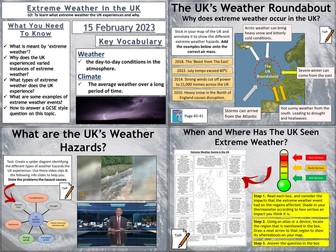
Extreme Weather In The UK
AQA GCSE Geography lesson for the new specification Unit 1A: In this lesson we look at what extreme weather is, what type of extreme weather the UK experiences and whether the UK may experience more in the future.
The lesson has a retrieval practice starter where the pupils choose the places or the circumstances where tropical storms can be found. We then look at the definition of extreme weather. The students complete a map exercise which helps to explain why the UK’s geographical location allows a variety of extreme weather to be experienced. The students then complete a spider diagram on the types of extreme weather, there are some video clips and information slides to help with this which could be a carousel activity. We then complete a map exercise where the students use an atlas to locate where the extreme weather impacted and evaluate how severe the weather event was. We finish with a GCSE-style practice question with some guidance and structure provided for the students.
Hope this saves you some valuable planning time.
https://www.tes.com/teaching-resources/shop/markthegeographer
 Quick View
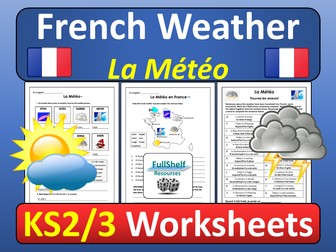
French Weather Worksheets La Meteo
Quel temps fait-il? Weather in French topic printable writing activities for reviewing La Météo en Francais / Le Temps vocabulary. It includes differentiated versions: worksheets (including weather map / forecast activities for France and Canada), crosswords, and word search puzzles, plus vocabulary pages for support if required. Great for main lesson activities, early finisher challenges, starters, homework, fun home learning etc. My French basics resources are designed for Year 4, 5, 6, 7 and 8 but might suit others, depending on experience. Please check the preview for a sample. Within the Zip file, is a 23-page PDF of worksheets and puzzles (and answer keys for all) and a 10-page file of vocab support.
SAVE: Get this in my French Weather BUNDLE, together with French Weather Presentation and Activities and French Weather Games.
ALSO INCLUDED IN:
French KS2 / KS3 MEGA BUNDLE 1
French Worksheets MEGA BUNDLE
The resources focus on 12 key phrases: il pleut, il neige, il gele, il fait beau, il fait mauvais, il fait chaud, il fait froid, il y a des nuages, il y a du brouillard, il y a de l’orage, il y a du soleil, il y a du vent.
3 WORKSHEETS with answer keys. Each differentiated 3 ways, using a star system (1-star for lower ability or younger learners and 3-star the most challenging). The less challenging ones include word banks and / or sentence starters for support. Worksheet 1 reviews key weather phrases. Worksheet 2 focuses on writing sentences about the weather in different French cities, while Worksheet 3 is a Canadian version of Worksheet 2, as there are many French speakers in Canada.
HIDDEN WORD PUZZLE - Students find translation errors in weather phrases and use the linked letters to discover a word to complete a sentence related to the topic.
CROSSWORD - Included with and without a word bank. Answer key included.
WORD SEARCHES - The 1-star and 2-star puzzles are the same (1-star has a little more support). The 3-star puzzle is a different, more challenging one, featuring the full weather phrases rather than just the main word.
VOCABULARY SUPPORT - different formats, with and without background colour
TEACHER NOTES
Many thanks for your interest in my resources.
YOU MIGHT ALSO LIKE:
French KS2 / KS3 MEGA BUNDLE 2
French KS2 / KS3 MEGA BUNDLE 3
undefined
 Quick View
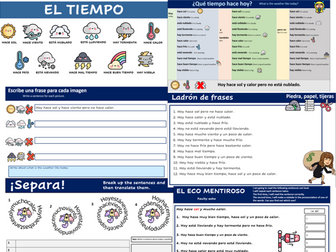
El tiempo - The weather
This resource is to talk about what is the weather like. It has different Conti approach activities IT IS EDITABLE:
Flashcards for each type of weather
What is missing? Game
match the word with the picture
What is the correct spelling
Sentence builder
Listen and tick the word I say
Read my mind
Sentence stealer
Sentence bingo
Faulty echo
Sentence chaos
Break the flow
Write sentences following the pictures
Grab the pencil (game)
Sentence race (mini whiteboard game)
 Quick View
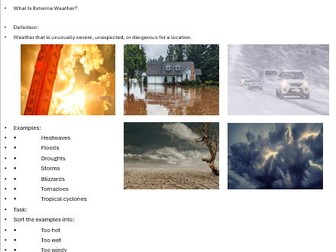
Weather: Extreme Weather
Bring extreme weather to life in your classroom with this fully resourced, high‑impact lesson exploring four major UK weather events: Storm Eunice, the Somerset Levels Floods, the Beast from the East, and the UK Heatwaves. Designed to build strong geographical understanding, this lesson includes detailed case‑study content, a comparison table for students to complete, and structured activities that develop analytical and evaluative skills. Students examine causes, effects, and impacts in depth, then rank events by severity and identify patterns over time—perfect for KS3 Geography, case‑study revision, or thematic climate change work. Clear, accessible explanations and ready‑to-use worksheets make this lesson ideal for stretched teachers wanting quality, exam‑focused resources that pupils can engage with immediately.
Bundle
 Quick View
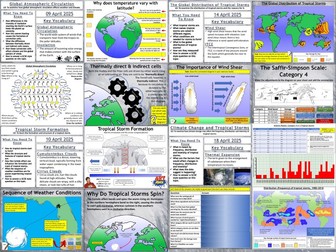
AQA GCSE Geography: Weather Hazards (Typhoon Haiyan Version)
Complete Weather Hazards sequence of lessons for Unit 1, Section A of the AQA GCSE. Typhoon Haiyan is the case study tropical storm and Somerset Levels is the example of extreme weather in the UK.
The lessons included are detailed below.
Global Atmospheric Circulation
The Global Distribution of Tropical Storms
The Formation of Tropical Storms
Climate Change and Tropical Storms
Typhoon Haiyan: A Tropical Storm
Responses to Typhoon Haiyan
Reducing the Effects of Tropical Storms
Extreme Weather In The UK
The Somerset Levels Floods: 2014
Hope this saves you some valuable planning time.
https://www.tes.com/teaching-resources/shop/markthegeographer
 Quick View
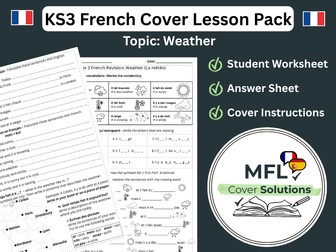
KS3 French Cover Lesson - Weather (La météo)
This ready-to-use two-page cover lesson is designed specifically for KS3 French and focuses on the topic of weather (la météo). Perfect for planned or last-minute cover, the resource is structured to keep students engaged and working independently while requiring minimum printing.
This lesson includes a variety of activities to maintain student focus and challenge learners of different abilities. Everything students need to succeed is included on the sheet so this eliminates confusion and makes it achievable for all students. Activities build on key weather vocabulary, offering opportunities for vocab drills, translations and extension.
What’s included:
Student worksheet (1 page front-and-back for minimum printing)
Answer sheet for cover teacher
Clear, adaptable cover instructions for staff
The resource is suitable for mixed-ability groups and works well as a standalone lesson or as reinforcement of prior learning.
Ideal for:
emergency cover
non-specialist cover teachers
consolidation of core weather vocabulary
independent classroom work or homework
Looking for the Spanish version? Check it out here.
Weather - French
A lesson to practice weather in French
Activities and games and additional focus on grammar
 Quick View
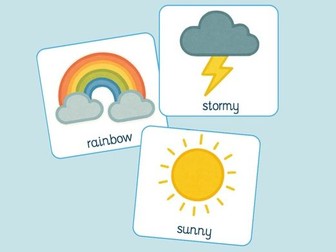
Weather Cards
Flashcards with pictures of weather types and labels.
Useful for identifying the weather, making weather reports and popping in a ‘Weather Station’ role play area. Easy to identify pictures make them great for early identification and sorting.
Spanish Weather Worksheet: El tiempo
This worksheet includes three parts to help your students get comfortable with weather expressions in Spanish:
matching 14 expressions (English to Spanish)
placing expressions on a chart choosing between Hace/Está/Hay
a short translation including the seasons and types of weather within the seasons.
Editable Word file
Answer key included.
Geography - Weather and climate lessons
7 fully resourced lessons suitable for KS3 Geography. A wide range of activities included e.g. crosswords, odd one out tasks, exam questions, worksheets etc. Main activities are differentiated.
Lessons include:
What is weather and climate?
How do we measure weather?
How can weather data be presented?
What are clouds and why does it rain?
What are depressions and anticyclones?
What is the climate of the UK?
How does climate vary across the world?
 Quick View
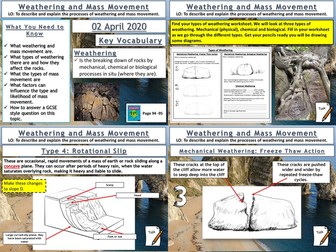
Coasts: Weathering and Mass Movement
AQA GCSE Geography lesson for the new specification Unit 1C: In this lesson we look at the different types of weathering and mass movement.
We start with a true or false retrieval practice quiz on wave types from the previous lesson.
We then introduce the concept of weathering and proceed to look at mechanical, biological and chemical weathering. The pupils have a variety of annotation, drawing and question tasks to complete on the worksheet.
Moving on to mass movement, the pupils get a second worksheet with 4 different slopes on. The pupils then are given information on each type of mass movement. They sketch the type of mass movement onto their slope and add labels. We finish with a simple GCSE-style question which I get the pupils to answer on a post-it note.
In a nutshell lesson includes:
True or False starter on wave types
Weathering activity sheet with diagrams and questions.
Mass movement ‘change the slope’ activity sheet.
Video clips where appropriate
GCSE-style question plenary
Hope this saves you some valuable planning time.
https://www.tes.com/teaching-resources/shop/markthegeographer
Sale
Weather and Clothes Sorting Worksheet
This engaging and interactive worksheet is designed to help children connect different types of weather with appropriate clothing choices.
Key Features and Activities
Sorting Activity: The resource features various weather conditions (e.g., sunny, rainy, snowy, cloudy) in separate boxes. At the bottom of the worksheet is a collection of clothing items (pictures) that need to be cut out and pasted into the correct weather box.
Discussion & Speaking: This worksheet serves as an excellent springboard for conversation and speaking practice. Children can explain their choices, discussing why a certain item (like a swimsuit or a winter coat) is suitable for a specific type of weather. This encourages critical thinking and the use of descriptive vocabulary.
Fine Motor Skills: The cutting and pasting element helps to develop and practice fine motor skills and hand-eye coordination.
Educational Value
This resource is ideal for:
Weather and Seasonal Units: Reinforcing knowledge of different weather types and their characteristics.
Vocabulary Building: Introducing and practicing the names of various clothing items and weather-related words.
Reasoning and Logic: Encouraging students to justify their decisions and think logically about real-world scenarios.
It’s a fun, hands-on activity that is perfect for individual work, small group centers, or as an assessment tool.
 Quick View
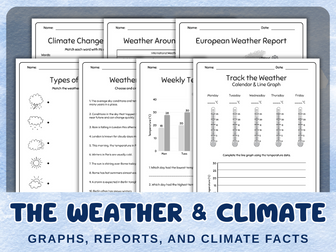
Weather & Climate Worksheets | Weather Vocabulary, Forecasts, Graphs & Climate Change
Make learning about weather and climate engaging with this versatile Weather & Climate Worksheets pack for elementary and ESL learners. Students explore weather vocabulary, weather vs. climate, temperature data, weather forecasts, weather around the world, and climate change vocabulary through a variety of activities.
What’s Included:
● Types of Weather vocabulary matching
● Weather or Climate sorting and identification
● Weekly temperature tracker with data questions
● Weather calendar and line graph activity
● International Weather Report activity
● European Weather Report fill-in-the-blank activity
● Climate Change vocabulary matching
These worksheets are ideal for weather lessons, science, geography, ESL/EFL, morning work, independent practice, homework, or review activities.
Spanish Weather - El tiempo
PowerPoint presentation to introduce the weather expressions and seasons in Spanish. It includes an activity where students have to describe what they do depending on the Weather.
WEATHER BOXES
Activities and resources for different types of weather. Great to have ready to use whatever the weather.