7 comprehensive worksheets (including answers) on the topic of ‘my town’ / where I live’ for KS3 pupils or beginners.
The content is all based on Unit 5 of Viva 1, ‘mi ciudad’ and the worksheets will support pupils to talk and write about where they live and the activities they do, and will do, in their town. Topics: places in my town, describing my town, activities I do in my town, telling the time, going to a cafe, money and numbers, immediate future tense, and giving an opinion on where I live.
Format: 7 Word/PDF documents with answers.
A standalone worksheet on the topic of ‘donde vivo’. This can be used as an introduction to the topic and there is an accompanying worksheet for homework/consolidation. The worksheet includes vocabulary tasks, reading exercises and translation into English and Spanish.
Format: Word document & PDF with answers. All pages of the worksheet are shown as PDF so you can view the resource fully.
Reading comprehension describing where a variety of characters live. Revises: greetings, my name is, age, types of homes, location, countries, pets, rooms in a house, shops and places in a town, personalities and also a brief mention of what clothes someone is / is not wearing. I thought this worksheet would consolidate much of the work we have been covering recently. (My students are 9 & 10 years old.) I have also included an exercise where questions are in English and to be answered in English. Answers are provided. If you consider this worth buying, ‘un très grand merci.’
Resource contains 5 files
AS TES CONTINUE TO HAVE PROBLEMS WITH WORD DOCUMENT PREVIEWS I HAVE INCLUDED SCREEN SHOTS TO SHOW HOW THE FILES WILL LOOK WHEN DOWNLOADED
**If you have previously purchased my GCSE 2016 unit 5 and 7 resources, please get in touch if you are interested in upgrading to this new version. **
In this digital product:
You will find everything you need to teach Topic 9: The Environment and Where people live (third topic of Theme 3 of the new GCSE course (with AQA): Communication and the World around us.)
The Presentation (approx. 190 slides, including answer slides) covers the whole topic and is composed of 4 parts:
A: Where people live
B: My local area
C: Social and Environmental issues
D: Possible solutions
There are 4 folders (A, B, C and D) containing the relevant files for that part.
It includes:
• a range of Listening, Speaking, Reading, Writing and Translation activities
• grammar points including: Revision of present, perfect, imperfect, near future and future tenses.
• Revision of most elements of phonics
• retrieval activities, cultural aspects and homework tasks
• QR codes/ links for independent study
• vocab lists (full topic list or 4 lists for the 4 parts) + link to online course
• comments under the slides for notes and worksheet location
• answers
• audio files and transcripts
• .pdf and editable versions of the worksheets (with the exception of the Puissance 4 games, which are only available as .pdfs)
Activities are differentiated and exam style.
The first 15 files are a preview of what is included in the .zip folder: Topic9.zip.
After downloading, save the .zip file in your computer (in “documents” for example), then right-click and select “extract all” to access all the resources.
For the full overview, you can check the free SOW available for download here
If you have any questions or if you are interested in more resources like this one, you can check this Facebook page: @Frenchresources, where links to resources and freebies are posted regularly.
Assessment/worksheet on the topic of house and home. Includes places in town, advantages and disadvantages, reading comprehension and translation with adjectival agreement. Ideal for GCSE Foundation.
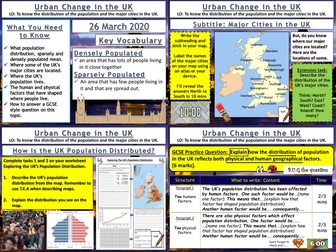
AQA GCSE Geography lesson for the new specification Unit 2A: In this lesson we look at where people in the UK live and the reasons for our population distribution.
The starter is based on the population total for the UK and the pupils have some questions to think about. I usually do this as a discussion. There is also a can you name 15 cities starter which works well for high ability groups.
We then look at cities in the UK. the pupils have a map and need to find the location of some of the major cities in the UK, we then briefly talk about their distribution. Next the pupils consider the human and physical factors that affect population distribution before putting this knowledge to work on a worksheet with several tasks and questions.
We finish with GCSE-style question on human and physical factors that affect population distribution.
In a nutshell lesson includes:
Two starters on population and cities.
Map task on the major cities of the UK
Worksheet on the population distribution in the UK
Video clips where appropriate
GCSE-style question with guidance on how to respond.
Hope this saves you some valuable planning time.
https://www.tes.com/teaching-resources/shop/markthegeographer
Worksheet suitable for KS 3 for a starter lesson about where your home is located. Matching activity, translation and information gap grid based on a map of France.
12 varied activities on where you live (picture-based task, match-up, translation…) It comes with an extensive vocab list (2 pages) that will be sent in 2 formats (PDF and Word), in case you want to change it. This booklet has tasks on:
where you live (house, by the sea, in the south…)
rooms in the house
-activities done in different rooms (we…)
-objects that go in various rooms
-bedroom furniture
prepositions
colours
This booklet would suit a year 7 group.
A worksheet on talking about where you live. Includes tasks to practice different locations (e.g. a town, a village, by the seaside…) and builds up to written translations into French. Suitable for year 7 as a main written activity or for older years as a starter / revision activity.
A 30-minute introduction to describing:
- Where you live
- Whether it's a village, town or city
- Whether it's in the mountains etc.
It could be made longer by teaching different forms of the verb wohnen
Describe daily activities in the home using key verbs and rooms. It develops present and future tense skills, reflexive verb knowledge, and vocabulary recall through engaging tasks, pair work, translations, and scaffolded writing support.
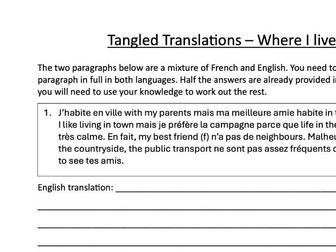
A worksheet to practice translation skills both from French to English and English to French. Ideal for cover, homework and revision. Answers included.
The worksheet contains two ‘tangled translations’ about ‘where I live’ where the text is written in a mixture of French and English. Pupils must write the full translation for both languages.
This PowerPoint contains 126 slides divided into 7 lessons.
I hope it helps your students as much as it helps mine learning about describing and commenting where we live, asking for our way and giving directions as well as conjugating verbs.
It covers:
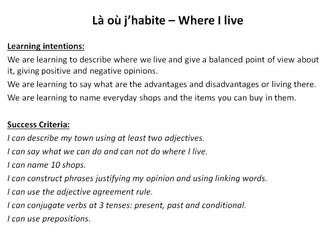
Learning intentions:
We are learning to describe where we live and give a balanced point of view about it, giving positive and negative opinions.
We are learning to say what are the advantages and disadvantages or living there.
We are learning to name everyday shops and the items you can buy in them.
Success Criteria:
I can describe my town using at least two adjectives.
I can say what we can do and can not do where I live.
I can name 10 shops.
I can construct phrases justifying my opinion and using linking words.
I can use the adjective agreement rule.
I can conjugate verbs at 3 tenses: present, past and conditional.
I can use prepositions.
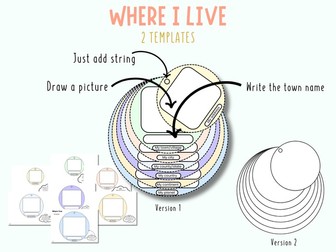
The ‘Where I Live’ resource will help young children to learn about locations and where they live from a global perspective.
Designed as a fun, engaging activity, children will be able to add drawings and personal pictures to develop a deeper understanding of geography at a personal level.
This activity highlights identity and promotes awareness.
This set includes 1 pack of coloured templates and 1 pack of plain templates.
This is a digital download. You will receive a PDF upon purchase.
Enjoy!
A selections of activities to practice saying where you live. Exercises for saying what country you live in and what city. Introduces names of 22 countries. There is a matching flag to name of country exercise and flags to colour and label. There is an exercise to learn how to say what country you are from and an exercise to say what languages you speak. There is also a crossword puzzel to complete of country names. There are two answer worksheets. Finally there is a test. There are 12 files in total. If you consider this worth buying ’ un très grand merci.’
DUE TO TES CONTINUING TO HAVE PROBLEM SHOWING WORD DOCUMENT PRINT PREVIEWS I HAVE INCLDED PDF’s SO THAT YOU CAN SEE HOW THE WORKSHEETS LOOK WHEN DOWNLOADED.
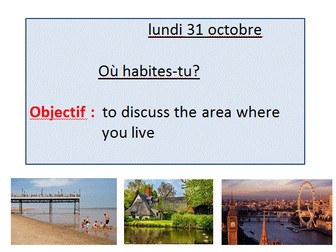
A Powerpoint introducing and practising language to describe the area where you live. Includes a vocab sheet, text with Find the French task and translation activity.
Where I live knowledge organiser:
Where I live
Places in town
Giving directions
Talking about my houes and bedroom ( in 3 tenses: past, present and future)
Advtanges and disadvantages of my town
How I would improve my town
Town in the past tense
Town in the future/ideal town
Totally editable.